Solana Trailing Stop Bot
A trailing stop follows the price up and sells once it drops a set amount from the high. On new Solana coins, where most of the run happens in the first minute and the fall comes in a single slot, the distance you pick decides almost everything. We took 2,023 real positions opened by 1,383 wallets on new Pump.fun coins and ran each one through trailing stops from 5% to 50%, stop-losses and plain holding. A 10% trail broke even where holding for 30 minutes lost 27.6%. Wider trails, late starts and slow sells all gave a large part of that back.
The short version
- Tighter worked better. Every step wider, from 10% to 50%, cost more on average. On new coins the drop after the high is usually steep, so a wide trail just sells lower.
- The stop is a trigger, not a price. Sells cluster. With a 20% trail, more than a quarter of exits filled 30% or more below the stop price.
- Start it at the buy. Waiting for +50% before the trail starts left most positions with no exit and averaged -13.0%.
- Speed matters less than distance. A 10% trail that sold 25 slots late still beat a 20% trail that sold in the next slot.
What a Solana trailing stop does
A stop-loss sells when the price falls a set amount below what you paid. A trailing stop measures the fall from the highest price since you bought instead, so it moves up as the token moves up and never moves down. Set it at 10% and buy a token that runs to +150%: the stop now sits at +125%, and the position sells once the price falls below that.
On a centralised exchange a trailing stop is an order type the exchange holds for you. On Solana there is nothing to hold it. A Pump.fun bonding curve or an AMM pool only knows the trades that reach it. So a trailing stop is something a bot does: it watches the pool price after every trade, keeps track of the high, and sends a sell of its own when the drop crosses your line. Two things follow from that, and both show up in the data. The sell lands in a later slot than the trade that triggered it, and the price it gets is whatever the pool says at that moment, not the stop price.
2,023 positions, replayed
We used the same sample as our copy trading study: coins created on Pump.fun between 14:56 and 16:51 on November 5, 2026, each followed trade by trade for its first 30 minutes on the bonding curve. We kept the 412 ordinary coins paired with SOL whose full trade history we had, leaving out Mayhem coins, and took every position opened by a wallet other than the creator with a first buy between 0.01 and 5 SOL. That is 2,023 positions by 1,383 wallets on 186 coins.
Each position became a 0.1 SOL buy at the same moment the real wallet bought. From there we followed the curve trade by trade. After every trade we priced what the position would get if sold, kept the high, and checked each exit rule. When a rule fired, the sell went out at the front of the next slot, ahead of everything else landing there. Positions no rule had closed were valued at the last curve price after 30 minutes. Prices come from the curve formula in Pump's public docs, before trading fees, network fees and tips.
These are real entries, not picked ones. Every position here was opened by a real wallet at a real moment. We did not choose coins that ran. Most of them did not.
Every exit rule, side by side
Every exit rule in numbers
Every exit rule in numbers
| Exit rule | Average | Median | In profit | Lost half or more |
|---|---|---|---|---|
| Hold for 30 minutes | -27.6% | -31.0% | 11.3% | 29.5% |
| Stop-loss 10% below the buy | -16.5% | -12.6% | 9.2% | 17.4% |
| Stop-loss 20% below the buy | -22.4% | -21.9% | 10.0% | 21.9% |
| Trailing stop 5% | +3.1% | -0.7% | 45.1% | 8.0% |
| Trailing stop 10% | 0.0% | -3.8% | 38.3% | 9.7% |
| Trailing stop 15% | -6.7% | -8.9% | 30.4% | 14.6% |
| Trailing stop 20% | -10.6% | -12.2% | 26.2% | 17.8% |
| Trailing stop 30% | -16.8% | -18.0% | 19.7% | 20.3% |
| Trailing stop 50% | -24.8% | -28.0% | 12.8% | 24.9% |
| The wallets' own sells | -10.5% | -3.6% | 41.6% | 20.6% |
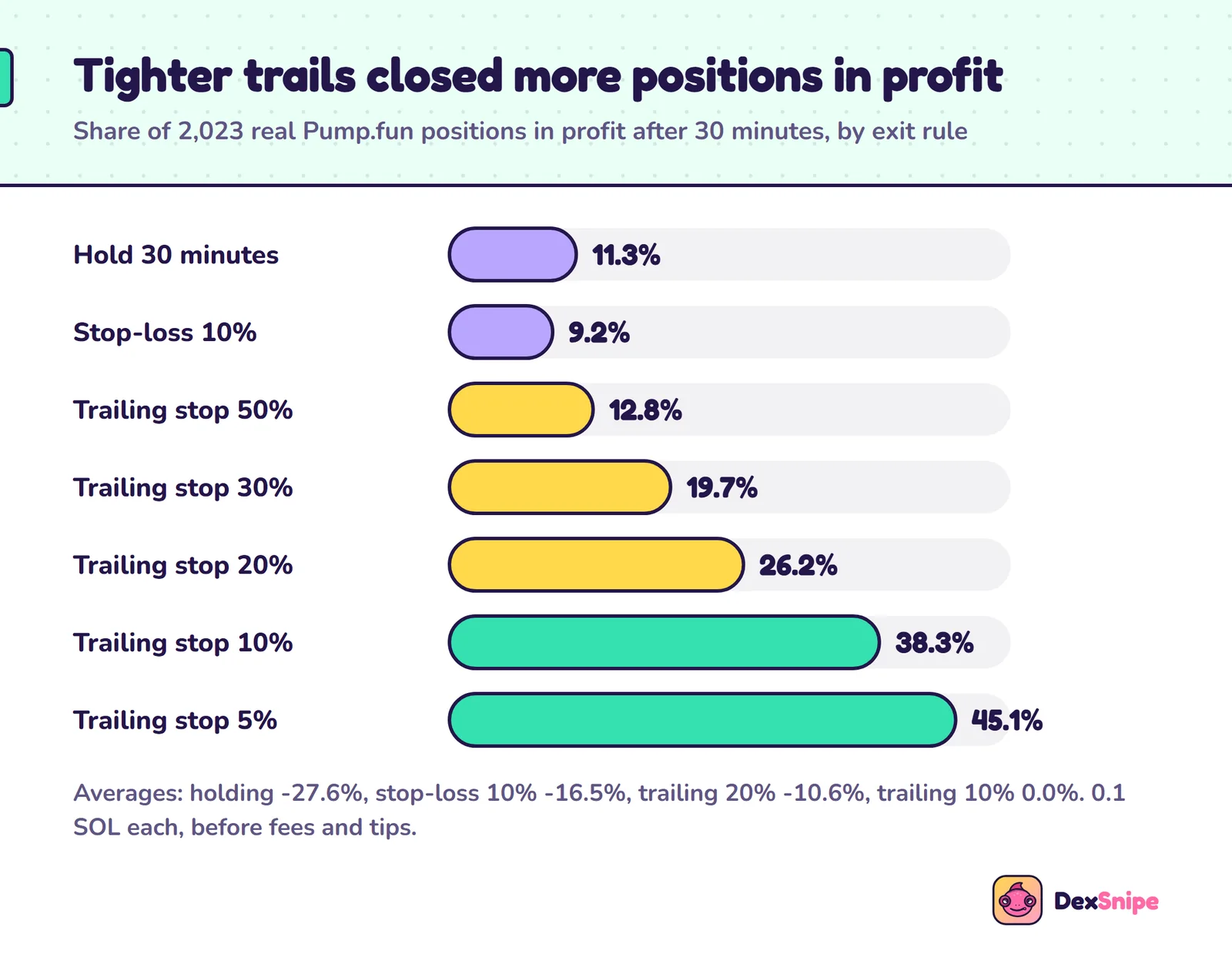
Holding is the baseline, and it is bad: -27.6% on average after 30 minutes, with only one position in nine in profit. That is what new Pump.fun coins do to most early buyers. 61.9% of these positions were up at least 10% at some point, and 24.9% were up 50% or more. Most of that was gone by the end of the window.
A plain stop-loss helped a little. A 10% stop below the buy took the average from -27.6% to -16.5%, by cutting the losers off before they lost everything. It did nothing for the winners, which kept riding until they were losers too, so the share in profit barely moved.
The trailing stops are where the table turns. A 10% trail averaged 0.0% and closed 38% of positions in profit, with fewer than one in ten losing half. Each step wider gave some of it back, and by 50% the trail was hardly better than holding. The last row is the real wallets with their own sells, priced the same way: -10.5% on average, with 41.6% in profit. On average, a 10% trailing stop did better than the people who actually traded these coins, though the real wallets closed a few more positions in profit.
The 5% row is the one to be careful with. It looks best, but its median exit is -0.7%, a trade that does almost nothing. Add Pump.fun's trading fee on the buy and the sell, plus your priority fee and tip, and most of those small exits turn into small losses. 10% is the tightest setting we would use.
One coin, four trailing stops
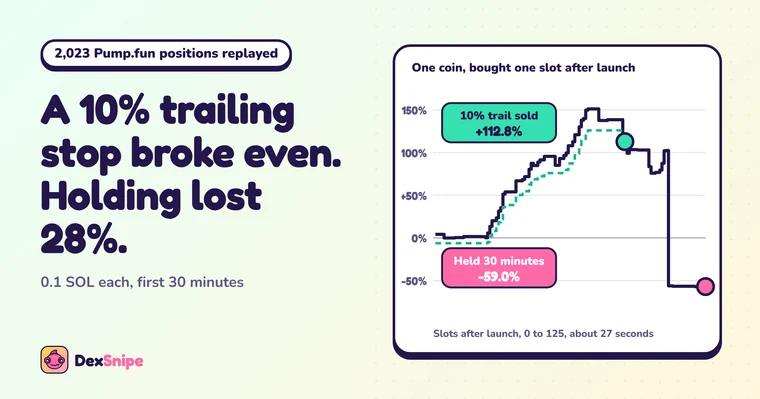
A single coin shows why the distance matters so much. It was created at 15:19:53, and three wallets bought 7.52, 4.80 and 4.02 SOL in the same block as the creator. Take a sniper that bought 0.1 SOL at the front of the next slot.
- Slot 71, about 15 seconds in. The price reaches its high. The position is up 151%.
- Slot 87. A 4.0 SOL sell takes the price more than 10% off the high. The 10% trail sells in the next slot for +112.8%.
- Slots 89 and 102. The price keeps sliding. The 20% trail sells for +99.2% and the 30% trail for +76.7%.
- Slot 108, about 23 seconds in. Four sells in one slot take 35.7 SOL out of the curve. The 50% trail was waiting at +25.5%. It fires at -55.6% and sells for -56.2%.
Holding to the end of the 30 minutes returned -59.0%. From launch to the dump took 23 seconds, and every trailing stop tighter than 50% got out with most of the run. The 50% trail is the warning. A wide trail does not give a position room to breathe on a coin like this. It gives the price room to fall past you in a single slot.
The stop price is not the sell price
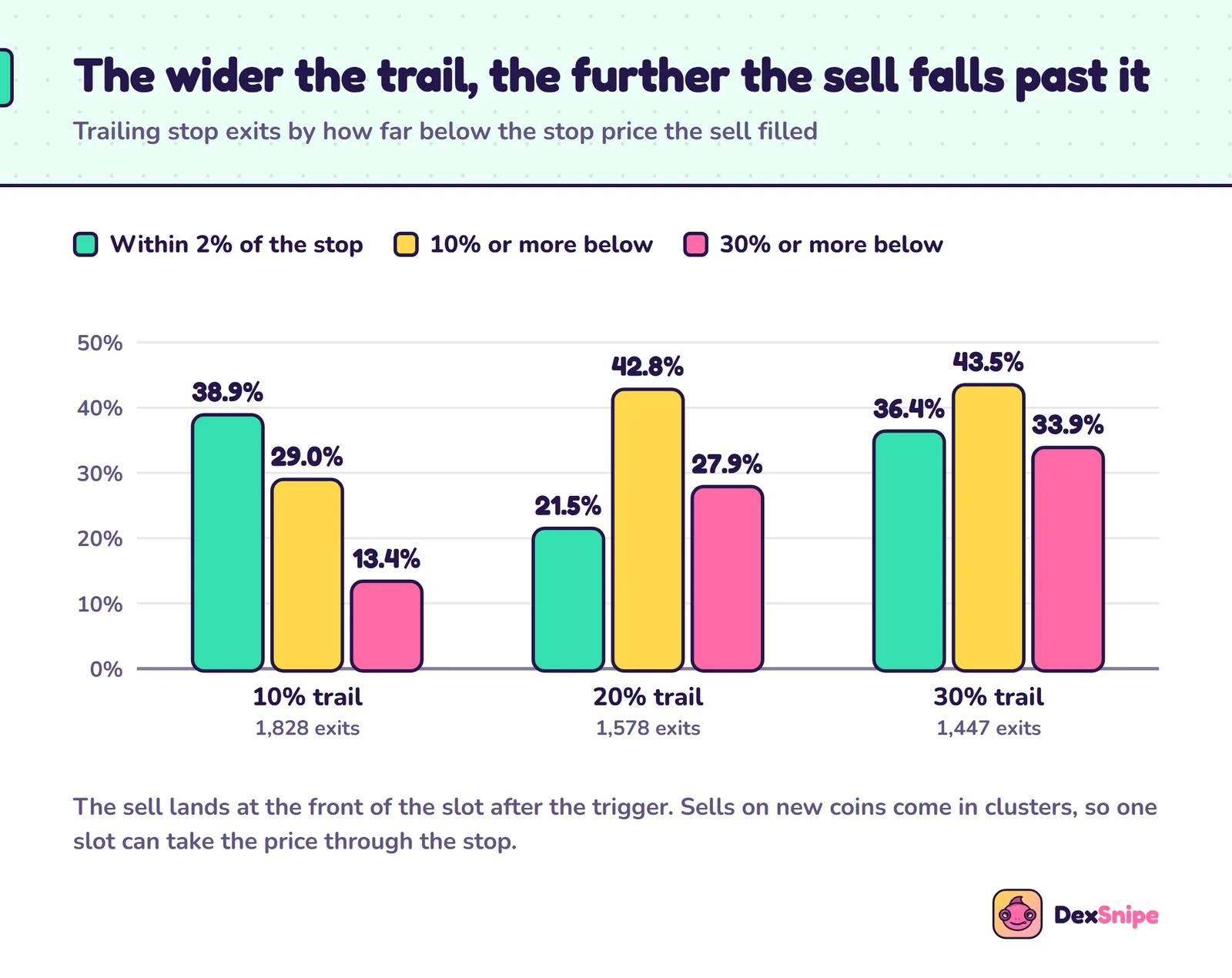
The 50% trail in that example was not unlucky. We measured where each trailing stop actually sold, against the stop price it was set to.
Fills against the stop price
Fills against the stop price
| Trail | Exits | Within 2% of the stop | 10%+ below | 30%+ below | Median fill vs stop |
|---|---|---|---|---|---|
| 10% | 1,828 | 38.9% | 29.0% | 13.4% | -3.2% |
| 20% | 1,578 | 21.5% | 42.8% | 27.9% | -8.4% |
| 30% | 1,447 | 36.4% | 43.5% | 33.9% | -9.3% |
With a 20% trail, only one exit in five sold close to the stop price. More than a quarter sold 30% or more below it. The cause is how new coins fall. The drop is rarely a slow slide. It is a creator selling, or a group of early buyers selling together, often in the same slot, and a trailing stop can only react after the first of those sells has landed.
Here is the clearest case in the sample. A coin created at 15:07:20 climbed until slot 76, 17 seconds in, where a buyer from the next slot would have been up 36.8%. In slot 77, sixteen trades landed together, among them the creator's sell, and took 28.5 SOL out of the curve. A 10% trail, a 20% trail, a 30% trail and a 50% trail all fired in that slot and all sold in the next one, at the same price: -63.6%. Nothing about the setting mattered. The price went through every stop at once.
Gaps hit the 10% trail too, but less often, because a tight trail usually sells on the first small dip, before the big sells arrive. That is most of the reason the tight setting wins: it leaves earlier, while the pool still has buyers in it. The dev-sell exit, which sells when the creator wallet sells, changed little on top of it in our test: a 10% trail with dev-sell on averaged -0.3%, against 0.0% without, because the creator's sell usually lands in a slot full of other sells.
Starting late leaves you bare
Most trailing stops, ours included, can wait for a gain before they start: trail by 10%, but only once the position is up 50%. The idea is to stop a small early dip from shaking you out of a coin that later runs. We tested it.
| Rule | Average | In profit | Lost half or more | Ended up 50%+ |
|---|---|---|---|---|
| 10% trail from the buy | 0.0% | 38.3% | 9.7% | 5.3% |
| 10% trail from +25% | -9.3% | 38.2% | 20.8% | 6.1% |
| 10% trail from +50% | -13.0% | 26.1% | 23.8% | 9.9% |
| 10% trail from +100% | -20.7% | 15.8% | 26.9% | 7.5% |
| 10% trail from +25%, 10% stop-loss | -3.1% | 33.1% | 12.0% | 5.6% |
| 20% trail from the buy | -10.6% | 26.2% | 17.8% | 4.0% |
| 20% trail from +50% | -18.1% | 22.9% | 26.5% | 5.9% |
The idea works on the winners and costs more on everything else. A 10% trail that started at +50% did let more positions run: 9.9% ended up 50% or more, against 5.3% for the same trail started at the buy. But three positions in four never reached +50%, and for those the late trail is no exit at all. They rode the coin down, and the average fell from 0.0% to -13.0%.
If you want a late start, pair it with a stop-loss. A 10% trail from +25% with a 10% stop-loss below the buy averaged -3.1%, close to the plain 10% trail, with a few more big winners. The stop-loss covers the positions that never reach the start line.
What it keeps on the runners
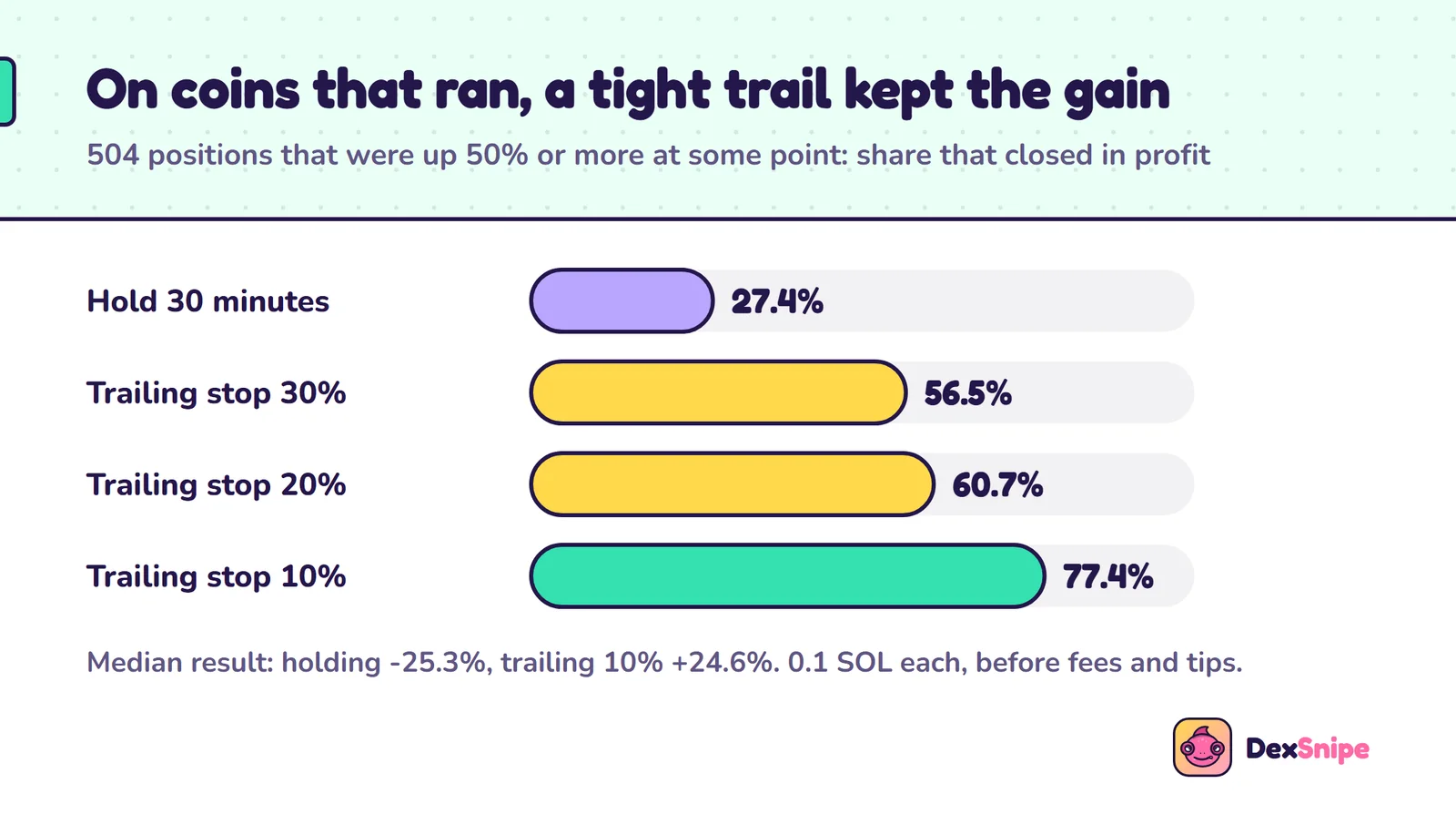
The usual worry with a tight trail is that it sells the coin that would have gone ten times. In this sample, 504 positions were up 50% or more at some point. Here is how they ended.
What each rule kept on the runners
What each rule kept on the runners
| Exit rule | Average | Median | In profit |
|---|---|---|---|
| Hold for 30 minutes | -6.6% | -25.3% | 27.4% |
| Trailing stop 30% | +13.8% | +6.3% | 56.5% |
| Trailing stop 20% | +21.5% | +13.2% | 60.7% |
| Trailing stop 10% | +34.5% | +24.6% | 77.4% |
Held for 30 minutes, the median runner ended at -25.3%. These are positions that were up 50% or more. With a 10% trail, more than three in four closed in profit, with a median of +24.6%. The coin that keeps going for hours exists, but on new Pump.fun coins it is rare, and a trailing stop gives up some of its upside to keep most of the much more common run that turns around in seconds.
If you want both, split the exit. Take-profit steps can sell part of the position on the way up, and the trailing stop handles what is left. That way the coin that runs for hours still has tokens riding it.
By when you bought
| Bought | Positions | Hold 30 min | 10% trail | 20% trail | Wallets' own sells |
|---|---|---|---|---|---|
| First 3 slots | 350 | -14.6% | +5.7% | -1.8% | +6.0% |
| 3 slots to 16 s | 677 | -40.0% | -7.0% | -19.6% | -24.3% |
| 16 s to 2.7 min | 598 | -35.2% | +2.3% | -14.9% | -14.8% |
| After 2.7 min | 398 | -6.5% | +3.5% | +3.5% | +5.2% |
The 10% trail helped in every group, and most where holding was worst. Positions opened between the third slot and about the third minute lost 35% to 40% when held. With the trail they averaged -7.0% and +2.3%. That stretch is the launch rush and the hangover after it, when early buyers are selling into late ones.
Launch snipes, in the first three slots, held badly too: -14.6%. With a 10% trail they averaged +5.7%, about what the real wallets made with their own sells. After about three minutes the coins that are still trading move slowly, and the 10% and 20% trails came out the same. That is where a wider trail costs least. For a Pump.fun sniper buying at launch, the tight setting is the one that fits.
Speed and size
Every result so far assumes the sell lands in the slot right after the trigger. We also ran the 10% and 20% trails with the sell landing later.
| Sell lands | 10% trail avg | 10% trail in profit | 20% trail avg |
|---|---|---|---|
| Next slot | 0.0% | 38.3% | -10.6% |
| 3 slots, about 0.6 s | -1.5% | 37.4% | -12.1% |
| 10 slots, about 2 s | -2.8% | 36.3% | -12.3% |
| 25 slots, about 5 s | -4.9% | 34.1% | -17.3% |
Speed helps, but the distance matters more. A 10% trail that sold 25 slots late, about 5 seconds, averaged -4.9%. A 20% trail that sold in the very next slot averaged -10.6%. A fast bot with a wide trail still sells lower than a slow one with a tight trail.
Size works the same way as in any trade on a curve. At 1 SOL per position instead of 0.1, the 10% trail averaged -4.3% and the 20% trail -14.0%, because a bigger sell moves the price further against itself. Holding at 1 SOL averaged -30.8%.
What this replay does not tell you
- It is two hours on one venue. All of it is the Pump.fun bonding curve on one afternoon. On tokens with deep pools, prices move slower and a wider trail costs less.
- It is before costs. Trading fees, network fees, priority fees and tips come off every buy and every sell.
- It is generous on timing. Each sell went first in its slot. A real sell competes with every other sell in that slot.
- It covers 30 minutes. Positions no rule had closed were valued at the last curve price, which is not what they finally sold for.
- Our sells do not move the curve for others. At 0.1 SOL that barely matters. At several SOL it would.
Trailing stop settings in DexSnipe
The trailing stop is one of five exits on every DexSnipe sniper, whatever its trigger: fresh launch, migration, new pool, creator watch, exact mint or copy trade. It manages the positions those snipers open. It is not a stop order you can put on a token you bought somewhere else.
- Trailing stop. The drop from the high, in percent, that sells the position. 0 turns it off.
- Trailing starts at. The gain at which the trail switches on. 0 trails from the buy price.
- Stop-loss. A fixed floor below the buy price. Use it whenever the trail starts late.
- Take-profit steps. Up to four, each with a gain and a share to sell. The trailing stop handles whatever the steps leave.
- Timer and dev-sell exit. Sell after a number of minutes, or when the creator wallet sells its own tokens.
Exits are checked against the live pool price and run on our servers, so they keep working after you close the tab. The sell goes out like any other trade, so on a new coin it can still fill below the stop when the price falls through it in one slot. If you are choosing between bots, our comparison of Solana sniper bots covers fees and exits side by side.
Set a trailing stop on a sniper
- Open the panel and click New sniper. Pick the trigger and the venues.
- Set the buy and the filters. Keep the size small enough that your own sell does not move the price far.
- Set the trailing stop to 10%. Leave Trailing starts at on 0 so it covers the position from the buy.
- Add take-profit steps if you want a runner. Sell part on the way up and let the trail handle the rest.
- Add a stop-loss if the trail starts late. 10% below the buy covers the positions that never reach the start.
- Connect your wallet, pick a plan and arm it. Add the key of a separate funded sniper wallet. The sniper and its exits run on our side.
Trade only what you can lose. A trailing stop limits how much of a run you give back. It does not make a losing coin a winner, and on new tokens most coins lose. This page is not financial advice.
Solana trailing stop questions
What is a trailing stop on Solana?
+
A sell rule that follows the price up and sells after it falls a set percentage from the highest point since you bought. With a 10% trailing stop, a token that runs to +150% is sold once it drops 10% from that high. On Solana a bot has to watch the pool and send the sell itself, because a bonding curve or AMM pool has no built-in stop order.
What trailing stop percentage works best for new Solana tokens?
+
In our replay of 2,023 real positions on new Pump.fun coins, tighter was better. At 0.1 SOL each and before fees, a 10% trailing stop from the buy averaged 0.0% with 38% of positions in profit. A 20% trail averaged -10.6%, a 30% trail -16.8%, and holding for 30 minutes -27.6%. A 5% trail did slightly better again, but by too little to survive trading fees and tips.
Why did my trailing stop sell far below the stop price?
+
Because the stop only decides when to sell. The price you get is wherever the pool is when your sell lands. On new coins sells come in clusters, and one slot can hold a creator dump and a dozen other sells. With a 20% trail, 43% of our exits filled 10% or more below the stop price, and 28% filled 30% or more below it.
Should a trailing stop start from the buy or after a gain?
+
From the buy, on new coins, unless you add a stop-loss. Waiting for a gain before the trail starts left most positions with no exit at all: a 10% trail that only started at +50% averaged -13.0% against 0.0% for the same trail started at the buy. A late start did let more winners run: 9.9% of positions ended up 50% or more against 5.3%.
Is a trailing stop better than a stop-loss?
+
On new coins it did much better in our replay. A 10% stop-loss below the buy averaged -16.5% with 9% of positions in profit, because it sells the losers but never sells a winner. A 10% trailing stop sells both, and averaged 0.0% with 38% in profit.
Does the DexSnipe trailing stop work on any token?
+
It works on the positions your DexSnipe snipers open, with any trigger: fresh launches, migrations, new pools, creator watch, exact mint and copy trades. It is an exit for those positions, not a standalone stop order for tokens you bought somewhere else. DexSnipe is a flat plan, 1 SOL for 7 days, 3 SOL for 30 days or 5 SOL for 90 days, with no cut of your trades.
Sources and method
The trades come from our Pump.fun sample: 1,205 coins created between 14:56 and 16:51 on November 5, 2026, each with every bonding curve trade for its first 30 minutes, read from the chain. We used the 412 ordinary SOL-paired coins with a complete trade history and left out Mayhem coins. A position is a wallet other than the creator whose first buy on the coin was 0.01 to 5 SOL and whose own token balance changed with each trade. That gave 2,023 positions by 1,383 wallets on 186 coins.
We rebuilt each curve's reserves trade by trade from its SOL and token balance changes, starting from the virtual reserves in Pump's README, and priced every trade with the constant product formula. Each position is a 0.1 SOL buy at the reserves the real wallet bought at. After every later trade we priced a full sell of the position, tracked the high and checked the rule. A triggered sell is priced at the reserves at the front of the next slot, or the slot the speed table names. Positions still open at 30 minutes are valued at the last curve price. "The wallets' own sells" sells the same share of the 0.1 SOL position as each real sell, at the reserves that sell met. Our trades are not added to the curve. All results are before trading fees, network fees, priority fees and tips. DexSnipe settings are taken from the product itself.
- Pump program README (Pump public docs)The bonding curve and its starting virtual reserves, which we used to price every sell.
- Pump program IDL (Pump public docs)The BondingCurve layout we decoded for the Mayhem flag, the quote asset and the complete flag.
- Pump program on SolscanProgram 6EF8rrecthR5Dkzon8Nwu78hRvfCKubJ14M5uBEwF6P, whose curve trades we replayed.
- The run example, on SolscanCreated at 15:19:53 on November 5, 2026.
- The gap example, on SolscanCreated at 15:07:20 on November 5, 2026.
- Solana terminology: slot (Solana docs)The period during which a leader ingests transactions and produces a block; we count reaction time in slots.
Keep the run, skip the dump
Trailing stop, stop-loss, take-profit steps, a timer and a dev-sell exit on every sniper. Flat plan, no cut of your trades.