PumpSwap Sniper Bot
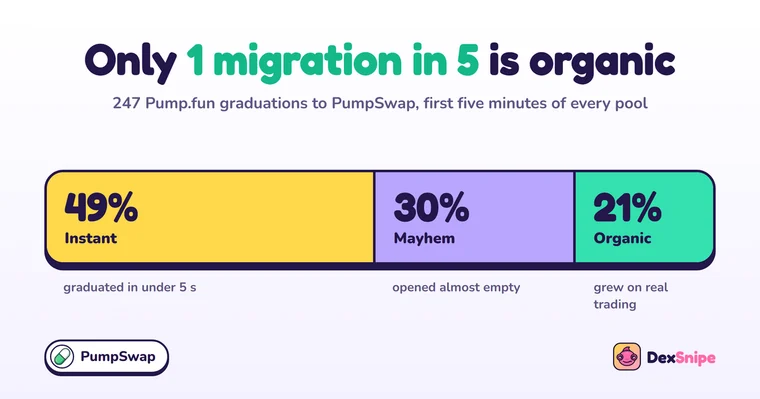
A PumpSwap sniper is built on one idea: when a Pump.fun coin graduates, be among the first to buy its new pool. We picked 247 migrations at random from early November 2026 and read every trade in their first five minutes. Most of them were not what a migration sniper thinks it is buying. Half were coins that graduated seconds after they were created, nearly a third were Mayhem pools that opened almost empty, and only one in five was a market that had grown on its own. Then we followed the first-block buyers of those real markets until they sold.
The short version
- Half of all migrations are instant. The coin is created and graduated within five seconds, usually by its own creator. In 35 of them, one wallet then bought more than half the pool in the opening block, at a median of about 2,400 SOL.
- Mayhem pools open nearly empty. Their median real liquidity at opening was about 0.2 SOL, and their price fell to around an eighth of the first trades within a minute.
- On real markets, the first block is not crowded. The median organic pool saw two buys in its opening block and about 2 SOL across its first three slots.
- The edge is small and costs take half of it. First-block buyers on organic pools made a median 13% before costs and 7.4% after, and most of them sold within five minutes.
What a PumpSwap sniper bot does
Every Pump.fun coin starts on a bonding curve. When enough SOL has gone in, the curve is complete and the coin migrates: its remaining tokens and the SOL it raised are moved into a new pool on PumpSwap, the exchange Pump.fun launched in March 2025 so that graduated coins would no longer leave for Raydium.
A PumpSwap sniper bot watches for that moment and buys the new pool in its first blocks, on the theory that a coin which just proved enough demand to fill its curve will see more demand once it trades on a real exchange. It then sells on rules: a take-profit, a stop-loss, a timer.
The theory assumes that a migration is the end of an honest race on the curve. That used to be close enough to true. In late 2026 it is not, and the reason is not that migrations got worse but that several very different things now produce one. A bot that treats them all the same buys three different trades and thinks it is buying one.
Three kinds of migration
We sampled the history of an account that takes part in every Pump.fun migration, picked migrations at random from November 3 to 5, 2026, and kept the 247 whose coins are paired with SOL. Another 44 paired with other coins were left out, since their prices are not in SOL. For each one we read the coin's curve account, found when the coin was created, and pulled every PumpSwap trade in the pool's first five minutes.
| Kind | Migrations | Share |
|---|---|---|
| Instant: graduated within 5 seconds of creation | 121 | 49% |
| Mayhem coins | 75 | 30% |
| Organic: curve filled by ordinary trading | 51 | 21% |
| All SOL-paired migrations | 247 | 100% |
The three kinds look the same in a migration feed: a curve completes, a pool opens with roughly the same token amount, a migration event fires. They behave nothing alike once the pool trades. The rest of this guide takes them one at a time, and then shows what a sniper actually earned on the kind worth sniping.
Coins that graduate in seconds
For 121 of the 247 migrations, the pool opened within five seconds of the coin's creation. Their curves had a median of four transactions before migrating. There was no race on these curves, and no time for one.
The pattern is simple. A wallet creates a coin and, in the same transaction, buys the entire curve. The curve is complete at once. A moment later the pool is opened, and in 96 of the 121 cases the wallet that opened it was the coin's own creator. 119 different creators were behind the 121 coins, so this is not one operator running a script; it is a common technique.
We saw the same thing on LetsBonk, where 777 graduations out of 12,632 were bought out in the creation transaction. On Pump.fun in early November 2026 it was not a side effect but the majority of migrations. A migration sniper that fires on every graduation is, more than half the time, buying a coin whose creator holds most of the supply and who opened the pool themselves.
What happens next
Instant migrations are busy. In their first five minutes the median instant pool saw 1,408 transactions, against 440 for an organic pool. The median price five minutes in was 1.68 times the average of the first three slots. That looks like the best trade on PumpSwap, until you see who is buying. The median instant pool took in 52.8 SOL in its first three slots, against 2.1 SOL for an organic pool, and much of it came in large buys, some of exactly the same size, from wallets that turn up in several of these pools.
The 5,000 SOL opening buy
In 35 of the 121 instant migrations, one wallet bought more than half of the pool's tokens in the block the pool opened. The median buy was about 2,400 SOL. The largest was 14,940 SOL. None of these happened on an organic migration.
One of them, step by step
- 15:30:11, November 4, 2026. A wallet creates a coin and buys its entire curve for 86 SOL in the same transaction.
- The same second. The PumpSwap pool opens with the usual amount of tokens and SOL.
- The same block. A second wallet spends 4,976 SOL and receives about 98% of the pool's tokens.
- Three minutes later. That wallet starts sending identical slices of 305,000 tokens to hundreds of other wallets, several per second.
On a constant product pool, buying 98% of the tokens multiplies the price by about 2,500. On paper, a coin whose whole supply was valued at about 400 SOL when the pool opened was suddenly valued at more than a million SOL, and minutes later it had hundreds of holders. Every SOL behind that price came from the same wallet that holds the tokens, and selling them is how it comes back out.
We cannot see why someone does this, and there are several possible reasons, from inflating a coin's rank on trackers to things we cannot observe. It does not matter for a sniper. The price after one of these buys is not set by a market, and a bot that buys after it is paying thousands of times the opening price for a token whose supply sits almost entirely with one group.
The filter that catches it. A top 10 holder cap. Right after the opening buy, one wallet holds almost every token outside the pool, which no sensible cap allows.
Mayhem pools open almost empty
Mayhem Mode is a Pump.fun option chosen at launch that gives a coin an automated trading agent for its first day. Mayhem coins carry a flag on their curve and on their pool, and Pump's own documentation excludes them from synthetic migration, described below. 75 of our 247 migrations, almost a third, were Mayhem coins.
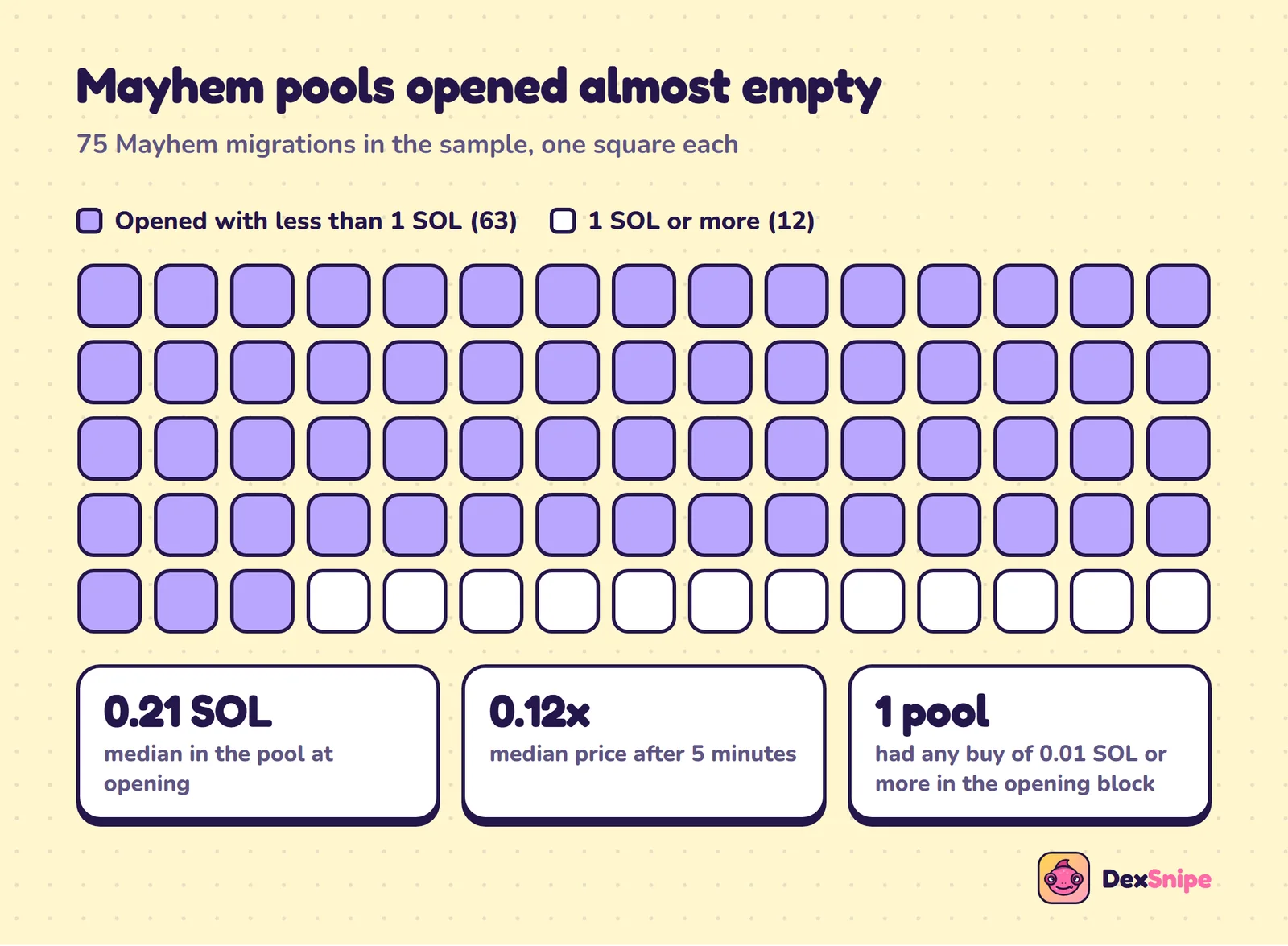
Their pools look nothing like a normal migration. A normal pool opens with about 67 SOL in its vault plus the boost reserve. The median Mayhem pool opened with 0.21 SOL. 63 of the 75 opened with less than 1 SOL, and only one with more than 10.
Data table
Mayhem pools in our sample
| What we measured | Result |
|---|---|
| Mayhem migrations | 75 of 247 |
| Median SOL in the pool at opening | 0.21 |
| Opened with less than 1 SOL | 63 |
| Pools with any buy of 0.01 SOL or more in the opening block | 1 |
| Median price after 1 minute, vs the first trades | 0.13x |
| Median price after 5 minutes, vs the first trades | 0.12x |
The market already knows. Sniper-sized buyers stayed away from almost every Mayhem pool in its opening block, and where there were trades, the price fell to about an eighth of the first ones within a minute. A pool with a fifth of a SOL in it cannot absorb even a small sell.
The filter that catches it. A minimum liquidity. Set at 20 SOL, it would have skipped 74 of the 75 Mayhem pools and none of the organic ones.
The one in five that is a market
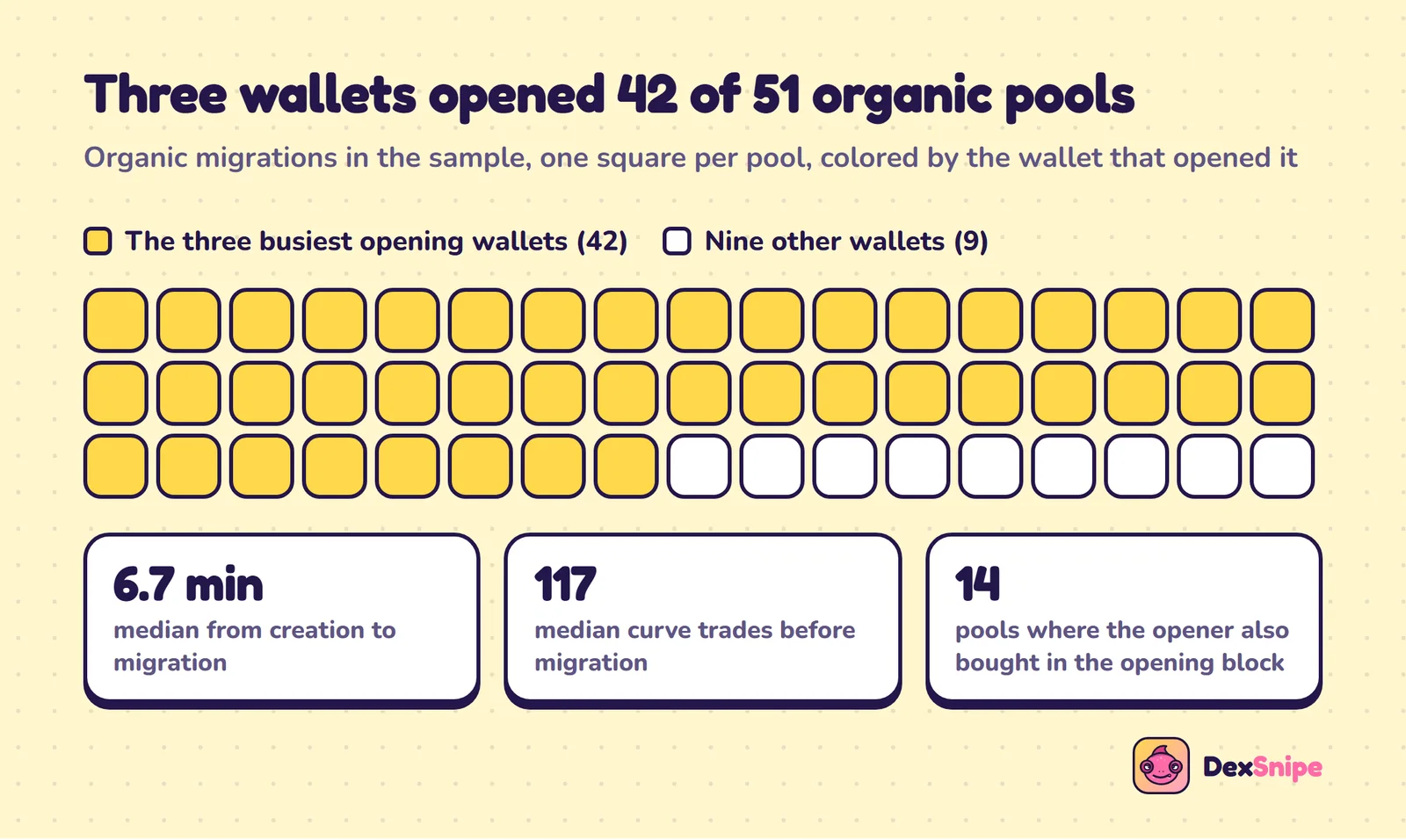
51 migrations, 21% of the sample, were what a migration sniper has in mind: a coin launched, people traded it on the curve, and the curve filled. Even these move fast. The median organic coin reached migration 6.7 minutes after it was created. A quarter got there in about a minute, and three quarters within 21 minutes. The median curve had 117 transactions before it completed.
Data table
Organic migrations in our sample
| What we measured | Result |
|---|---|
| Organic migrations | 51 of 247 |
| Median time from creation to migration | 6.7 minutes |
| Median curve transactions before migration | 117 |
| Different wallets that opened the pools | 12 |
| Pools opened by the three busiest of them | 42 |
| Pools where the opening wallet also bought in the opening block | 14 |
| Pools with a synthetic buy before opening | 26 |
Opening the pool is open to anyone. The Pump program's migrate instruction takes the caller as a signer, so whoever sends it first opens the pool. A handful of wallets do most of this, and in 14 of the 51 organic pools the wallet that opened the pool also bought in the same block. That is the most direct way to be first: be the one who opens the door.
A buy before the pool exists
In October 2026 Pump.fun documented a change to how a curve ends. Before, a buy could take at most what was left on the curve. Now, the buy that completes a curve can be bigger. It takes what is left at the curve price, and then buys more at the price the new pool would charge, from tokens that would have gone into the pool. Pump calls this a synthetic migration. The pool then opens at the price that buy left behind.
The curve records the size of that extra part, so we could read it for every coin in the sample. In 26 of the 51 organic migrations, half of them, someone had already bought into the pool before it opened. The median was about 0.47 SOL and the largest 3.3 SOL. Mayhem coins never had one, which matches the rule in Pump's documentation.
For a migration sniper this changes what "first" means. Half the time, the first buyer of an organic pool is not whoever lands in its opening block but whoever completed the curve, and they bought at the opening price before your bot could see the pool. The amounts are small, so the price effect is too. The lesson is that being first in the pool is worth less than it sounds, because often you are not first.
Inside the opening block
Snipers talk about the first block as if it were a stampede. On organic pools, it was not. We counted buys of 0.01 SOL or more.
| What we measured | Median | Top tenth of pools |
|---|---|---|
| Buys in the opening block | 2 | 6 or more |
| Wallets buying in the first three slots | 5 | 8 or more |
| SOL bought in the first three slots | 2.1 |
20 of the 51 organic pools had no buy of 0.01 SOL or more in their opening block at all. A slot lasted about a fifth of a second in our sample, so the first three slots are well under a second. In that time the median organic pool saw five buying wallets and about 2 SOL. A sniper with a sensible tip lands among them without trying very hard.
The four wallets that touch every pool
There was one kind of buyer in every pool. Within ten seconds of opening, at least one of the same four wallets bought into every one of the 247 pools, organic, instant and Mayhem alike. The busiest of them was in 245, and all four together appeared in 222. Each buy was worth a few hundred-thousandths of a SOL. They do not move the price. They do inflate the count of early buyers and trades, so a bot or a person who reads "ten buyers in the first second" as demand may be counting probes.
Price in the first five minutes
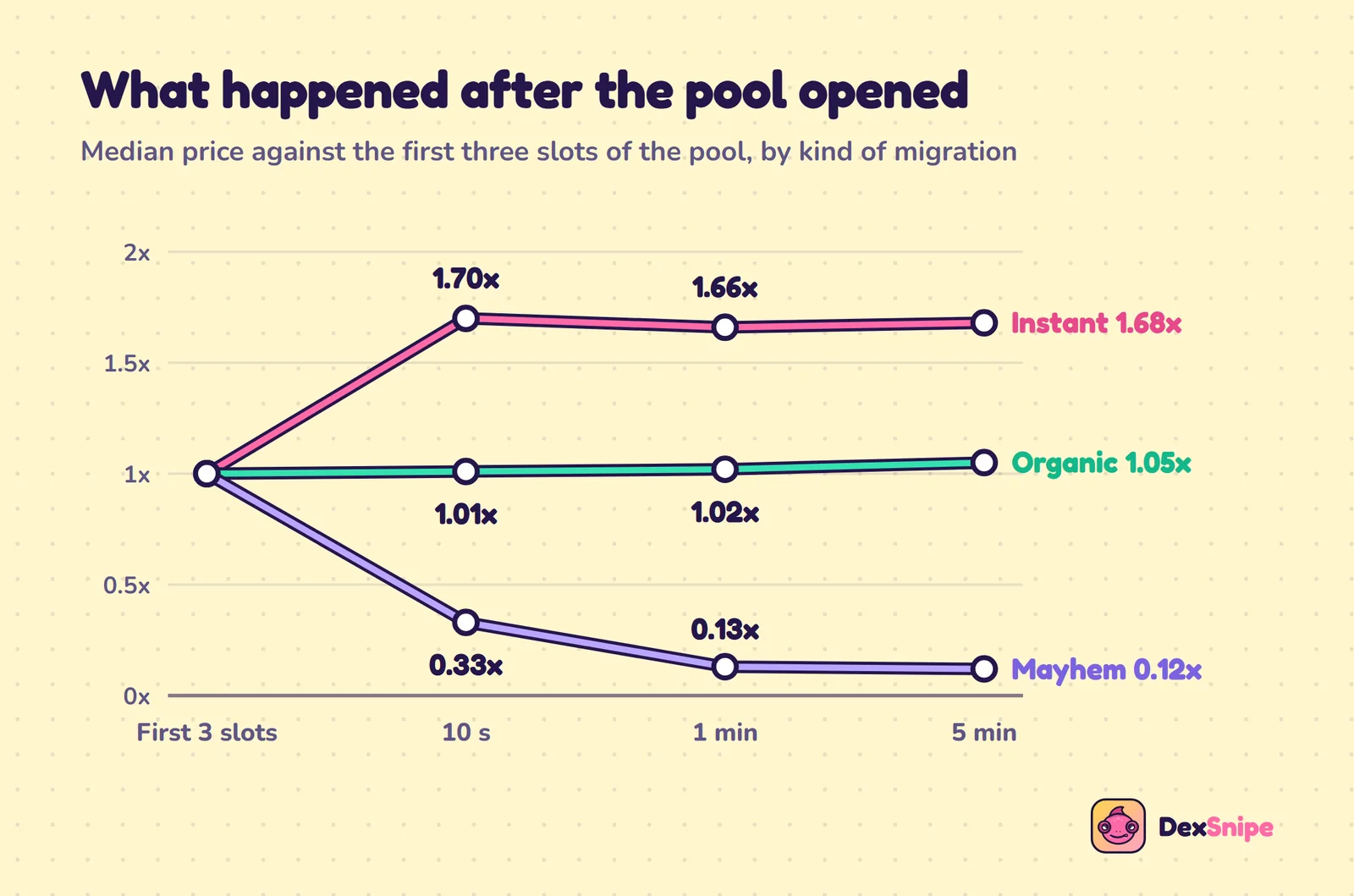
We compared the price of each pool at 10 seconds, 1 minute and 5 minutes with the average price of trades in its first three slots, which is roughly what a first-block buyer paid.
Data table
Median price relative to the first three slots
| Kind | After 10 s | After 1 min | After 5 min |
|---|---|---|---|
| Organic | 1.01x | 1.02x | 1.05x |
| Instant | 1.70x | 1.66x | 1.68x |
| Mayhem | 0.33x | 0.13x | 0.12x |
On organic pools, the median price barely moved, and at each point roughly half of the pools were below where the first buyers got in. That is a market in balance, and the reason is visible in the flows. In the first five minutes the median organic pool took in 96 SOL of buys and paid out 99 SOL of sells.
The buys come from snipers, from people who missed the curve, and from BOOST, which Pump.fun introduced in 2026 to spend part of each migration's liquidity on buys in the first five minutes. The sells come from people who bought on the curve and now have somewhere deep to sell. A migration is less a launch than a handover: curve holders taking profit, new buyers taking their place.
What first-block buyers made
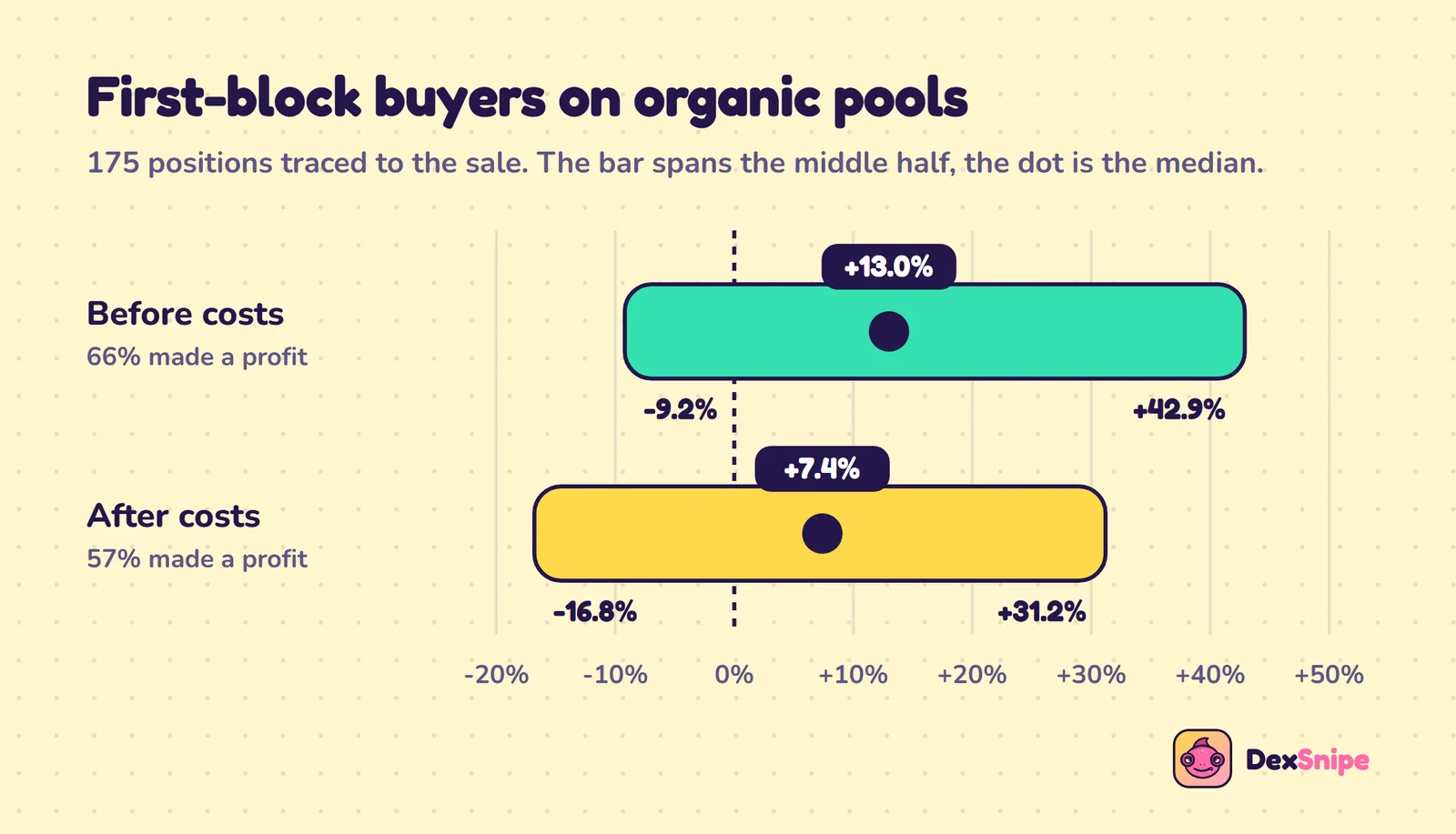
This is the number most sniper guides skip. We took every wallet that bought 0.01 to 5 SOL in the first three slots of an organic pool, paid in plain SOL and kept the tokens in its own wallet, and followed its token account until it sold. That left 175 positions, each traced to the end.
Data table
175 first-block positions on organic PumpSwap pools, traced to the sale
| What we measured | Before costs | After costs |
|---|---|---|
| Positions that made a profit | 66% | 57% |
| Median result | +13.0% | +7.4% |
| Bottom quarter did worse than | -9.2% | -16.8% |
| Top quarter did better than | +42.9% | +31.2% |
"Costs" here are what the wallet actually paid beyond the trade itself: network fees, priority fees and tips, read from its SOL balance. They took a median 3.1% of the buy size. A tenth of the buyers paid more than 15%, and those heavy tippers are where most of the difference between the two columns went. 15 of the 175 lost more than half; 13 more than doubled.
They also did not wait. The median position was sold 130 seconds after the buy. A quarter sold within a minute, and three quarters within five minutes, which is the length of the BOOST window. First-block buying on PumpSwap is a short trade, in and out while the handover is happening.
And on instant migrations
We ran the same trace on 254 small positions in instant pools. Before costs, 70% were in profit and the median was +5.1%. After costs, 57% and +1.9%, and taken together they lost 1.0 SOL on 62.9 SOL bought. The price chart of an instant pool goes up; the wallets that bought it small did not get much of that.
What the numbers say. On organic migrations, being early paid a little, about as much as a good exit adds or a bad tip removes. Speed beyond the first second did not buy much, and spending heavily to win it was the most reliable way to turn a small gain into a loss.
What this sample does not tell you
Three days of migrations is a snapshot, and a few things about it are worth saying plainly.
- The mix moves. We looked at three days. On another week, instant, Mayhem and organic migrations may come in different proportions. The three kinds and how to tell them apart will not change as quickly as their proportions.
- Five minutes is not the whole life of a coin. We read every trade in the first five minutes and followed first-block buyers until they sold, which for most of them was inside that window. We did not measure where organic coins were a day or a week later.
- Some buyers could not be traced. Wallets that paid through wrapped SOL accounts, or moved their tokens to another wallet before selling, were left out of the results, because their profit cannot be read cleanly from the chain.
- Coins paired with other assets are not here. About one migration in seven was paired with something other than SOL. Their prices move with that asset as well as with the coin.
Filters that sort the three kinds
The point of everything above is that a migration sniper should only fire on organic migrations. Each of the other two kinds has a signature that a filter can see before the buy is sent.
| Kind | What gives it away | Filter that skips it |
|---|---|---|
| Mayhem | A fraction of a SOL in the pool | Min liquidity, 20 SOL |
| Instant | The creator holds most of the supply | Dev holding cap |
| Instant with a whale buy | One wallet holds nearly every token | Top 10 holder cap |
| Organic | Real liquidity, spread holders | Passes all three |
- Min liquidity is the cheapest filter on PumpSwap. Organic pools open with dozens of SOL. Mayhem pools do not.
- Dev holding cap. A creator who bought the whole curve in the creation transaction holds most of the supply when the pool opens, unless they have already spread it around.
- Top 10 holder cap. Catches the opening buys of thousands of SOL, and the cases where a creator split the curve across a few wallets.
- Skip bundled launches. Catches creators who bought with several wallets at once to hide it.
PumpSwap sniper settings
Built from the numbers above. These are starting points, not promises.
| Setting | Value | Why |
|---|---|---|
| Trigger | Migration, Pump.fun | Buys only the pool the migration creates |
| Buy size | 0.2 to 0.5 SOL | Inside the range of the positions we traced |
| Slippage cap | 10 to 15% | Organic pools are deep enough |
| Priority fee | 0.001 SOL | The first second is not crowded |
| Jito tip | 0.002 SOL | Heavy tippers gave back their edge |
| Min liquidity | 20 SOL | Skips Mayhem pools |
| Dev holding cap | 10% | Skips most instant migrations |
| Top 10 holder cap | 35% | Skips whale-bought pools |
| Skip bundled launches | On | Skips hidden creator buys |
| Take-profit | +20% sell 50%, +50% sell 50% | The median trade was +13% before costs |
| Stop-loss | 20% | A quarter lost 17% or more |
| Timer | 5 minutes | The BOOST window, and when most sold |
Why the tip is low
Everything in the data points the same way. The opening block of an organic pool had two buyers at the median. The pool part of a synthetic migration means you are often not first anyway. And the buyers who paid the most to land early lost the largest share of their result to it. A modest tip lands you in the first second; a large one buys you a few hundred milliseconds that the price does not reward.
Why the take-profit is close
Organic pools moved a median 5% in five minutes. A first target of +100% is a lottery ticket on a pool that usually trades sideways while curve holders sell. A target of +20% hits often enough to matter, and the second half rides the cases that run.
Take profit, stop loss and selling
PumpSwap pools do not hold orders, so every exit is the bot watching the price and sending a sell. DexSnipe gives each sniper up to four take-profit steps, a stop-loss, a trailing stop, a timer and a dev-sell exit, all running on the server after you close the tab.
- Use the timer. Three quarters of first-block buyers were out within five minutes. A position still open after the BOOST window is a different trade from the one you entered.
- Keep dev-sell on. On an organic coin, the creator selling into the new pool is the clearest sign the handover is going one way.
- Leave room in the slippage cap. When a pool turns, every bot sells at once, and a tight cap can make your sell fail.
| What you see | Likely cause | What to change |
|---|---|---|
| Buys at thousands of times the opening price | Whale-bought instant pool | Add a top 10 holder cap |
| Sells return almost nothing | Mayhem pool with a fraction of a SOL | Set min liquidity to 20 SOL |
| Every trade small and slightly negative | Tips and priority eating the edge | Lower the tip, raise the first target |
| Sniper fires on most migrations | No dev cap, so instant ones pass | Set a dev holding cap |
Choosing a PumpSwap sniper bot
- Does it buy only the migration's pool? Anyone can open other PumpSwap pools for the same coin, and a careless bot can buy a near-empty one.
- Can it check holders at migration, with a dev holding cap and a top 10 cap, so instant and whale-bought pools are skipped?
- Does it have a minimum liquidity that reads the pool, so Mayhem pools are skipped?
- Does it run exits on a server, including a timer, so a five-minute trade is closed even when you are away?
- Is the price flat, or does it take a share of every trade? On a trade whose median gain is a few percent, a per-trade cut can take most of it.
PumpSwap in DexSnipe
The Migration trigger with Pump.fun ticked buys the PumpSwap pool the migration creates, and nothing else. PumpSwap is also its own venue for the New pool, Creator watch and Copy trade triggers. Every sniper has a minimum liquidity, dev and top 10 holder caps, a bundled launch check, mint and freeze authority checks and a word blocklist. The price is a flat plan from 1 SOL for 7 days with no cut of your trades. If you also snipe coins on the curve before they migrate, the Pump.fun sniper bot guide covers that side.
Set up a PumpSwap migration sniper in DexSnipe
- Open the panel and click New sniper. Choose the Migration trigger and tick Pump.fun.
- Set the buy: 0.2 to 0.5 SOL, a slippage cap of 10 to 15%, and a modest priority fee and tip.
- Set the filters: min liquidity 20 SOL, dev holding cap 10%, top 10 holder cap 35%, skip bundled launches on.
- Build exits: two take-profit steps, a 20% stop-loss, dev-sell on and a five-minute timer.
- Connect your wallet and save. Snipers are stored on your wallet address.
- Pick a plan, add a sniper wallet and arm it. Send 1, 3 or 5 SOL to the reserved address, add the key of a separate funded wallet, arm the sniper and close the tab.
Trade only what you can lose. The results above are medians over a few days of real trades, not a forecast. A third of first-block buyers lost money before costs even on the best kind of migration, and more than four in ten after costs. This page is not financial advice.
PumpSwap sniper bot questions
What is a PumpSwap sniper bot?
+
A bot that buys a Pump.fun coin on PumpSwap, Pump.fun's own exchange, in the first blocks after the coin's bonding curve completes and its pool opens, then sells it on rules you set. In DexSnipe this is the Migration trigger with Pump.fun selected.
Is every Pump.fun migration a real market?
+
No. Of 247 SOL-paired migrations we traced in early November 2026, 121 graduated within five seconds of the coin being created, usually because the creator bought the whole curve at once, and 75 were Mayhem coins whose pools opened with a fraction of a SOL. Only 51, about one in five, had a curve that filled through ordinary trading.
Do first-block buyers on PumpSwap make money?
+
On organic migrations, modestly. We traced 175 buys of up to 5 SOL made in the first three slots of those pools to the moment they were sold. Before costs, 66% made a profit and the median result was +13%. After the network fees, priority fees and tips they paid, 57% made a profit and the median was +7.4%.
What is a synthetic migration on Pump.fun?
+
Since a change Pump.fun documented in October 2026, the buy that completes a Pump.fun curve can be larger than what is left on the curve. The extra part is priced as if the PumpSwap pool already existed, and the pool then opens at the price that buy left behind. In half of the organic migrations we traced, someone had already bought this way before the pool opened.
What is a Mayhem coin on PumpSwap?
+
A coin launched with Pump.fun's Mayhem Mode, which gives the coin an automated trading agent for its first day. In our sample, Mayhem coins were nearly a third of all migrations, and their pools opened with a median of about 0.2 SOL of real liquidity. Prices in those pools fell to a fraction of the first trades within a minute.
Why did someone spend 5,000 SOL on a coin that just launched?
+
We saw it in 35 of 121 instant migrations: one wallet bought more than half of the new pool in the opening block, at a median of about 2,400 SOL. The SOL stays in the pool and the same group holds almost every token, so it can be taken back by selling. We cannot see the motive. What a sniper needs to know is that the price after such a buy is not a market price.
Can PumpSwap migrations be opened by anyone?
+
Yes. The Pump program's migrate instruction takes the user who calls it as a signer, so any wallet can open the pool once a curve is complete. In the organic migrations we traced, 12 different wallets opened the pools, and in 14 of 51 the opening wallet also bought in the same block.
Does DexSnipe take a fee on PumpSwap trades?
+
No. DexSnipe is a flat plan: 1 SOL for 7 days, 3 SOL for 30 days or 5 SOL for 90 days. You pay the network fee, your own priority fee and tip, and the trading fees Pump.fun and PumpSwap charge.
Sources and method
We listed the transaction history of an account that takes part in every Pump.fun migration for November 3 to 5, 2026, picked migrations from it at random and kept 291 distinct coins. 44 were paired with a quote other than SOL and left out, leaving 247. For each coin we derived its canonical PumpSwap pool and its bonding curve, read the curve's Mayhem flag, quote and synthetic migration fields, and took the curve's oldest transaction as the coin's creation time. An instant migration is one whose pool opened within five seconds of creation. A whale buy is a single buy in the opening block of more than half of the pool's starting tokens.
For every pool we read all successful transactions in its first five minutes and measured each trade from the change in the pool's own token and SOL vaults, so prices are what traders actually paid. For the results section we took every buy of 0.01 to 5 SOL in the first three slots of a pool, kept wallets that paid in plain SOL and never moved the tokens elsewhere, and followed each one's token account until it sold. "Before costs" is the SOL paid into and taken out of the pool; "after costs" is the change in the wallet's SOL balance, which also includes network fees, priority fees, tips and token account rent. Time between trades is measured from block times. DexSnipe triggers, filters and exits are taken from the product itself.
- Synthetic migration: the last buy on the bonding curve has no max size (Pump public docs)How the completing buy can extend into the pool before it exists, the BondingCurve fields that record it, and the rule that Mayhem coins are excluded.
- Pump program IDL (Pump public docs)The migrate_v2 instruction, whose user account is a signer, and the BondingCurve layout we decoded, including is_mayhem_mode and quote_mint.
- PumpSwap program README (Pump public docs)Pool layout, the canonical pool and the is_mayhem_mode flag on pools.
- Virtual quote reserves and fees kept in the pool (Pump public docs)Why the SOL in a pool's vault is not the same as its liquidity, and how boost reserves enter the price.
- PumpSwap program on SolscanProgram pAMMBay6oceH9fJKBRHGP5D4bD4sWpmSwMn52FMfXEA, whose pool histories we read.
- Pump migration account on SolscanAn account present in every migration, whose history we sampled to pick migrations at random.
- A coin created and migrated in the same second, on SolscanCreation and a buy of the whole curve for 86 SOL, November 4, 2026.
- The 4,976 SOL opening buy, on SolscanBought about 98% of the new pool's tokens in the block the pool opened.
- The pool that buy went into, on SolscanPumpSwap pool 2dXcc4...7Hk4j.
- A Mayhem pool that opened with 0.145 SOL, on SolscanA Mayhem coin's PumpSwap pool from our sample.
- One of the four wallets that pinged every pool, on SolscanBought a few hundred-thousandths of a SOL in 245 of our 247 pools within ten seconds of opening.
- SolanaFloor: Pump.fun unleashes Mayhem ModeNovember 13, 2025. Mayhem Mode attaches an automated trading agent to a new coin for its first 24 hours and doubles its supply.
- The Block: Pump.fun token graduation rate jumps after BOOST changes launch incentivesJuly 29, 2026. BOOST spends part of each migration's liquidity on buys in the first five minutes.
- Decrypt: Pump.fun debuts PumpSwap exchangeLaunch report from March 20, 2025.
Snipe the migrations worth sniping
Build your snipers for free, then a plan from 1 SOL switches them on. No cut of your trades.