Orca Sniper Bot
Most guides to sniping Orca treat a Whirlpool's fee as a fixed number: 0.3%, 1%, maybe 2%. On a growing share of new pools, it is not. Orca's adaptive fee pools raise their fee when the price moves fast, up to a hard limit of 10%. We read all 167,036 Whirlpools, decoded the 25,674 adaptive fee oracles, and measured the fee on every trade in the opening of 76 new pools. The first buyers paid little. The minutes after them did not.
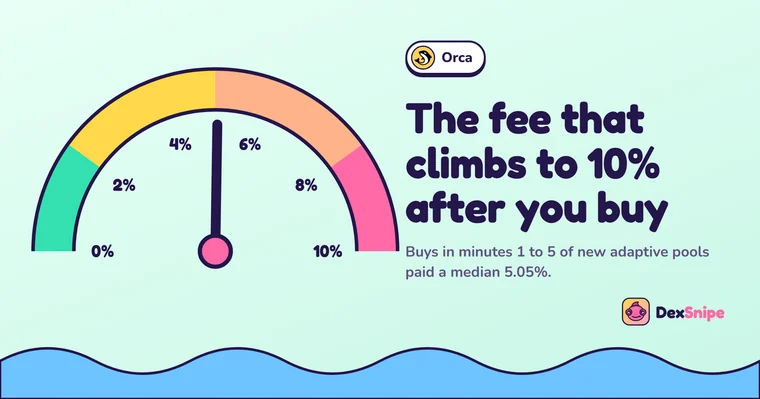
The short version
- The fee follows the price, not the clock. Adaptive pools charge the base fee when trading is calm and add to it when the price moves fast, up to a 10% total.
- The first buyer pays least. Buys in the first ten seconds paid a median of 2.0%. Buys in minutes one to five paid 5.05%, and more than half paid 5% or more.
- Selling into a pump costs the same. The fee applies both ways. A sniper whose take-profit fires during a fast move can give up close to a tenth of the sale.
- New pools trade a minute late. No pool in our sample received liquidity in the transaction that created it. The median first swap came about a minute later.
What an Orca sniper bot does
Orca is not a launchpad. It is a concentrated liquidity exchange, and its pools are called Whirlpools. Anyone can create one for any pair of tokens and deposit liquidity into it. An Orca sniper bot watches the Whirlpools program for new pools, waits for real liquidity, buys, and sells on rules you set. A Creator watch sniper narrows that to pools created by chosen wallets.
The coins that show up in new Whirlpools come from everywhere. Pump.fun coins, LetsBonk coins, Jupiter Studio coins and Bags coins all get Orca pools, created by their teams, by market makers or by anyone else. Some launchpads graduate straight into Orca. So an Orca sniper is less about one launchpad's rules and more about one exchange's rules, and on Orca the rule that matters most to a sniper is the fee.
Whirlpools in one page
A Whirlpool is a concentrated liquidity pool. Liquidity providers choose a price range, and their liquidity only works while the price is inside it. Prices are measured in ticks, and each pool has a tick spacing that sets how finely ranges can be drawn. Wider spacing goes with higher fee tiers.
Every pool also has a fee tier. Orca's docs describe tiers from 0.01% to 2%, and the chain shows a few hundred pools on a 6% tier as well. Until 2025, the fee tier was the fee: every swap in a 1% pool paid 1%. Adaptive fee pools changed that. The tier became a base fee, with a second, moving part added on top.
| Fee tier | Pools |
|---|---|
| 0.01% | 71,483 |
| 0.3% | 43,283 |
| 1% | 15,363 |
| 2% | 5,591 |
| 0.02% | 1,648 |
| 0.16% | 937 |
For a sniper, the fixed-fee pools are simple. You know the fee before you buy and it never changes. The rest of this guide is about the pools where it does.
Every Whirlpool, on chain
On November 6, 2026 we downloaded every Whirlpool account and every oracle account of the Whirlpools program. An oracle is the extra account an adaptive fee pool carries; a pool without one charges a fixed fee. We decoded the oracles with the layout in Orca's open-source program.
| Measure | Value |
|---|---|
| Whirlpools | 167,036 |
| Adaptive fee pools | 25,674 |
| Adaptive pools paired with SOL | 10,579 |
| Adaptive pools that can reach the 10% cap | 22,468 |
| Adaptive pools with a trade enable time | 85 |
| Splash pools, full range | 15,639 |
| Adaptive pools for coins with the pump suffix | 5,466 |
| Fixed-fee pools for coins with the pump suffix | 3,375 |
The last two rows show where memecoin pools on Orca have gone. Among pools for coins with the pump suffix, adaptive pools now outnumber fixed-fee ones. If you snipe new Orca pools for launchpad coins, most of what you buy will have a fee that moves.
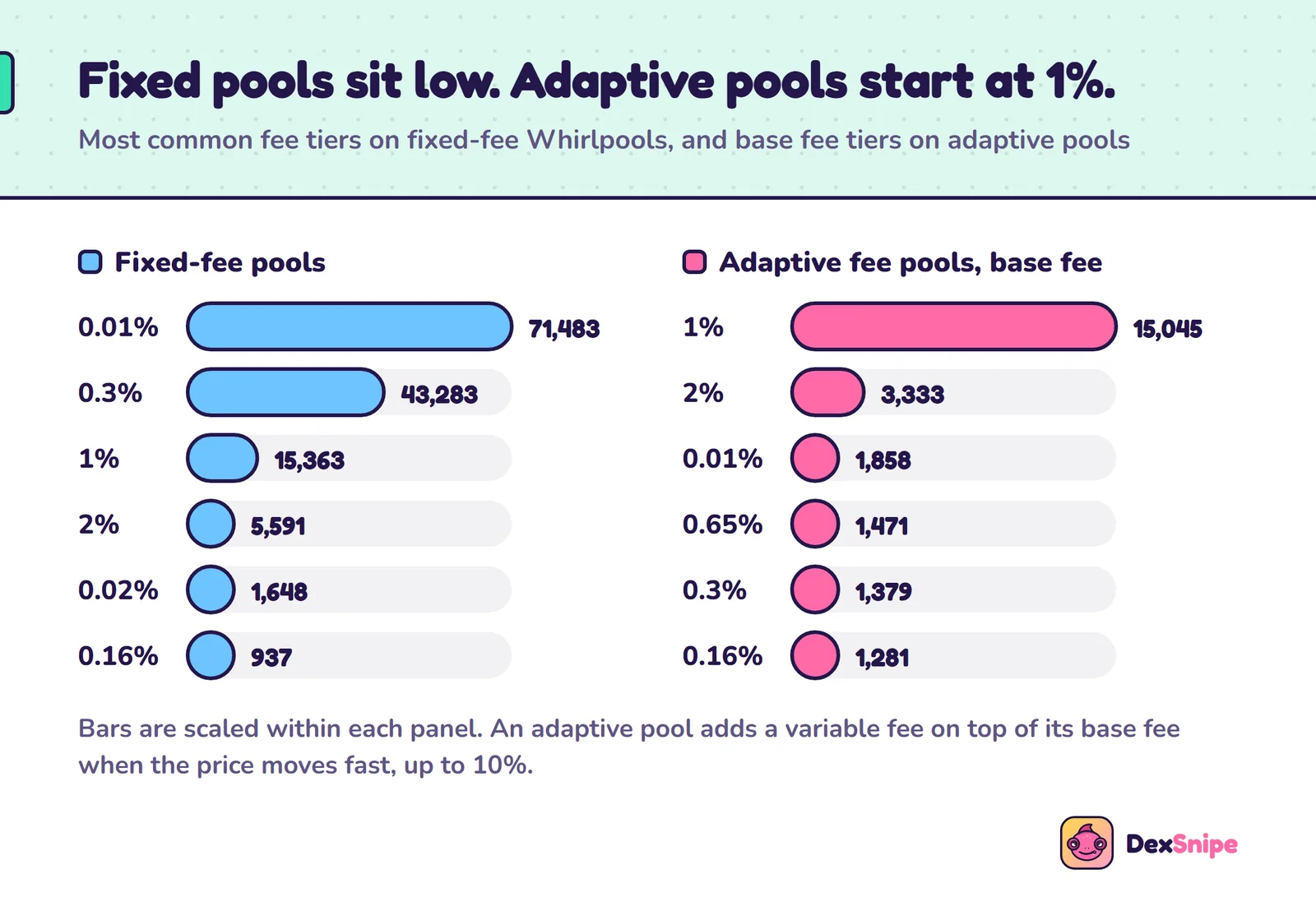
Data table
Base fee tiers on adaptive pools
| Base fee | Pools |
|---|---|
| 1% | 15,045 |
| 2% | 3,333 |
| 0.01% | 1,858 |
| 0.65% | 1,471 |
| 0.3% | 1,379 |
| 0.16% | 1,281 |
How an adaptive fee works
Orca's docs put it simply: the effective fee in an adaptive pool may be higher than the base fee when price movement increases, and closer to the base fee when things are calm. The program is more precise, and the precision is what a sniper needs.
Each oracle keeps a running measure of volatility, called the volatility accumulator. When a swap moves the price across tick groups, the accumulator grows. The adaptive part of the fee is proportional to the square of that number, scaled by a control factor set when the pool was created. The base fee and the adaptive part are added, and the total is capped at 10%.
Three timers in the oracle decide how fast the fee comes back down. On almost every adaptive pool we read, they are set the same way:
- Filter period, 30 seconds. Swaps within 30 seconds of the last reference update build on the same volatility. A burst of buys keeps stacking.
- Decay period, 600 seconds. Between 30 seconds and ten minutes after the reference was last updated, the stored volatility is cut by the reduction factor, which is 50% on almost every pool we read.
- After ten minutes, the stored volatility resets to zero and the fee is back to base.
The steepness varies with the settings. On the most common configuration, used by 14,892 pools, almost all with a 1% base fee, the adaptive part can add far more than 9% by the time the accumulator is full, so the cap is what binds. 22,468 of the 25,674 adaptive pools have settings steep enough to reach the 10% cap; most of the rest top out between 0.7% and 7.4% of extra fee.
What this means in practice. In a quiet pool, an adaptive 1% pool charges 1%. In a pool that has just moved a long way in a few seconds, the same pool can charge 10%. The fee you pay depends on what other traders did in the last half minute.
What new pools actually charged
To see what this does to a launch, we took 76 adaptive pools paired with SOL and created in 2026, spread evenly through the year, and read their first 100 transactions. Every swap emits a trade event recording the amount in and the fees taken, so the effective fee of each trade can be read directly. We grouped the trades by time since the pool's first trade.
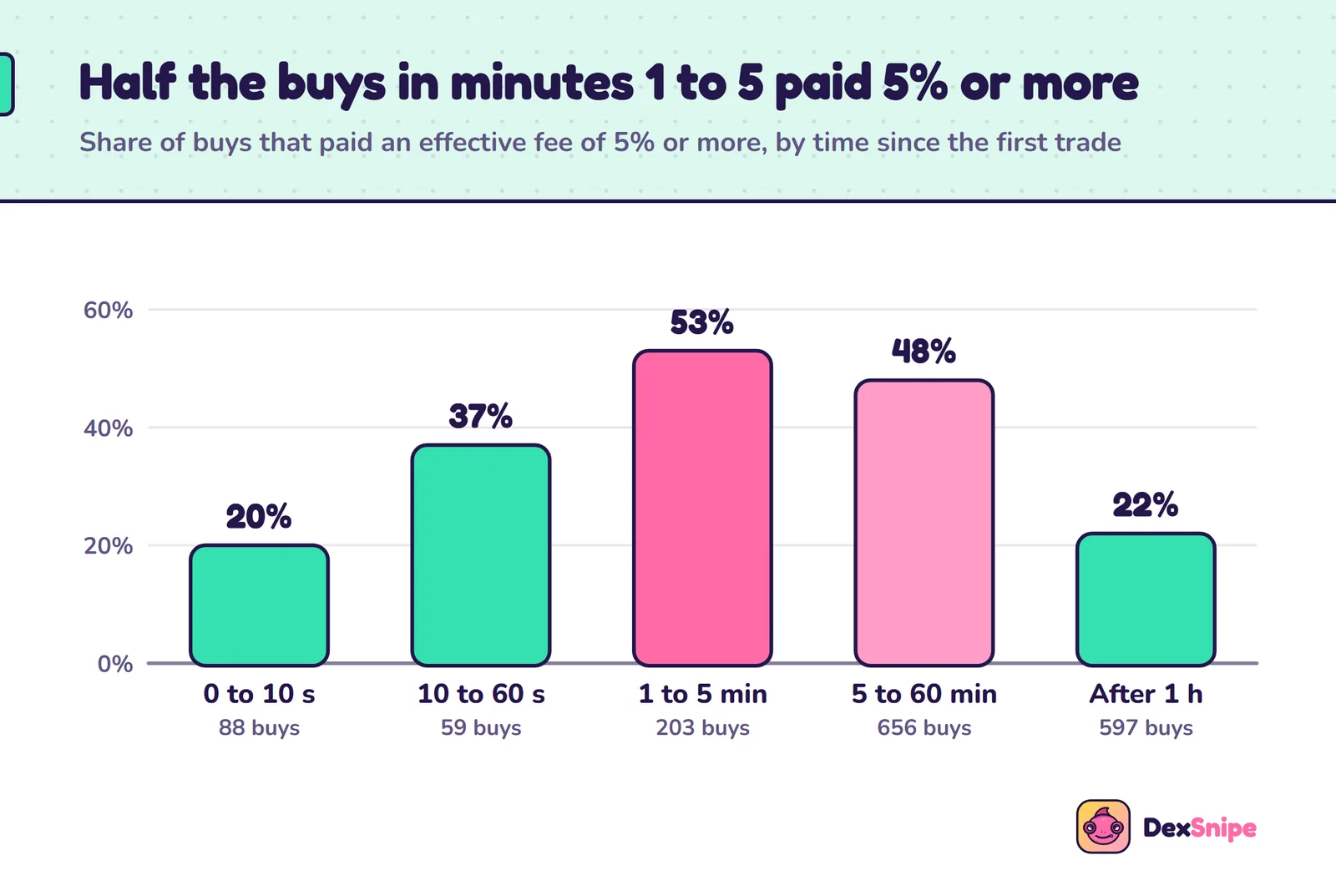
Data table
Effective fee on buys, 76 new adaptive pools
| Time since first trade | Buys | Median fee | Paid 5% or more |
|---|---|---|---|
| 0 to 10 seconds | 88 | 2.00% | 20% |
| 10 to 60 seconds | 59 | 3.05% | 37% |
| 1 to 5 minutes | 203 | 5.05% | 53% |
| 5 to 60 minutes | 656 | 4.47% | 48% |
| After an hour | 597 | 1.85% | 22% |
Most of these pools have a 1% base fee, so the median buy in minutes one to five paid about five times the base. Across all trades in that window, 29% paid the full 10%. 34 of the 76 pools charged close to 10% on at least one trade in their opening, and 49 charged 5% or more.
The fee comes back down once the opening is over. After the first hour the median buy paid 1.85%, close to the base fee plus whatever the latest move added. The expensive window is the one in which most of a launch's trading happens.
One pool, minute by minute
FOMOEYES got an adaptive splash pool on Orca on October 29, 2026, with a 1% base fee and the most common adaptive settings. Here are its first two and a half minutes of trading, with the fee each trade paid.
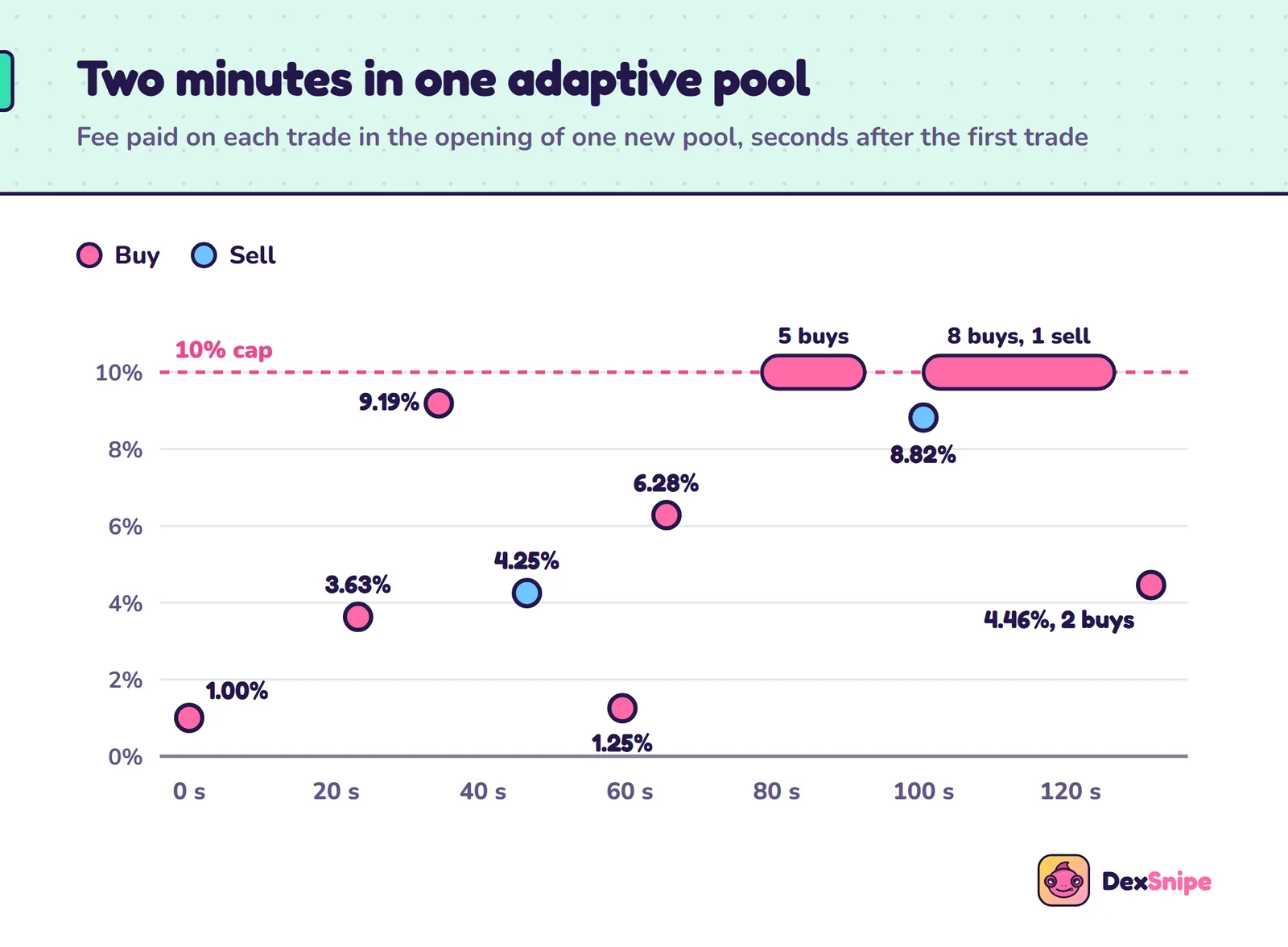
Fee paid on each trade in the first 131 seconds
Fee paid on each trade in the first 131 seconds
| Time after first trade | Trade | Fee paid |
|---|---|---|
| 0 seconds | Buy | 1.00% |
| 23 seconds | Buy | 3.63% |
| 34 seconds | Buy | 9.19% |
| 46 seconds | Sell | 4.25% |
| 59 seconds | Buy | 1.25% |
| 65 seconds | Buy | 6.28% |
| 78 to 92 seconds | Five buys | 10.00% each |
| 100 seconds | Sell | 8.82% |
| 100 to 126 seconds | Eight buys, one sell | 10.00% each |
| 131 seconds | Two buys | 4.46% |
The first buyer paid the base fee. Twenty-three seconds later the next buyer paid more than three times that, and eleven seconds after that more than nine times. A pause let the fee fall back to 1.25%, and then a wave of buys sent it to the cap, where it stayed for most of a minute. Everyone in that wave paid 10% to get in. The sellers who took profit in the middle of it paid 8.8% and 10% to get out.
Nothing in the pool's settings changed during those two minutes. The fee moved because the price did.
Why the first buyer pays least
Launch fee schedules on other venues tax speed. On Believe, a buy in the first seconds paid close to 50%, falling over a minute. On Jupiter Studio, launches with anti-sniping switched on charge 99% at first. Those schedules are written into the launch config and depend only on time.
Orca's adaptive fee depends on volatility, and a pool has no volatility until someone moves the price. The first trade into a calm pool pays the base fee, or close to it. In our sample, the 67 buys that landed in the very first second of trading paid a median of 1.5%. The fee then builds as each new buy pushes the price further, and it is the crowd that arrives after the first few seconds that pays the most.
So the adaptive fee does not punish snipers the way a launch schedule does. If anything it favours the very first buyer, who sees the cheapest fee, and then charges everyone chasing the move. That changes how a sniper should think about Orca: being first is worth more than usual, and being second or third, a few seconds later, can be much more expensive than the base fee suggests.
The fee is on your exit too
The part most Orca guides miss is that the adaptive fee applies to sells as well.
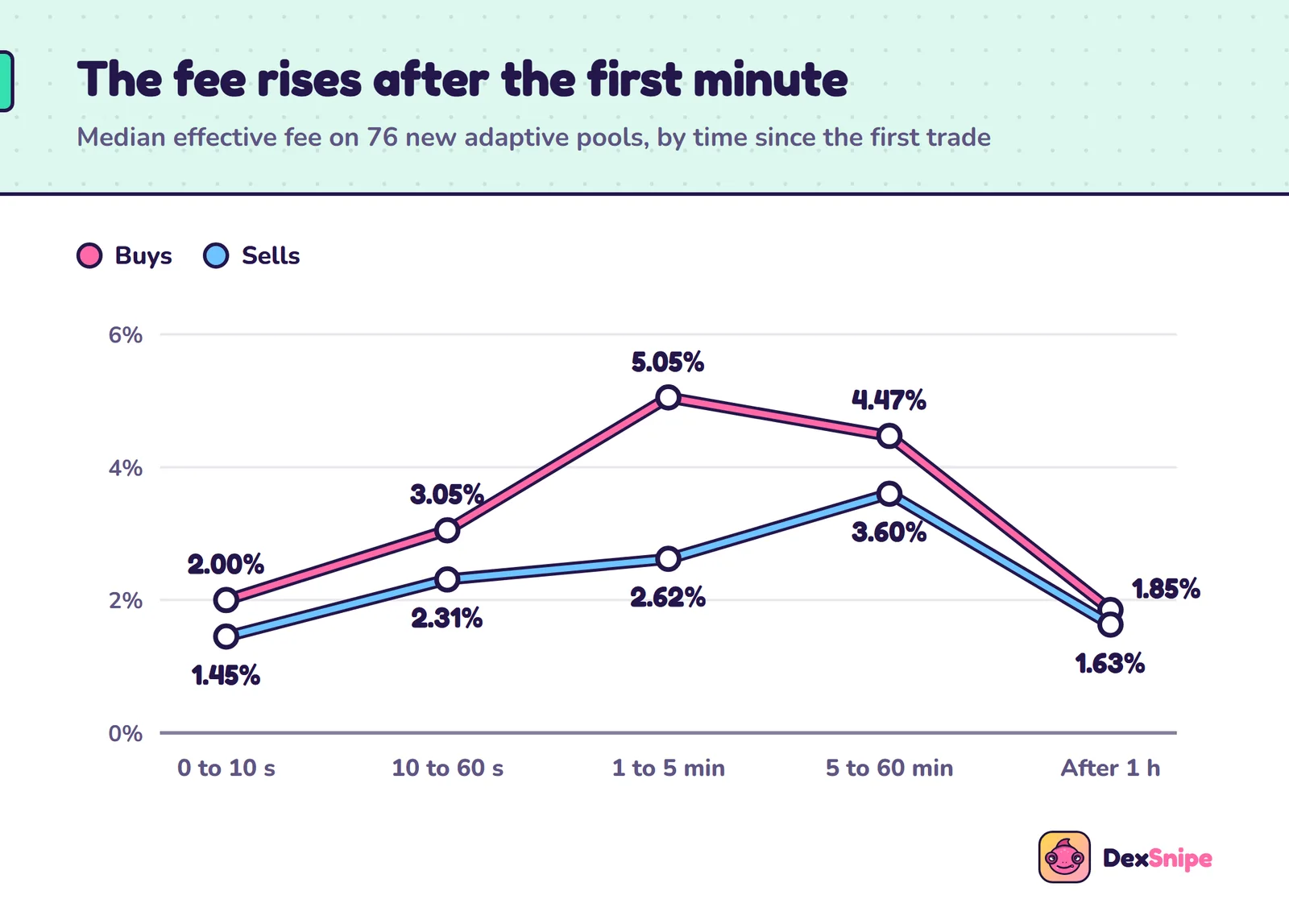
Data table
Effective fee on sells, same 76 pools
| Time since first trade | Sells | Median fee | Paid 5% or more |
|---|---|---|---|
| 0 to 10 seconds | 45 | 1.45% | 13% |
| 10 to 60 seconds | 46 | 2.31% | 28% |
| 1 to 5 minutes | 104 | 2.62% | 38% |
| 5 to 60 minutes | 297 | 3.60% | 42% |
| After an hour | 496 | 1.63% | 20% |
A sniper buys early and sells into strength. Strength is a fast-moving price, and a fast-moving price is exactly when an adaptive pool charges the most. A take-profit at +30% that fires in the middle of a wave of buys can pay close to 10% on the way out, turning a 30% gain into something nearer 15% once the buy fee is counted as well.
There are two practical answers. One is to set take-profit targets high enough that a 10% exit fee still leaves a gain worth having. The other is to use a trailing stop, which sells after the move has peaked and the price has started to fall back. A falling price still moves ticks, so the fee does not vanish, but the trailing exit tends to fire after the fastest part of the move, when the accumulator has had time to start decaying.
Splash pools and memecoins
Orca has a pool type built for token launches: the splash pool. It is a full-range Whirlpool, with a tick spacing of 32896 and a 1% fee tier, so liquidity providers do not have to choose a range and the pool behaves like a classic constant product pool. Orca's developer docs list it as best for token launches and passive liquidity providers.
15,639 Whirlpools are splash pools, and 8,367 of them use adaptive fees. FOMOEYES, in the example above, is one. For a sniper, a splash pool has two useful properties. Its liquidity is spread over every price, so a buy cannot run out of liquidity at the edge of a narrow range. And its depth is easy to judge: the SOL in the pool is the SOL you are trading against.
Concentrated pools are less predictable. A new pool with liquidity in a narrow range can look deep at the current price and then thin out a few percent higher, so a large buy moves much further than the pool's total liquidity suggests. On a concentrated pool, a tighter slippage cap matters more.
How new pools appear
A Whirlpool is created empty. To see what happens next, we read the first transactions of 80 adaptive SOL pools created in 2026.
| Measure | Value |
|---|---|
| Liquidity added in the creation transaction | 0 of 80 |
| Swap in the creation transaction | 0 of 80 |
| Median first swap after creation | about 1 minute |
| Fastest 10% of first swaps | within 5 seconds |
| Slowest 10% of first swaps | about an hour or more |
| Different creator wallets | 68 |
| Pools created by the busiest wallet | 9 |
Every pool was created in one transaction and funded in a later one. The creation transaction sets up the pool and a few tick arrays, and that is all. A sniper that fires on pool creation alone would be trying to buy into an empty pool.
This is why the minimum liquidity filter matters on Orca more than anywhere else. DexSnipe's New pool trigger waits for a pool to hold at least the liquidity you set before it buys. On Orca, that is the difference between buying the moment trading opens and buying nothing.
The creator wallets are worth a look too. 68 wallets created the 80 pools, and one created nine. A wallet that creates pools for coin after coin is often a launch service or a market maker, and its pools follow a pattern. Creator watch is how you follow one, or avoid one.
Pools that tell you when trading starts
Orca's oracle has one more field a sniper should know about: a trade enable time. If it is set, the program refuses every swap in the pool until that moment. Orca's code allows it to be up to 72 hours after creation.
85 adaptive pools have one. When we checked each pool's first transaction against its trade enable time, the gap was exactly 30 seconds on every one. 69 of the 85 are for coins whose mints end in "wave": they are graduations from Wavebreak, Orca's own launchpad, which SolanaFloor described at launch as built around anti-bot protection. 64 of them were created in July 2025 and the rest later in 2025, except one in August 2026.
For a sniper, a scheduled start is the opposite of a race. The pool exists, with its liquidity and its fee settings, a full 30 seconds before anyone can trade. Everyone who is watching knows the exact second trading opens. A bot that reads the oracle can send its buy to land at that second; a bot that does not read it will fail every attempt it makes before then.
When adaptive pools arrived
Pools do not record when they were created, so we read the first transaction of 500 adaptive pools and 500 fixed-fee pools, chosen at even intervals, and dated each one.
The earliest adaptive pool in our sample dates from May 2025. From July 2025 on, every month contributed between 22 and 40 of the 500, a steady pace that, scaled to all 25,674 adaptive pools, works out to somewhere between about 1,100 and 2,000 new adaptive pools a month. There was no launch spike and no fade: adaptive pools became a normal way to open a pool on Orca and stayed that way.
Fixed-fee pools are still created too, and in larger numbers. In the fixed-fee sample, each month of 2026 accounted for between 13 and 64 of the 500, which scaled to all fixed-fee pools means thousands a month. A sniper on Orca therefore sees both kinds side by side, and should not assume either. The only reliable way to know which one a new pool is, is to check whether it has an oracle.
The mix matters most for memecoins. Pools for coins with the pump suffix lean adaptive, 5,466 against 3,375, and the creators of those pools are often the same launch services and market makers week after week. If your Orca sniper mostly buys launchpad coins, most of its fills will be in pools whose fee moves.
Five mistakes Orca snipers make
- Reading the fee tier as the fee. On an adaptive pool, the tier is the floor. In our sample, the median buy between one and five minutes paid five times the base.
- Firing on pool creation. New Whirlpools start empty. Without a minimum liquidity filter, the sniper tries to buy into nothing.
- Chasing the second wave. The first seconds are cheap; the wave that follows is the most expensive time to buy on an adaptive pool. A sniper that misses the open is often better off skipping the pool than buying into the rush.
- Setting take-profits for fixed fees. A +20% target that works on a 0.3% pool can come out flat on an adaptive pool once both fees are paid during a fast move.
- Ignoring the trade enable time. On scheduled pools, every attempt before the start fails and costs network fees. The start time is on chain; read it.
None of these is a reason to avoid Orca. Each is a reason to read the pool before the sniper fires. Orca publishes everything a bot needs to price a trade properly; the snipers that do well on it are the ones that use it.
Reading an Orca pool before you buy
An Orca pool tells you most of what you need, if you know where to look.
- Does it have an oracle? If yes, it is an adaptive pool and the fee you pay is not the tier on the label. If no, the fee is fixed.
- The base fee and the cap. On a 1% adaptive pool, expect anything from 1% to 10%. On a 0.01% adaptive pool, the extra is usually smaller.
- The current volatility. The oracle stores the accumulator. A high value means the next trade, yours included, pays more.
- The trade enable time. If it is set and in the future, trading has not started. Time the buy to it.
- The liquidity shape. Splash pool or concentrated? Full range is easy to read; a narrow range can thin out quickly.
- The coin itself. Orca pools are created for coins from every launchpad. The coin still needs its own checks: creator holdings, top holders, mint and freeze authority, and any Token-2022 transfer fee.
What this data does not tell you
- The fee findings come from a sample. 76 adaptive SOL pools created in 2026, first 100 transactions each. Older pools, non-SOL pairs and later trading may look different.
- Effective fees are fees over input. We divided the LP and protocol fee in each trade event by the amount in. A handful of trades with Token-2022 transfer fees or unusual routes produced odd values; we left out the ten that came out above 10%.
- Creation dates come from a sample too. Pools do not store their creation time, so we read the first transaction of 500 adaptive pools and 500 fixed-fee pools to date them.
- Coin suffixes are a shortcut. A mint ending in "pump" is almost always a Pump.fun coin, but we did not check each one.
- Wallets are not people. A wallet that creates many pools may be one person, a service or a market maker.
Filters that fit Orca
- Minimum liquidity. The most important filter on Orca. New pools start empty; a minimum keeps the sniper from firing at them.
- Dev holding cap and top 10 holder cap. An Orca pool says nothing about the coin. These checks read the coin's holders before the buy.
- Mint and freeze checks. Orca pools are created for any token. A coin with an active mint or freeze authority is skipped.
- Maximum tax. Many new coins are Token-2022 mints. A tax cap reads the transfer fee and skips coins that charge one above your limit.
- Creator watch. Follow the wallets that create pools for coins that go somewhere, and skip the ones that create pools for everything.
Orca sniper settings
Starting points for the New pool and Creator watch triggers on Orca. Adjust them to your size and patience.
| Setting | New pool | Creator watch |
|---|---|---|
| Trigger | New Whirlpools | Creator watch, one sniper per wallet |
| Minimum liquidity | 10 SOL or more | 5 SOL or more |
| Buy size | 0.1 to 0.3 SOL | 0.2 to 0.5 SOL |
| Slippage cap | 15% | 15% |
| Priority fee | 0.001 SOL | 0.001 SOL |
| Jito tip | 0.003 SOL | 0.002 SOL |
| Dev holding cap | 10% | 15% |
| Top 10 holder cap | 30% | 40% |
| Maximum tax | 0% | 0% |
| Take-profit | +60% sell 50%, +150% sell 50% | +60% sell 50%, +200% sell 50% |
| Trailing stop | 20% | 25% |
| Stop-loss | 25% | 30% |
| Timer | 60 minutes | 120 minutes |
Why the take-profits are higher
On an adaptive pool, a fast exit can pay up to 10%, on top of whatever the buy paid. A first take-profit at +30% could leave very little after both fees. Starting at +60% keeps the target clear of the worst case.
Why the tip is a little higher
On adaptive pools, the first seconds are the cheapest. That is a real reason to land early, which is not true on venues whose launch fees tax speed. A slightly higher tip is worth it here.
Leave room for the fee in the slippage cap
The adaptive fee is taken from your trade, so if the quote leaves it out, a buy that pays 10% in fees looks like a buy with 10% slippage. A 15% cap leaves room for a high-fee fill without accepting a bad price on top of it.
Take profit, stop loss and selling
Whirlpools do not hold orders, so every exit is the bot watching the price and sending a sell. DexSnipe gives each sniper up to four take-profit steps, a stop-loss, a trailing stop, a timer and a dev-sell exit, all running on the server after you close the tab.
- Count the adaptive fee in every target. On a 1% adaptive pool, plan for a round trip of anything from 2% to 20%.
- Prefer the trailing stop in fast moves. It sells after the peak, when the fee has had a chance to ease.
- Use the timer. After an hour the fee drifts back toward base, and so does the interest in most new pools.
- Keep a stop-loss. It does not save the fee, but it stops a slow bleed from becoming a large loss.
| What you see | Likely cause | What to change |
|---|---|---|
| Buys fill far below the quoted size | Adaptive fee was high at fill | Buy earlier or skip pools mid-move |
| Profitable exits come out flat | Sold into a high-fee wave | Raise take-profits, add a trailing stop |
| Sniper fires but nothing fills | Pool created empty or not yet tradable | Raise minimum liquidity, check trade enable time |
| Large buys move price far more than expected | Narrow concentrated range | Lower buy size or prefer splash pools |
Choosing an Orca sniper bot
- Does it read Whirlpools directly? A bot that only watches launchpads will miss the pools created for coins after they leave the curve.
- Does it wait for liquidity? New Whirlpools start empty.
- Does it check the coin, not just the pool? Dev holdings, top holders, mint and freeze authority and transfer fees.
- Does it have a trailing stop for exits in pools whose fee rises with the move?
- Do exits run on a server when you are offline?
- Is the price flat? On a venue where the pool fee can already reach 10%, a bot that adds its own cut to every trade makes it worse.
Orca in DexSnipe
DexSnipe supports Orca Whirlpools with three triggers: New pool, Creator watch and Copy trade. A Creator watch or Copy trade sniper can cover Orca together with any of the other venues, including Pump.fun, LetsBonk, LaunchLab, Bags, Believe, Boop, Jupiter Studio and Heaven, plus pools on PumpSwap, Raydium and Meteora. Every sniper has a minimum liquidity filter, a dev holding cap, a top 10 holder cap, mint and freeze checks, a maximum tax check and a word blocklist, and up to four take-profit steps with a stop-loss, trailing stop, timer and dev-sell exit. The price is a flat plan from 1 SOL for 7 days with no cut of your trades.
Set up an Orca sniper in DexSnipe
- Open the panel and click New sniper. Choose New pool or Creator watch.
- Tick Orca, and any other venue that supports the same trigger.
- Set the minimum liquidity so the sniper ignores empty pools.
- Set the buy: size, a 15% slippage cap, priority fee and tip.
- Set the filters and exits: dev holding cap, top 10 cap, maximum tax, take-profits from +60%, a trailing stop, a stop-loss and a timer.
- Connect your wallet and save. Snipers are stored on your wallet address.
- Pick a plan, add a sniper wallet and arm it. Send 1, 3 or 5 SOL to the reserved address, add the key of a separate funded wallet, arm the sniper and close the tab.
Trade only what you can lose. Most new coins lose value, and on adaptive pools the fee can take a large share of a fast trade. This page is not financial advice.
Orca sniper bot questions
What is an Orca sniper bot?
+
A bot that watches Orca's Whirlpools program for new pools and buys the moment one opens with liquidity, then sells on rules you set. It can also follow chosen wallets and buy only the pools they create.
What is an Orca adaptive fee pool?
+
A Whirlpool whose trading fee has two parts: a fixed base fee and an adaptive part that rises when the price moves fast. On chain, each one has an oracle account that stores the adaptive fee settings and the pool's current volatility. 25,674 of the 167,036 Whirlpools we read are adaptive.
How high can an Orca adaptive fee go?
+
Orca's program caps the total fee at 10%. On 22,468 of the 25,674 adaptive pools, the adaptive settings are steep enough to reach that cap. In the opening trades of 76 new adaptive pools we measured, 34 pools charged close to 10% on at least one trade.
Do snipers pay the highest fee on Orca?
+
Usually not the very first buyer. The adaptive fee rises with price movement, so the first trades in a calm pool pay close to the base fee. In our sample, buys in the first ten seconds paid a median of 2.0%, while buys between one and five minutes paid a median of 5.05%. The fee lands hardest on the crowd that follows, and on anyone selling into a fast move.
What is an Orca splash pool?
+
A full-range Whirlpool with a 1% fee tier and a tick spacing of 32896, which Orca recommends for token launches. 15,639 Whirlpools are splash pools, and 8,367 of them use adaptive fees.
Can I see when trading starts on an Orca pool?
+
On some. An adaptive pool's oracle can hold a trade enable time, and the program refuses swaps before it. 85 pools have one set, most of them Wavebreak graduations, and on every one trading opened exactly 30 seconds after the pool was created.
How soon do new Orca pools start trading?
+
In 80 adaptive SOL pools created in 2026, none received liquidity or a swap in the transaction that created it. The median first swap came about a minute after creation; a tenth traded within five seconds and a tenth waited close to an hour.
Does DexSnipe take a fee on Orca trades?
+
No. DexSnipe is a flat plan: 1 SOL for 7 days, 3 SOL for 30 days or 5 SOL for 90 days. You pay the network fee, your priority fee and tip, and the pool's own trading fee, which on adaptive pools can change from one trade to the next.
Sources and method
On November 6, 2026 we listed every Whirlpool account and every oracle account of the Whirlpools program. From each pool we read the config, tick spacing, fee tier, liquidity and token mints; from each oracle, the pool it belongs to, the trade enable time, the adaptive fee settings and the current volatility. The oracle layout and the fee formula come from Orca's open-source program on GitHub. The maximum adaptive fee for each pool was computed from its settings with that formula and capped at the program's 10% limit.
To date pools, we read the first transaction of 500 adaptive and 500 fixed-fee pools chosen at even intervals. For fees, we read the first 100 transactions of 76 adaptive SOL pools created in 2026 and decoded the trade event of every successful swap: amount in, LP fee and protocol fee. Buy or sell was decided from the swap direction and which side of the pool is SOL. For creation, we read the first 12 transactions of 80 adaptive SOL pools from 2026. Trade enable times were checked against each of the 85 pools' first transaction. DexSnipe triggers, filters and exits are taken from the product itself.
- Orca docs: Adaptive Fee PoolsThe base fee and adaptive fee, and how price movement across tick groups raises the adaptive part.
- Orca docs: Understanding Whirlpool feesHow swap fees are calculated and split.
- Orca docs: Ticks, tick spacing and fee tiersFee tiers, tick spacing and adaptive fee pools.
- Orca developer docs indexFee tiers by tick spacing, and splash pools as full-range 1% pools for token launches.
- Orca docs: Trading feesHow trading fees are charged and distributed.
- Whirlpools fee rate manager on GitHubThe adaptive fee formula and the 10% hard limit on the total fee.
- Whirlpools oracle account on GitHubThe oracle layout we decoded, the trade enable time and its 72 hour maximum.
- Whirlpools program on SolscanThe program whose 167,036 pools and 25,674 oracles we read.
- FOMOEYES pool on SolscanThe adaptive splash pool in the worked example.
- FOMOEYES pool creation on SolscanOctober 29, 2026.
- SolanaFloor: Orca joins launchpad wars with WavebreakWavebreak's anti-bot design and graduation into Whirlpools.
One sniper, every venue
Build your snipers for free, then a plan from 1 SOL switches them on. No cut of your trades.