Pump.fun Sniper Bot
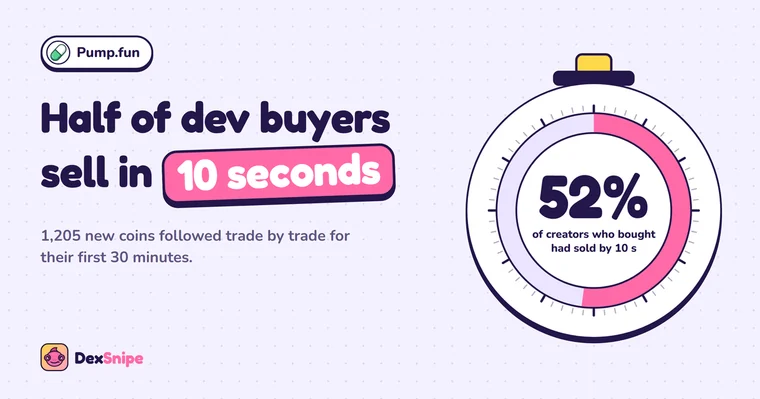
Every Pump.fun sniper guide tells you to watch the dev. We wanted to know how long you actually get. We picked 1,205 coins at random from two hours of launches on November 5, 2026 and followed every trade on their curves for 30 minutes. Of the creators who bought their own coin at launch, half had sold within 10 seconds, most of them in a single sell. The clock is faster than any exit, and the coins where it runs fastest are exactly the ones a naive sniper is drawn to.
The short version
- The dev sell comes in seconds, not minutes. 43% of creators holding tokens after launch had sold within 5 seconds, 52% within 10, and 85% within 30 minutes.
- A big dev buy is inventory, not commitment. Creators who bought 2 SOL or more sold fastest, and the 2 to 5 SOL group came out ahead most often.
- Those coins are also where the bots are. A median of 948 failed transactions hit them in their first 16 seconds. Coins with no dev buy saw none.
- Early buyers did best where the creator bought nothing. 62.5% of them were in profit, against 44% across all coins.
What a Pump.fun sniper bot does
A new Pump.fun coin starts on a bonding curve: a fixed formula that sells tokens for SOL, cheaper for the first buyers and dearer for each one after. A sniper bot watches for new coins and buys in the first blocks, before the price has moved, then sells on rules you set. Some snipers also buy at graduation, when the curve fills and the coin moves to PumpSwap; that side has its own guide.
The usual advice for launch sniping is simple: buy early, watch the creator, and get out if they sell. Almost every bot offers a dev-sell exit for exactly that reason. The advice assumes the creator's sell is something that happens after you are in, with enough time for your bot to see it and react. That assumption is what we tested.
1,205 coins, followed for 30 minutes
Every new Pump.fun coin is minted through the same mint authority account, so its transaction history is a list of every launch. We took 1,205 coin creations spread across two hours on the afternoon of November 5, 2026. For each one we read the creation transaction, the creator's own buy, and every trade on the curve for the next 30 minutes. A day later we read each curve again to see which had graduated.
| Group | Coins | Share |
|---|---|---|
| Paired with SOL, ordinary | 523 | 43% |
| Paired with SOL, Mayhem Mode | 293 | 24% |
| Paired with another asset | 389 | 32% |
| All coins | 1,205 | 100% |
A third of new coins are no longer priced in SOL at all. They are paired with one of 56 other assets, from USDC and Pump.fun's own PUMP token to tokenized stocks, and their prices move with that asset as well as with the coin. Mayhem coins, which come with an automated trading agent, behave so differently that we treat them on their own further down. The core of this study is the 523 ordinary SOL-paired coins.
How much creators buy at launch
On Pump.fun the creator can buy their own coin in the same transaction that creates it, before anyone else can trade. That first buy is at the very bottom of the curve, so it is the cheapest position anyone will ever get.
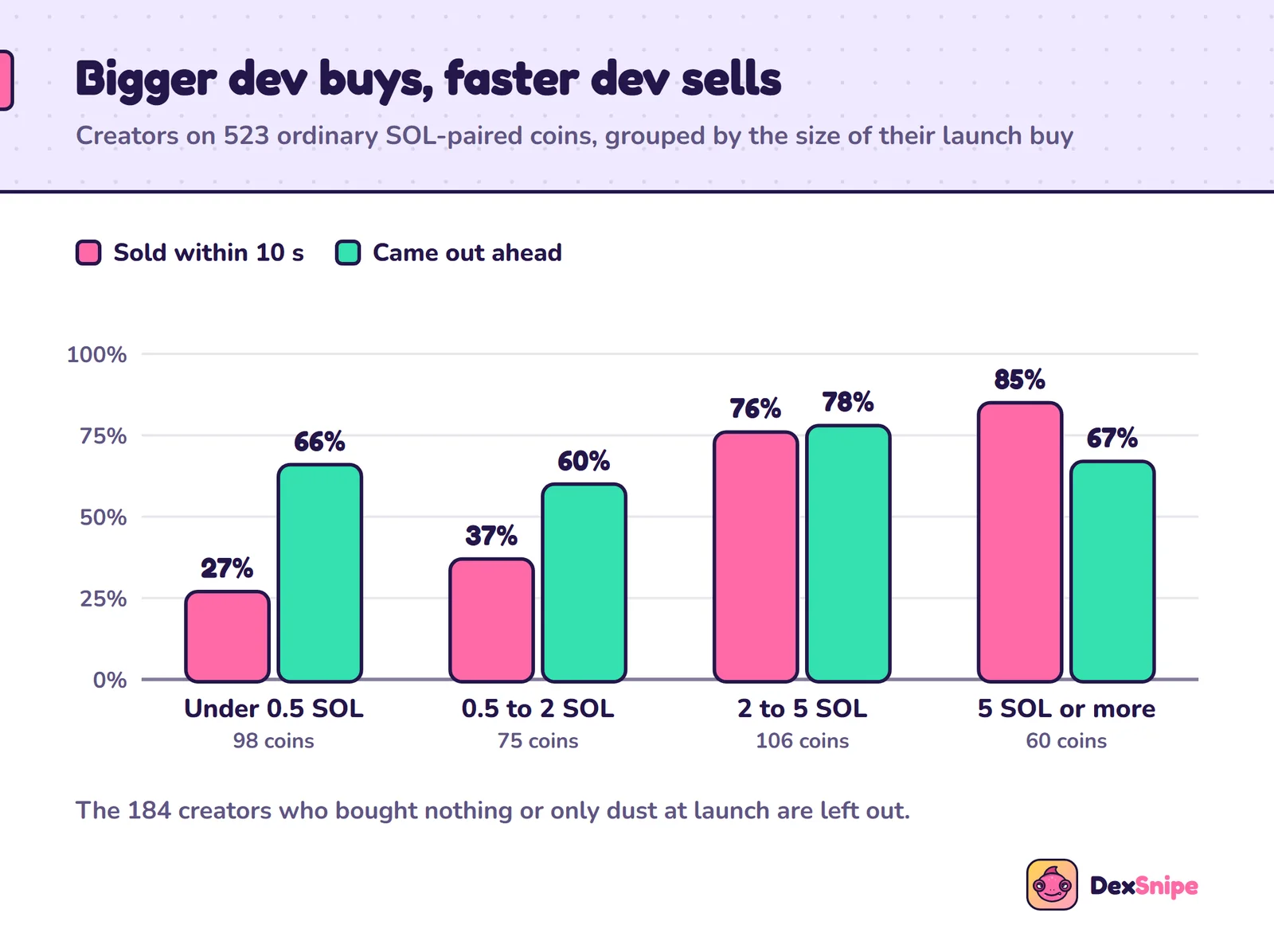
Data table
Creator buys at launch, 523 ordinary SOL-paired coins
| Creator's launch buy | Coins | Sold within 10 s | Came out ahead |
|---|---|---|---|
| Nothing or dust | 184 | ||
| Under 0.5 SOL | 98 | 27% | 66% |
| 0.5 to 2 SOL | 75 | 37% | 60% |
| 2 to 5 SOL | 106 | 76% | 78% |
| 5 SOL or more | 60 | 85% | 67% |
184 creators, 35%, bought nothing or only dust, under 0.003 SOL. The median buy was 0.30 SOL, a quarter bought about 3 SOL or more, and 60 bought 5 SOL or more. Measured in supply, the median creator who held tokens had 4.7% of the coin, and a quarter had more than 12.5%.
The last two columns are the point of this article. Read down them and the pattern is plain: the more a creator buys at launch, the faster they sell, and the 2 to 5 SOL buyers came out ahead most often, 78% of the time. "Came out ahead" means the creator took more SOL out of the curve in the first 30 minutes than they put in, before fees and before any creator fees they earn.
The dev sell clock
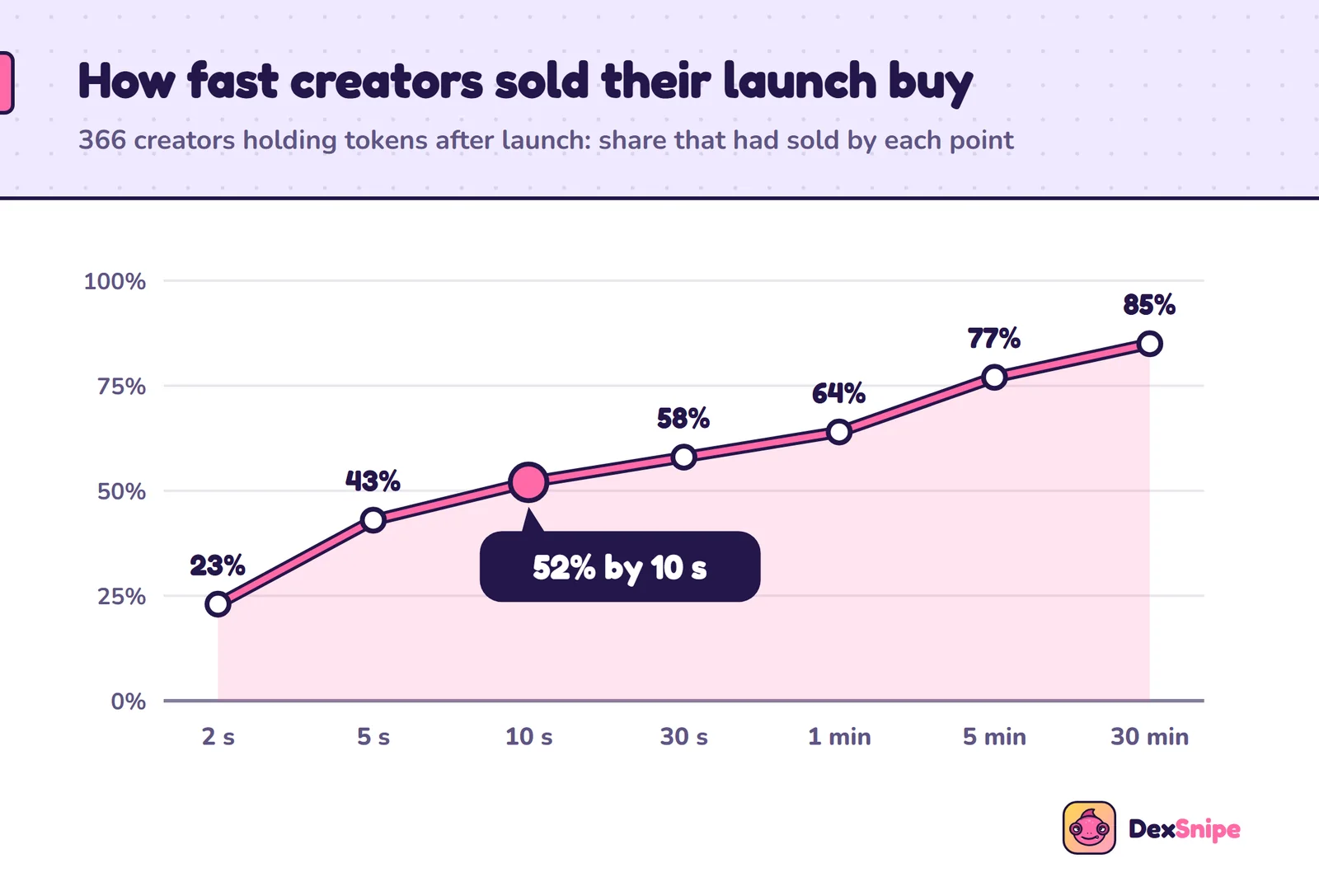
For the 366 ordinary coins where the creator ended the launch transaction holding tokens, we recorded the first moment those tokens went down, by a sell or by a transfer to another wallet.
Data table
Time from launch to the creator's first sell, 366 creators holding tokens
| Creator had sold | Creators | Share |
|---|---|---|
| Within 2 seconds | 84 | 23% |
| Within 5 seconds | 158 | 43% |
| Within 10 seconds | 190 | 52% |
| Within 30 seconds | 214 | 58% |
| Within 1 minute | 233 | 64% |
| Within 5 minutes | 281 | 77% |
| Within 30 minutes | 311 | 85% |
The median creator who sold did it 5 seconds after launch. 84 sold within 2 seconds, which on Solana is about nine blocks. And they did not sell a little: 290 of the 366 had sold their entire position within 30 minutes, at a median of 9 seconds after launch. Only 4 moved tokens to another wallet before selling; the rest sold straight back into the curve.
What this means for a dev-sell exit. An exit reacts to a sell that has already landed. When the sell comes 5 seconds after launch, your bot sees it at the same moment as every other bot, and the price you get is the price after the dump. The protection has to come before the buy, from a filter, not after it.
One coin, second by second
Here is a typical one from the sample, picked because it is ordinary, not extreme.
- 16:00:25. A wallet creates the coin and, in the same transaction, buys 2.96 SOL of it: 96.4 million tokens, 9.6% of the supply.
- The same block. Three other wallets buy between 0.89 and 0.99 SOL each.
- 16:00:30. The creator sells all 96.4 million tokens for 3.44 SOL, a gain of about 0.48 SOL, or 16%, in five seconds.
- The first 16 seconds. 452 transactions reach the curve. 444 of them fail.
Nothing about this is hidden. The creator's buy, the three same-block buyers and the sell are all on chain within seconds. But a sniper that bought in that window, attracted by a creator who "put 3 SOL in", was the exit for that 3 SOL.
Why the flip works: the curve arithmetic
A bonding curve is a closed box. Every SOL that comes out of it went in from somebody's buy, so when a creator walks away with more SOL than they paid, the difference was paid by the people who bought after them, less the fees the curve kept.
The Pump program README gives the starting point: the curve opens with 1.073 billion virtual tokens, of which 793.1 million are real tokens for sale. Price is the ratio of SOL to tokens in the curve's reserves, so every buy lifts it and every sell lowers it. The first buyer, who is always the creator when there is a launch buy, gets the lowest price the coin will ever have.
Run the example coin through it. The creator put in 2.96 SOL. In the same block three other wallets put in 2.87 SOL between them, which pushed the price up. Five seconds later the creator sold all 96.4 million tokens back and took out 3.44 SOL. Of the SOL those three buyers had paid, roughly half a SOL was now in the creator's wallet, and the three buyers were holding tokens worth less than they paid for them, at a price the creator had just pushed back down.
Nothing about this needs a trick. It is how the curve works, and it is why the size of the launch buy matters so much. The bigger the creator's position, the more SOL it can pull out of the curve on a small lift, and the more any buyer in the next few seconds is simply the other side of that trade.
Why a dev-sell exit fires too late
A dev-sell exit works by watching for the creator's sell and then sending one of its own. That chain has steps: the sell has to land in a block, your bot has to see it, build a transaction and get it into a later block. On Solana, a block comes about every 0.2 seconds, so even a fast bot is a slot or more behind, and every other bot with the same exit is selling in the same slot. When the creator sells 5 seconds after launch, you are selling at the bottom of their sell along with everyone else who reacted.
Launch and flip is a business
Look again at the 2 to 5 SOL row. 106 creators bought that much at launch; 81 sold within 10 seconds and 102 within 30 minutes. 83 of them came out ahead, and the median creator in that group made about 0.48 SOL per coin. Repeat that a few dozen times a day and it is a living.
The mechanics explain why it works. The creator buys first, at the bottom of the curve. Anyone who buys after them, whether a person or a bot, lifts the price. The creator then sells into that lift. They do not need the coin to succeed; they need a few buyers in the first seconds, and a visible dev buy is what attracts them. On Pump.fun's standard curve, a 3 SOL launch buy takes about a tenth of the supply, which on a token list reads as a creator with skin in the game.
The 5 SOL and up group sold even faster, 51 of 60 within 10 seconds, but fewer of them came out ahead, 40 of 60, and taken together they lost money. Bigger positions need more buyers to sell into, and on most coins those buyers never came.
Creators who bought nothing
The other end of the table behaves differently. Of 184 creators who bought nothing at launch, only 13 sold anything in the first 30 minutes, since they had nothing to sell unless they bought later. These coins had no cheap creator position sitting on top of every buyer.
The failed transaction storm
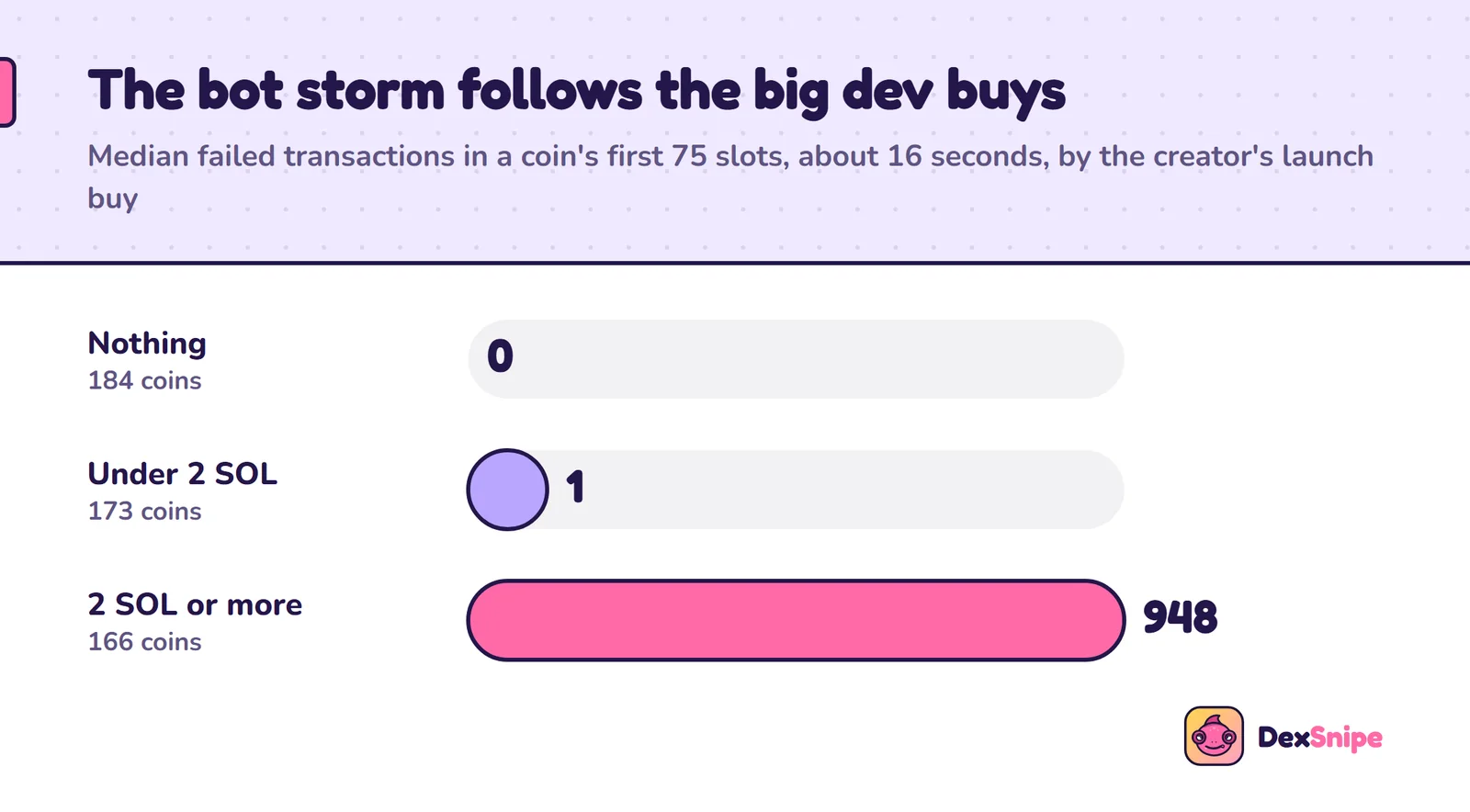
When we pulled the full history of the example coin, 444 of the 452 transactions in its first 75 slots, about 16 seconds, had failed. So we counted failed transactions in the first 75 slots of all 523 ordinary coins.
Data table
Failed transactions in a coin's first 75 slots, about 16 seconds
| Creator's launch buy | Coins | Median failed |
|---|---|---|
| Nothing | 184 | 0 |
| Under 2 SOL | 173 | 1 |
| 2 SOL or more | 166 | 948 |
Across the 523 coins, 151,044 of 160,320 transactions in the first 75 slots failed, and almost all of those failures were on coins with a big creator buy. On the 2 SOL and up coins, one in ten saw 977 failures or more; our count stops at 1,000 per coin, so the real top end is higher. They come from a small crowd of bots: on each busy coin, between 4 and 19 wallets sent the failures, and the same wallets turn up coin after coin. Failing costs a bot very little, so it keeps trying until its conditions are met.
Two lessons follow. First, a big dev buy is a signal, and a crowd of automated buyers is already watching for it; competing in that crowd means paying for priority against bots that try hundreds of times. Second, if your sniper fires on the same signal, its buys are landing among those hundreds of attempts, right where the creator is selling.
What early buyers got
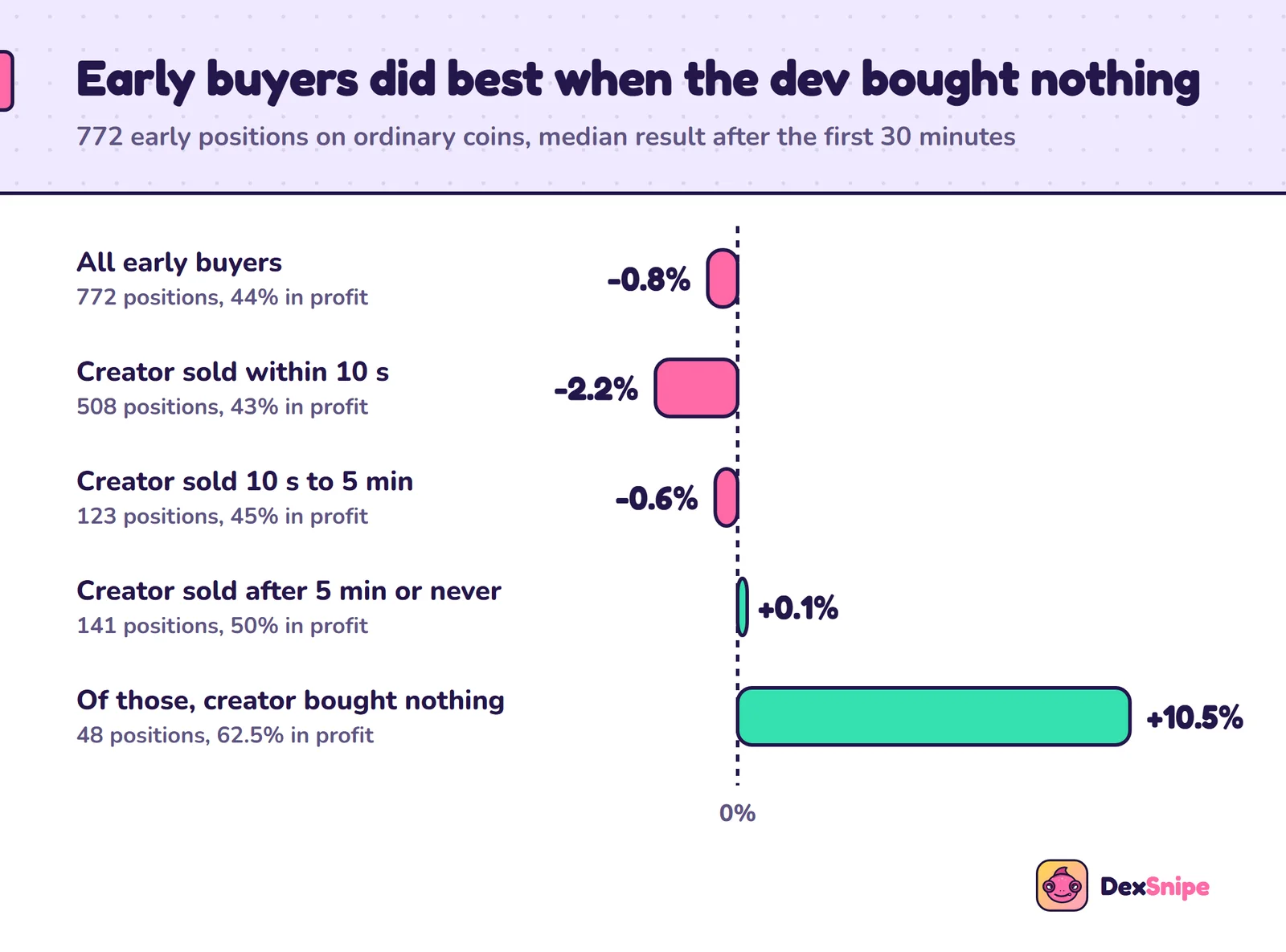
We took every buy of 0.01 to 5 SOL in the first three slots of each ordinary coin, other than the creator's own, and followed it through the 30-minute window. Sells were counted at the SOL they returned; anything still held at the end was valued at the last curve price. These are results before network fees and tips.
Data table
772 early positions on ordinary Pump.fun coins, first 30 minutes
| Group | Positions | In profit | Median |
|---|---|---|---|
| All early buyers | 772 | 44% | -0.8% |
| Creator sold within 10 s | 508 | 43% | -2.2% |
| Creator sold 10 s to 5 min | 123 | 45% | -0.6% |
| Creator sold after 5 min or never | 141 | 50% | +0.1% |
| Of those, creator bought nothing | 48 | 62.5% | +10.5% |
Across all coins, the median early buyer finished slightly down, and only 2.3% doubled their money within 30 minutes. That is the honest baseline for launch sniping on Pump.fun: a coin flip with a small house edge against you, before costs.
The groups pull apart in the direction the clock predicts. Where the creator sold within 10 seconds, early buyers did worst. Where the creator bought nothing, they did clearly best: 62.5% in profit and a median of +10.5%. The sample is smaller there, 48 positions, but it is the one group in the table with a real positive edge, and it is the group a sniper drawn to big dev buys never sees.
Bundles point the same way. On 202 of the 523 coins, 39%, other wallets bought in the creator's own launch block. Early buyers on coins without such a bundle were in profit 50.7% of the time, against 43.8% on bundled coins. The unbundled group is small, 75 positions, so read it as a direction rather than a precise edge.
Timing inside the window matters less than people think. Buyers in the creation block itself were in profit 46% of the time; those who landed one or two slots later, 40.8%, with a median of -0.9%. Being first is not the edge. Being on the right coin is.
One caution on the launch-block numbers. Some of the wallets that buy in the creator's own block are almost certainly the creator's, which is how a creator spreads a position across wallets. We cannot tell from the chain alone which ones, so those positions are counted as early buyers like any other.
The coins that graduated
When we checked a day later, 8 of the 523 ordinary coins had graduated, about 1.5%, in the same range as the weekly rates reported from Dune data earlier in 2026. That is too few to build statistics on, but one detail stood out.
In 7 of the 8, the creator had sold nothing in the first 30 minutes. Two of them never bought at all, and one was a creator who bought the entire curve at launch for about 85 SOL, which graduates the coin on the spot, a pattern the PumpSwap guide covers in detail. Only one graduate had a creator who sold inside the first 30 minutes.
Coins that make it are, almost by definition, coins whose creator did not dump in the first seconds. A dev holding cap and a dev-sell exit do not find winners. They remove the most common way of losing.
Mayhem coins and their agent
Mayhem Mode is a Pump.fun option chosen at launch that gives a coin an automated trading agent for its first 24 hours. 293 of the 816 SOL-paired coins in our sample, 36%, were Mayhem coins, and none of them had graduated a day later.
One wallet traded every Mayhem coin we looked at and no ordinary coin. In the first 30 minutes it made 17,754 of the 26,551 curve trades on Mayhem coins, 67% of all of them. Nearly every Mayhem coin, 290 of 293, also had at least one outside buy, but on a coin where two trades in three come from an agent, volume, trade count and buyer activity say very little about demand.
For a sniper, Mayhem coins are a different game. The agent buys and sells in patterns no person chose, the price swings for reasons unrelated to interest in the coin, and when they migrate, their PumpSwap pools open with a fraction of a SOL of liquidity. If you snipe them, do it on purpose, with its own small sniper.
Coins nobody else bought
221 of the 523 ordinary coins, 42%, did not get a single outside buy of 0.01 SOL or more in their first 30 minutes. For about a third, the curve saw three trades or fewer in that time.
A sniper with no filters buys every one of them. The cost is not dramatic per coin, since a small buy on a dead curve can usually be sold back for close to what it cost, minus fees. But it is a steady drain, and it fills a bot's wallet with positions that tie up SOL while the coins that do move go past. A timer exit exists for exactly this.
What this sample does not tell you
The numbers above come from one afternoon of launches on one day. They are a snapshot of how Pump.fun behaved in November 2026, not a law, and a few limits are worth stating plainly.
- Thirty minutes is a short window. A coin that sat quiet for half an hour and took off that evening counts here as a dead coin, and an early buyer who held it counts as a small loss.
- Creator results leave out creator fees. A creator also earns a share of trading fees on their coin, so the creator side looks slightly worse here than it was.
- Buyer results are before costs. Network fees, priority fees and tips come off every trade, and on a position of 0.1 SOL they are not small.
- Some early buyers are creators in disguise. Wallets in the creator's own block may belong to the creator. We cannot separate them, so they are counted as buyers.
- Coins paired with other assets are excluded. A third of launches are priced in something other than SOL, and they behave differently enough to need their own study.
- Pump.fun changes its rules often. New instructions, Mayhem Mode and changes to how graduation works have all arrived within a year. Recheck the pattern before trusting it months from now.
None of these change the main finding. A creator who sells 5 seconds after launch has sold before most snipers could react, whatever the window or the fees.
Filters built on the clock
If the dev sell comes in seconds, the defence is a filter applied before the buy. These are the ones the data supports.
- Dev holding cap at 5%. On the standard curve a creator who buys about 1.5 SOL at launch holds around 5% of the supply. A 5% cap skips nearly all of the 2 SOL and up launches, the group that flipped fastest and drew the bot storm, while keeping every coin whose creator bought nothing.
- Skip bundled launches. Early buyers did worse on coins where other wallets bought in the creator's own block, and some of those wallets are the creator's.
- Top 10 holder cap. Catches creators who spread a position across several wallets to slip under the dev cap.
- Check the pair. A third of new coins are not priced in SOL, so their price also moves with the asset they are paired with. Targets set in SOL assume a SOL pair.
- Mayhem coins. Their volume is mostly the agent, so price moves on them say little about real demand. A short timer limits how long you sit in one.
- Blocklist words. Copycat names of whatever is trending are a large share of launch-and-flip coins.
Pump.fun sniper settings
Two snipers, two jobs. These are starting points, not promises.
| Setting | Fresh launch | Creator watch |
|---|---|---|
| Trigger | Fresh launch, Pump.fun | Creator watch, one wallet |
| Buy size | 0.05 to 0.15 SOL | 0.2 to 0.5 SOL |
| Slippage cap | 15 to 20% | 20 to 25% |
| Priority fee | 0.0005 SOL | 0.001 SOL |
| Jito tip | 0.001 SOL | 0.002 SOL |
| Dev holding cap | 5% | 10% |
| Skip bundled launches | On | On |
| Top 10 holder cap | 25% | 35% |
| Take-profit | +25% sell 50%, +80% sell 50% | +60% sell 50%, +200% sell 50% |
| Stop-loss | 25% | 30% |
| Timer | 10 minutes | 30 minutes |
| Dev-sell exit | On | On |
Why the fresh launch tip is low
The coins with the biggest crowds of fast bots are the big dev buy coins, which this sniper skips. On the coins it does buy, mostly creators with small or no launch buys, there is no storm of failed transactions to outbid. Paying for priority there buys little.
Why creator watch is different
A creator watch sniper follows one wallet you chose because of its record. It is the one case where you know in advance which launch to be first on, so a slightly higher tip makes sense, and the dev cap can be looser for a creator whose normal launch buy you have already checked. Read the LetsBonk guide for how to judge a creator's record; the method is the same on Pump.fun.
Take profit, stop loss and selling
Curves do not hold orders, so every exit is the bot watching the price and sending a sell. DexSnipe gives each sniper up to four take-profit steps, a stop-loss, a trailing stop, a timer and a dev-sell exit, all running on the server after you close the tab.
- Keep the dev-sell exit on, knowing what it can do. It will not save you from a 5 second dump; it will get you out when a creator who held for minutes finally sells.
- Take something early. Only 2.3% of early buyers doubled within 30 minutes. A first target in the tens of percent hits far more often.
- Use the timer on fresh launches. Four in ten ordinary coins got no outside buyer in 30 minutes. A timer frees the SOL.
- Leave room in the slippage cap. When a creator sells, every bot with a dev-sell exit sells into the same block, and a tight cap can make your sell fail.
| What you see | Likely cause | What to change |
|---|---|---|
| Price drops seconds after your buy | Creator flipped the launch buy | Lower the dev holding cap to 5% |
| Buys fail again and again | Competing with the bot storm on big dev buys | Skip big dev buys instead of raising the tip |
| Wallet fills with coins that never move | No outside buyers | Add a timer exit |
| Wild price swings with no news | Mayhem agent trading | Add a short timer exit |
Choosing a Pump.fun sniper bot
- Does it check the creator's holding before the buy, with a dev cap you set, rather than only reacting after a sell?
- Can it skip bundled launches and cap the top 10 holders?
- Does it run exits on a server, including a timer and a dev-sell exit, when you are not watching?
- Does it support creator watch, so you can follow wallets with a record instead of every launch?
- Is the price flat, or does it take a share of every trade? When the median early trade is close to break-even, a per-trade cut decides whether you win or lose.
Pump.fun in DexSnipe
Pump.fun is a venue for the Fresh launch, Migration, Creator watch and Copy trade triggers. Every sniper has a dev holding cap, a top 10 holder cap, a bundled launch check, mint and freeze authority checks and a word blocklist, and up to four take-profit steps with a stop-loss, trailing stop, timer and dev-sell exit. The price is a flat plan from 1 SOL for 7 days with no cut of your trades.
Set up a Pump.fun sniper in DexSnipe
- Open the panel and click New sniper. Choose Fresh launch and tick Pump.fun.
- Set the buy: a small size, a slippage cap of 15 to 20%, and a modest priority fee and tip.
- Set the filters: dev holding cap 5%, skip bundled launches on, top 10 holder cap 25%.
- Build exits: two take-profit steps, a stop-loss, a timer and dev-sell on.
- Connect your wallet and save. Snipers are stored on your wallet address.
- Pick a plan, add a sniper wallet and arm it. Send 1, 3 or 5 SOL to the reserved address, add the key of a separate funded wallet, arm the sniper and close the tab.
Trade only what you can lose. The median early buyer in our sample finished slightly down before costs. A good filter set improves the odds; it does not turn new coins into a safe trade. This page is not financial advice.
Pump.fun sniper bot questions
What is a Pump.fun sniper bot?
+
A bot that buys new Pump.fun coins in their first blocks on the bonding curve, or the moment they migrate to PumpSwap, and sells them on rules you set: take-profit steps, a stop-loss, a timer and an exit when the creator sells. It runs on its own, so it can act faster than a person clicking.
How fast do Pump.fun creators sell?
+
Very fast. We followed 1,205 coins created on November 5, 2026. Of the 366 SOL-paired, non-Mayhem coins whose creator held tokens after the launch transaction, 158 creators sold within 5 seconds, 190 within 10 seconds, 233 within a minute and 311 within 30 minutes. Most sold everything in one go.
Is a big dev buy a good sign on Pump.fun?
+
Not in our data. Creators who bought 2 to 5 SOL at launch sold within 10 seconds 76% of the time, and 78% of them came out ahead, with a median gain of about half a SOL. Early buyers did best on coins where the creator bought nothing at all: 62.5% were in profit, with a median of +10.5%.
Can a dev-sell exit protect a Pump.fun snipe?
+
Against later sells, yes. Against the fastest ones, no. Half of the creators who sold did so within about 5 seconds of launch, often before or at the same moment as the first outside buys. An exit reacts to a sell after it lands. The protection against an instant dump is a dev holding cap that skips the coin before you buy.
Why do so many transactions fail on new Pump.fun coins?
+
Bots. On coins where the creator bought 2 SOL or more, the median coin saw 948 failed transactions in its first 16 seconds, sent by a handful of wallets, often the same ones coin after coin. On coins with no creator buy, the median was zero. A big dev buy is a signal those bots react to.
How many Pump.fun coins graduate?
+
In our sample, 8 of 523 ordinary SOL-paired coins, about 1.5%, had graduated when we checked a day later, and none of the 293 SOL-paired Mayhem coins. In 7 of the 8, the creator had sold nothing in the first 30 minutes.
What are Mayhem coins on Pump.fun?
+
Coins launched with Mayhem Mode, which gives a coin an automated trading agent for its first 24 hours. They were 36% of SOL-paired launches in our sample. In their first 30 minutes, two thirds of all curve trades came from the agent's own wallet, so their volume says little about real demand.
What dev holding cap should a Pump.fun sniper use?
+
Around 5% for fresh launches. On Pump.fun's standard curve a creator who buys about 1.5 SOL at launch holds roughly 5% of the supply, so a 5% cap skips the 2 SOL and up launch buys, the group that sold fastest and drew the most bots, while keeping coins whose creator bought little or nothing.
Should I snipe Pump.fun coins paired with USDC or other assets?
+
Only on purpose. A third of new coins in our sample were priced in one of 56 assets other than SOL, from USDC to tokenized stocks. Their price moves with that asset as well as with the coin, and buying them from SOL adds a swap on the way in and out. If your targets are set in SOL, leave them out.
Does DexSnipe take a fee on Pump.fun trades?
+
No. DexSnipe is a flat plan: 1 SOL for 7 days, 3 SOL for 30 days or 5 SOL for 90 days. You pay the network fee, your own priority fee and tip, and Pump.fun's trading fees.
Sources and method
We read the transaction history of Pump.fun's mint authority account between 14:55 and 16:52 on November 5, 2026 and took 1,205 coin creations from it. For each coin we read the creation transaction to find the creator and the launch buy, then every transaction on its bonding curve for the following 30 minutes. A trade's size is the change in the curve's SOL balance and token balance; the creator's position is the change in tokens held by the creator's wallet. A day later we read each curve account for its Mayhem flag, quote asset and complete flag.
"Came out ahead" for a creator compares SOL taken out of the curve with SOL put in during the 30 minutes, excluding the creation cost and any creator fees. Early buyers are wallets other than the creator that bought 0.01 to 5 SOL in the first three slots; holdings left at 30 minutes are valued at the last curve price. Failed transactions were counted from each curve's history for its first 75 slots, about 16 seconds, up to 1,000 per coin. Results exclude network fees, priority fees and tips. DexSnipe triggers, filters and exits are taken from the product itself.
- Pump program README (Pump public docs)The bonding curve, its starting virtual reserves and the curve account fields.
- Coin creation accounts (Pump public docs)The create_v2 instruction, its mint authority and the user who signs and pays.
- Pump program IDL (Pump public docs)The BondingCurve layout we decoded, including the Mayhem flag, the quote asset and the complete flag.
- Pump program on SolscanProgram 6EF8rrecthR5Dkzon8Nwu78hRvfCKubJ14M5uBEwF6P, whose curve accounts we read.
- Pump mint authority on SolscanAn account in every coin creation. We sampled its history to pick new coins at random.
- The example coin, on SolscanCreated November 5, 2026 with a 2.96 SOL creator buy.
- Its creation transaction, on SolscanCreateV2 and the creator's buy in one transaction.
- The creator's sell, five seconds later, on SolscanAll 96.4 million tokens sold for 3.44 SOL.
- The Mayhem agent wallet, on SolscanTraded only Mayhem coins in our sample, and made 67% of their curve trades.
- SolanaFloor: Pump.fun unleashes Mayhem ModeNovember 13, 2025. Mayhem Mode attaches an automated trading agent to a new coin for its first 24 hours.
- KuCoin News: Pump.fun graduation rate reaches 2.01%Weekly graduation rate of 2.01% for March 9 to 15, 2026, based on Dune data, for comparison with our sample.
Filter before the buy, not after
Build your snipers for free, then a plan from 1 SOL switches them on. No cut of your trades.