Boop Sniper Bot
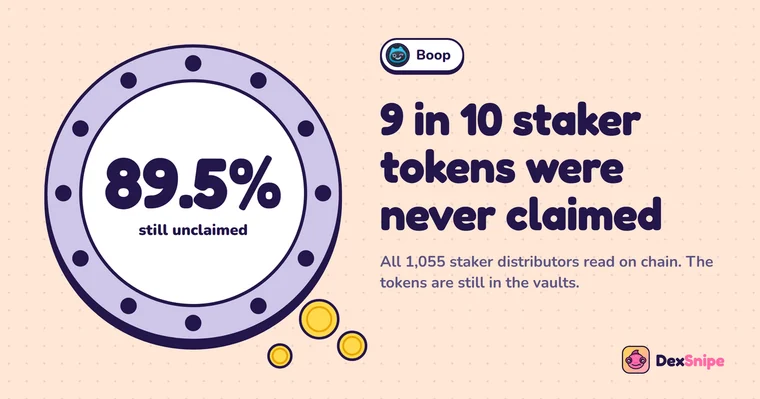
Boop's pitch was that every coin to graduate would hand 5% of its supply to people staking BOOP. For anyone sniping a Boop graduation, that sounds like a warning: 50 million tokens landing in thousands of wallets the moment the pool opens. We read all 1,055 staker distributors, 1,038 of them opened by Boop, and traced the claims. The dump mostly never came. Nearly nine in ten of those tokens were never claimed, and they are still sitting in the vaults.
The short version
- The staker airdrop is real and fast. About a minute after a coin graduates, Boop opens a claim vault holding 5% of the supply. The first claims land a couple of minutes later.
- Most stakers never claim. The median vault had 2,644 wallets on its claim list and 13 claims. Across the 983 coins that received the full 50 million, 89.5% of the tokens were never claimed.
- Those who claim mostly sell or move the tokens. 88 of 108 early claimers we checked no longer held any of the coin.
- The unclaimed tokens are an overhang. Every main vault passed its one-year clawback date months ago, and none had been clawed back when we read them.
What a Boop sniper bot does
Boop coins start on Boop's own bonding curve, a program written for the launchpad rather than borrowed from Meteora or Raydium. A sniper bot watches for new curves, buys in the first moments, and sells on rules you set. When a curve reaches its target, the coin graduates to a Raydium constant product pool, and a migration sniper can buy the moment that pool opens. A third kind of sniper follows chosen creator wallets and buys only their launches.
What sets Boop apart is not the curve. It is what happens at graduation. Most launchpads move the curve's SOL and the unsold tokens into a pool and stop there. Boop also carves out 5% of the supply for people who stake its BOOP token, and puts it where they can claim it. That is the part of a Boop graduation that every serious sniper asks about, and the part most guides wave through with a line about "staker rewards". This page is about what those rewards did on chain.
How a Boop coin graduates
Boop launched at the start of May 2025. Decrypt's coverage on launch day described the hook: daily BOOP rewards for users, and stakers earning a share of trading fees plus a percentage of every coin that graduates its bonding curve. Third-party guides put that percentage at 5% of supply, and the chain agrees. Every one of the 49,931 bonding curve accounts we read sets aside 500 basis points of supply for stakers.
The curves themselves are uniform. Each coin has a supply of one billion tokens. Each curve has a graduation target of 86 SOL and a graduation fee of 6 SOL. Virtual SOL reserves of about 30 SOL set the starting price, so the first buyer is not dividing by zero. Third-party guides describe graduation as happening around 400 SOL of market cap; the curve itself only counts the SOL it holds.
When the target is reached, a single transaction does three things. It takes the 6 SOL fee. It moves the rest of the curve's SOL and a fixed block of tokens into a new Raydium CPMM pool. And it sends 50 million tokens, the stakers' 5%, to a wallet Boop uses for distribution. A second transaction, seconds later, locks the pool's LP tokens.
Two things a migration sniper can count on. The pool opens with locked liquidity, so the creator cannot pull it. And 5% of the supply is about to be offered to thousands of wallets for free. The first is good news. This page is mostly about how much the second really matters.
Boop on chain
On November 6, 2026 we downloaded every bonding curve account of Boop's launchpad program and every distributor account of its distributor program, then decoded both. The curve layout comes from the program's published IDL. The distributor accounts match the open-source Jito merkle distributor field for field, so we read them with that layout and checked it against transactions we could trace by hand.
| Measure | Value |
|---|---|
| Bonding curves | 49,931 |
| Mints ending in boop | 49,554 |
| Different creator wallets | 20,190 |
| Curves graduated | 1,050 |
| Staker distributors opened | 1,055 |
| Distributors with the full 50 million | 983 |
| Distributors with 5 million | 55 |
| First distributor | May 1, 2025 |
| Last distributor | September 22, 2025 |
A few of the 1,055 distributors are not standard graduations: 17 were opened by other wallets, most with small amounts and a 30-day clawback. We leave those out of the claim figures below and work with the 1,038 opened by Boop's distributor wallet.
Boop mints also carry a signature. 49,554 of the 49,931 end in the letters "boop". On an explorer, that suffix is a quick way to recognise a Boop coin; the curve account is the certain test.
Where the staker 5% goes
The 50 million tokens do not go straight to stakers. At graduation they land in a token account owned by a single wallet, J7cV46, which Boop uses to run distributions. That wallet then does two things.
- It opens a distributor. This is an account on Boop's distributor program that holds a merkle root: a fingerprint of a list of wallets and the amount each one may claim. The list itself is kept off chain. The account records how many wallets are on it, how many tokens can be claimed in total, when claiming starts and when unclaimed tokens can be taken back.
- It moves the tokens into the distributor's vault. From then on, a wallet on the list can claim its share by presenting a proof that it belongs to the merkle root. The program checks the proof and sends the tokens.
This is a standard way to run an airdrop on Solana. It is cheap, because the program never stores the full list, and it puts the cost of each transfer on the person claiming. It also means that tokens nobody claims stay exactly where they are.
The distributor account tells a sniper four useful things: how many wallets were eligible, how many have claimed, how many tokens have left the vault, and the date after which the rest can be swept. All four are public. None of them is shown on Boop's coin pages as far as we could see, and none appears in a typical token scanner.
One graduation, minute by minute
TELE is a typical early graduate. Its curve completed on May 10, 2025, nine days after Boop launched. Every step below is a transaction you can open on Solscan.
| Time | What happened |
|---|---|
| 01:27:10 | Graduation. 6 SOL fee taken. 80 SOL and 206.9 million TELE into a new Raydium CPMM pool. 50 million TELE to Boop's distributor wallet. |
| 01:27:29 | LP tokens locked, 19 seconds after graduation. |
| 01:28:18 | Distributor opened: 3,006 wallets on the claim list, claiming open immediately, clawback allowed from May 10, 2026. |
| 01:28:26 | 50 million TELE moved from the distributor wallet into the claim vault. |
| 01:45:58 | A claim of about 191,000 TELE. |
| 01:54:07 | A claim of about 239,000 TELE. |
| May 12, 2025 | Last claim. 14 claims in total. |
Fourteen of 3,006 eligible wallets claimed: under half of one percent. Together they took about 1.92 million TELE, 3.8% of the vault. On November 6, 2026 the vault still held 48.08 million TELE, about 4.8% of the coin's entire supply, eighteen months after graduation and six months after its clawback date.
For a migration sniper, the important window in that table is the first hour. The pool opened at 01:27:10. The staker tokens became claimable just over a minute later. By the time the first sizeable claims came in, a quarter of an hour had gone by, which on a fresh pool is a long time. The pressure a sniper feared at the open did not arrive at the open, and when it arrived it was small.
How many stakers claimed
TELE is not unusual. Across the 1,038 distributors opened by Boop's wallet, claim lists were long and claims were few.
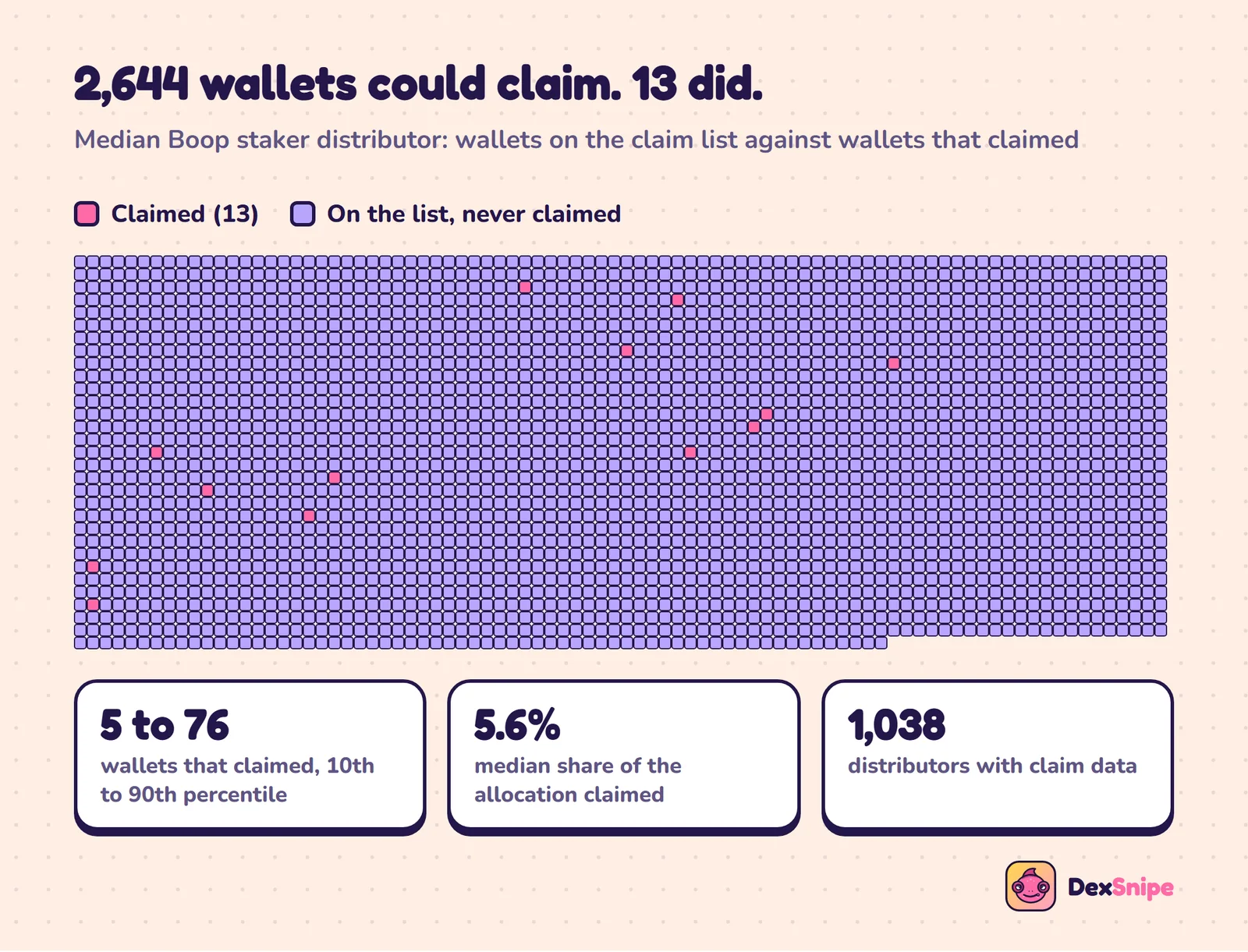
Data table
Staker claims per distributor, 1,038 distributors
| Measure | 10th percentile | Median | 90th percentile |
|---|---|---|---|
| Wallets on the claim list | 1,481 | 2,644 | 3,217 |
| Wallets that claimed | 5 | 13 | 76 |
| Share of the allocation claimed | 1.8% | 5.6% | 25.8% |
Added up across all 1,038 distributors, there were about 2.6 million places on claim lists and 42,948 claims: 1.6%. On the 983 distributors that held the full 50 million, 89.5% of the tokens were still in the vaults when we read them.
Why so few claimed
The chain does not say why, but the shape of the numbers suggests the reasons. A staker with a small BOOP position was on hundreds of claim lists, one per graduation, each worth a small slice of a coin they may never have heard of. Each claim costs a transaction and a new token account. For most stakers, most of the time, a few hundred thousand tokens of a coin that has just graduated were not worth the effort of finding the claim and signing it, especially when hundreds of coins graduated in May 2025 alone.
The claims that did happen were lopsided. In our sample, the median claim was about 219,000 tokens, around 0.02% of supply. The largest was about 5.4 million, more than half a percent of supply, in a single wallet. A few large stakers took the bulk of what was claimed.
When the claims arrive
For timing, we took 90 of the full-allocation distributors spread evenly through Boop's history and read every transaction on each vault.
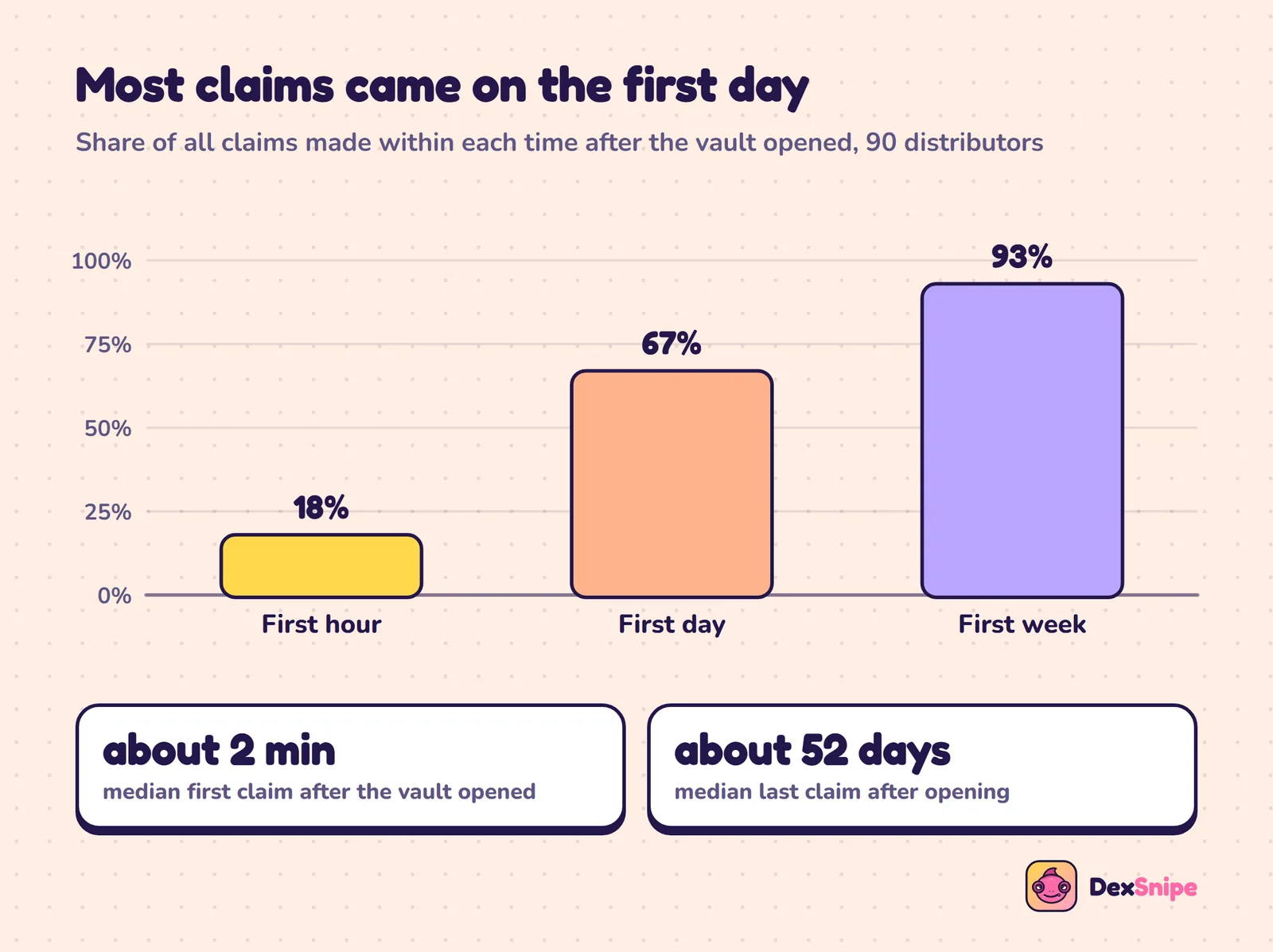
Data table
Claim timing, 90 distributors
| Measure | Value |
|---|---|
| Median first claim after the vault opened | about 2 minutes |
| Fastest 10% of first claims | under 40 seconds |
| Slowest 10% of first claims | over 85 minutes |
| Claims in the first hour | 18% |
| Claims in the first day | 67% |
| Claims in the first week | 93% |
| Median last claim | about 52 days after opening |
Two things stand out. First, someone was almost always watching. On half the vaults, the first claim came within about two minutes, and on a tenth of them within forty seconds. Those are automated claims, by stakers or services built to collect every airdrop the moment it opens.
Second, the claims were spread out. Only about one claim in five landed in the first hour. Two thirds came within the day, and the tail ran for weeks. A migration sniper holding for minutes saw only the first trickle. A holder for a day saw most of it.
What claimers did next
Claiming is one thing; selling is another. To see which happened, we took up to the first six claims on each of 20 distributors, 108 claims in all, and checked whether each claiming wallet still held the coin on November 6, 2026.
| Held when we checked | Claims |
|---|---|
| None of the coin | 88 |
| Some, but less than claimed | 0 |
| All of the claim or more | 20 |
Eight in ten early claimers had let go of everything they claimed. We cannot tell from balances alone whether each one sold or sent the tokens to another wallet, but the pattern is plain enough: early claimers were not long-term holders. The split was also all or nothing. No claimer in the sample had sold part of a claim and kept the rest.
That fits the timing. A wallet that claims within forty seconds of a vault opening is not waiting to see how the community develops. It collects and moves on. For a sniper, that means the early claims are best treated as sell orders that arrive a few minutes after the pool opens, in amounts of a few hundred thousand tokens each.
Why the feared dump was small
It helps to put the numbers against the pool. Take TELE's opening pool, 80 SOL against 206.9 million tokens, and ask what a sale of staker tokens would do to the price, before fees and before anyone else trades.
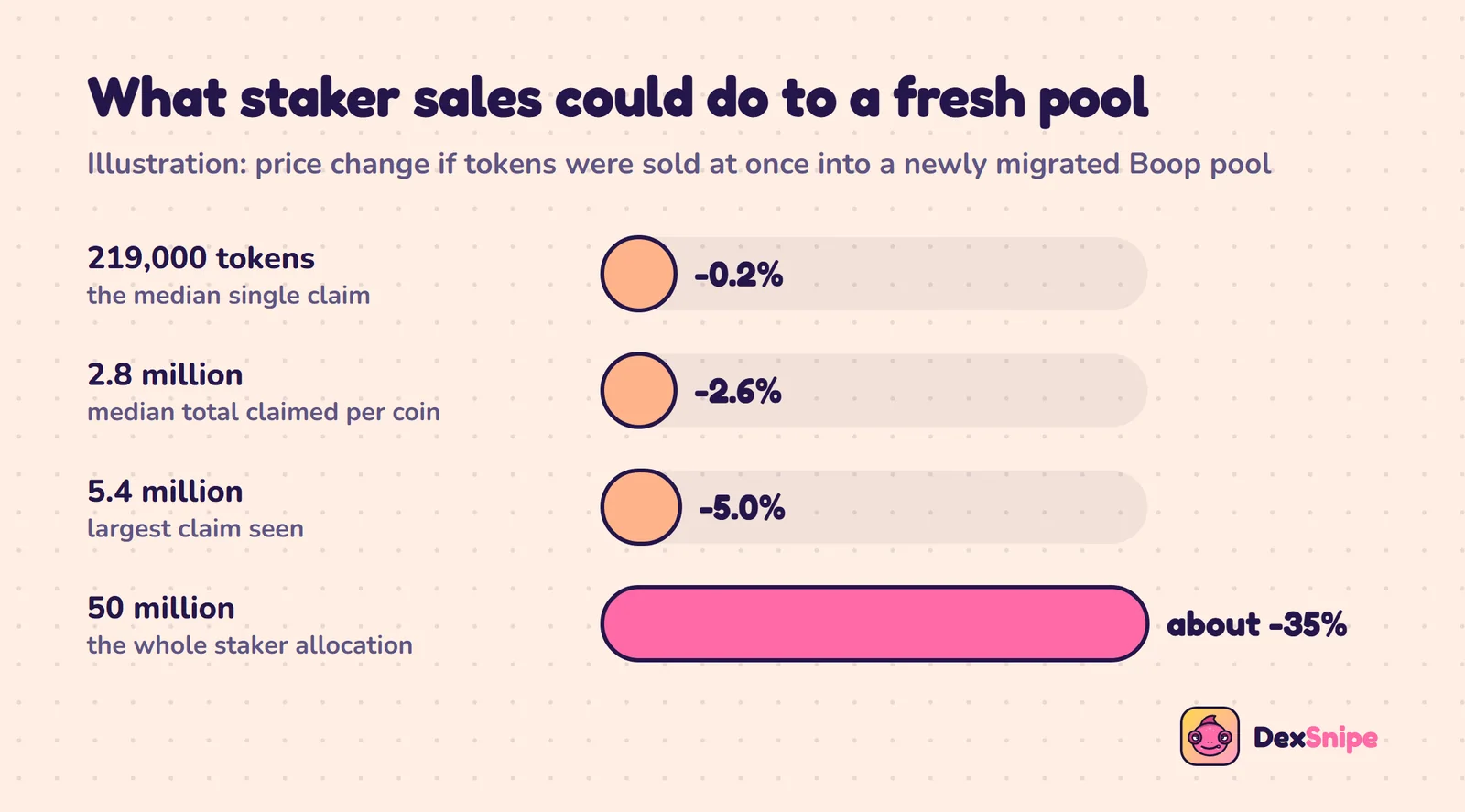
Data table
Staker sales into a fresh Boop pool, illustration
| Tokens sold at once | Share of supply | SOL out | Price change |
|---|---|---|---|
| 219,000 (median claim) | 0.02% | about 0.08 | about -0.2% |
| 2.8 million (median total claimed) | 0.28% | about 1.07 | about -2.6% |
| 5.4 million (largest claim seen) | 0.54% | about 2.03 | about -5.0% |
| 50 million (the whole allocation) | 5% | about 15.6 | about -35% |
The last row is the fear: every eligible staker claims at once and sells into the opening pool. It would take about a third off the price. The rows above it are what the chain shows actually happened. The median coin saw about 2.8 million tokens claimed over days, not seconds, and sold in pieces. Spread over the first day, that is noise next to ordinary trading in a pool that just raised 86 SOL.
None of this means the airdrop never hurt a coin. On the busiest tenth of distributors, a quarter or more of the allocation was claimed, and a single large claimer could put a few percent of downward pressure on a thin pool. But the dump story that circulated in May 2025, of thousands of stakers wiping out every graduate, is not what the vaults record.
The tokens nobody claimed
The more interesting number is the one left behind. On the 983 coins that received the full allocation, 89.5% of 50 million tokens, about 4.5% of each coin's supply on average, is still in a claim vault.
Every distributor records a clawback date. On all 1,038 opened by Boop's wallet, that date is 365 days after the vault opened. In the Jito distributor that Boop's accounts match, a clawback after that date sends everything still in the vault to a clawback receiver fixed in the account, and marks the distributor as clawed back so it cannot happen twice. For each Boop distributor, the clawback receiver is a token account owned by the same distribution wallet that received the 50 million at graduation.
The last full-allocation vault opened on June 19, 2025, so every one of their clawback dates had passed by June 2026. When we read them on November 6, 2026, none had been clawed back. The tokens are still in the vaults, still claimable by stakers who never claimed, and movable to Boop's wallet whenever someone triggers the clawback.
Why this matters to anyone buying an old Boop coin. For a typical early graduate, about 4.5% of supply sits in one vault that can be emptied in a single transaction. We do not know what Boop intends to do with clawed-back tokens, and nothing on chain says they will be sold. But a holder of an old Boop coin should know the block is there, and a sniper buying one should treat it like any other large wallet in the top holders list.
The vault balance is easy to check. Open the coin's distributor on Solscan, look at its token vault, and compare the balance with the 50 million it started with. That one number tells you how much of the 5% is still waiting.
July 2025: 5 million instead of 50
The distributors also show a change of policy. Every graduation from May 1 to June 19, 2025 put the full 50 million into the claim vault. From July 6, 2025, the next 55 graduations did something else. The 50 million still arrived in Boop's distribution wallet at graduation, but only 5 million went into the claim vault. The other 45 million were burned in the same transaction.
You can see the result in the token supply. A full-allocation graduate like TELE has close to a billion tokens in supply. A coin from the later period has about 955 million, the burned 45 million missing for good, and its stakers' share is half a percent of supply rather than five.
For a sniper, the July change makes the overhang question smaller still. On a coin that graduated after July 6, 2025, the most that could ever be claimed is 0.5% of supply. The burn also slightly raises each remaining token's share of the pool, which is a small benefit to holders at graduation. The chain does not tell us why Boop made the change; the low claim rates on the earlier coins are one obvious candidate.
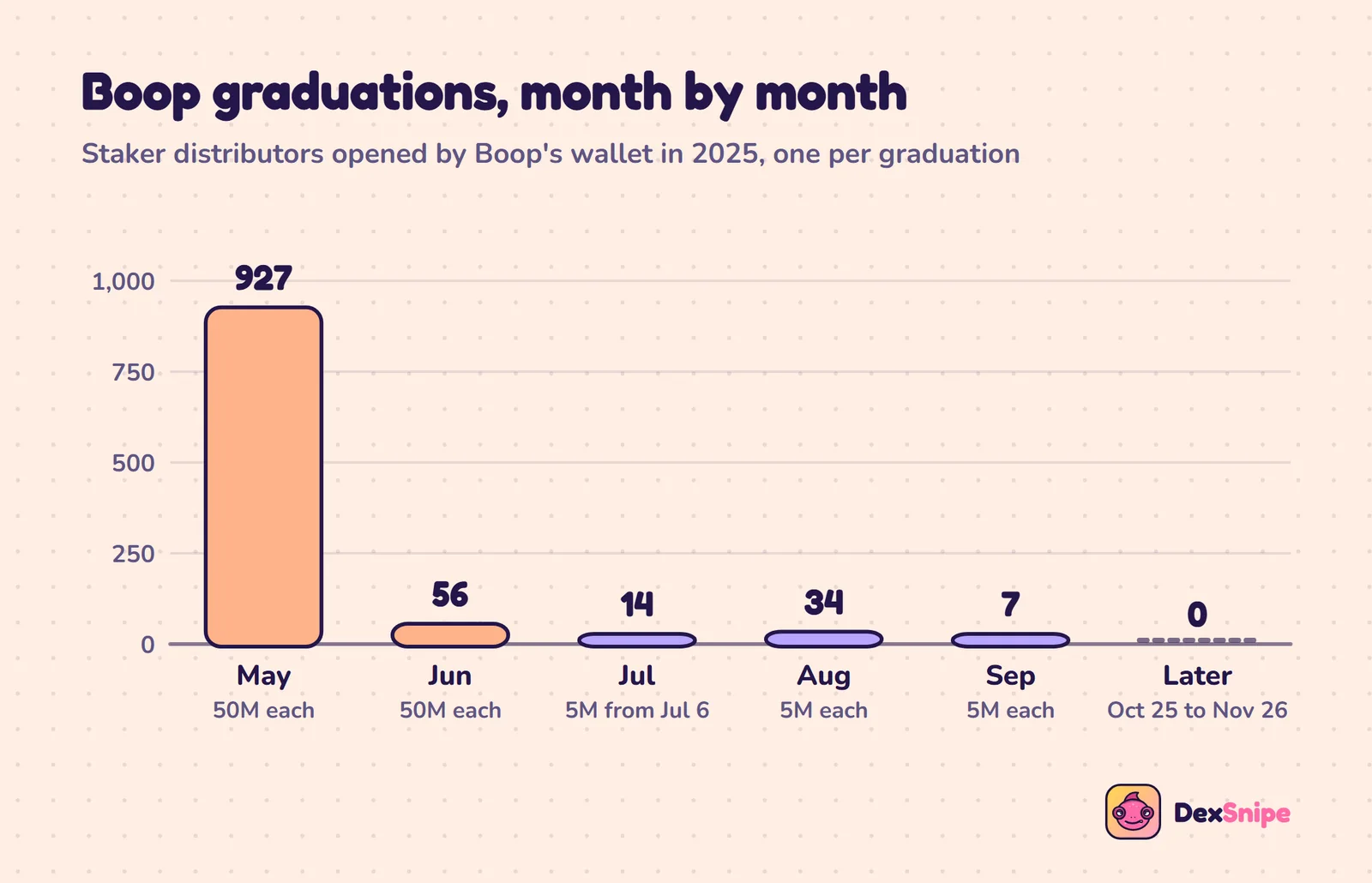
Graduations, month by month
Each graduation opens one distributor, so the distributors double as a record of when Boop coins graduated.
Data table
Distributors opened by Boop's wallet, by month
| Month | Graduations | Staker allocation |
|---|---|---|
| May 2025 | 927 | 50 million |
| June 2025 | 56 | 50 million |
| July 2025 | 14 | 5 million from July 6 |
| August 2025 | 34 | 5 million |
| September 2025 | 7 | 5 million |
| October 2025 to November 2026 | 0 | none |
Boop was a May 2025 launchpad. 927 of the 1,038 distributors Boop opened came in its first month, when the BOOP airdrop and influencer launches drew attention to it. June brought 56. The second half of 2025 brought a few dozen, and the last graduation was on September 22, 2025.
The program has not stopped entirely. From mid-January to early November 2026 it processed about 6,000 transactions, a handful of new coins among them, with most of the rest being trades on existing curves. On November 6, 2026, only five live curves held more than 10 SOL, and none held more than about 25 SOL of the 86 SOL target. A Boop sniper today will fire rarely, and a Boop migration sniper may not fire at all until activity picks up.
That is worth saying plainly because a lot of what is written about Boop sniping was written in May 2025 and still reads as if it were May 2025. The mechanics in this guide still apply to every Boop launch. The volume does not.
Who launches on Boop
20,190 different wallets launched the 49,931 Boop coins. Most launched once. A small group launched a lot.
| Creator group | Wallets | Launches | Graduation rate |
|---|---|---|---|
| One launch | 15,637 | 15,637 | 2.6% |
| 2 to 9 launches | 4,198 | 12,507 | 3.1% |
| 10 or more launches | 355 | 21,787 | 1.2% |
355 wallets made 44% of all Boop launches, and the busiest single wallet launched 2,662 coins. Their coins graduated at less than half the rate of everyone else's. That is the usual pattern on Solana launchpads: a few bulk launchers fill the feed with coins nobody buys, and a Fresh launch sniper that does not filter them spends most of its buys on them.
The flip side is a list worth having. 719 creator wallets graduated at least one Boop coin, 111 graduated two or more, and one wallet graduated 54. A wallet that has repeatedly taken coins to 86 SOL on Boop is exactly the kind of creator a Creator watch sniper is for.
The 1% and 2% curves
Boop curves come with one of two trading fees: 1% or 2% a trade. Creators who chose the higher fee were betting that buyers would not care. The chain says they did.
| Curve fee | Curves | Graduated | Graduation rate |
|---|---|---|---|
| 1% | 45,752 | 1,021 | 2.2% |
| 2% | 4,179 | 29 | 0.7% |
The 1% curves graduated three times as often. Part of that is cost: a 2% fee makes every round trip 4% before network costs, which is a lot for a buyer hoping for a quick move. Part is probably who picks it. A creator who sets a higher fee on a coin that has not yet found buyers is optimising for the wrong thing.
The curve fee is in the curve account from the start, so a sniper can filter on it before the first buy. On Boop, skipping 2% curves costs you very few graduates.
Reading a Boop coin before you buy
Most of what matters about a Boop coin can be read from two accounts: its bonding curve and, if it has graduated, its distributor. Here is what to check, in the order we would check it.
- The curve fee. 1% or 2%. On the evidence above, a 2% fee is a mild negative signal and a cost on every trade.
- The creator's record. How many Boop coins has this wallet launched, and did any graduate? A wallet with hundreds of launches and no graduations is a bulk launcher. A wallet with several graduations is worth following.
- How far along the curve is. The curve account holds its real SOL reserves. A curve at 70 SOL of 86 is a different trade from one at 2.
- For graduates, the vault balance. Find the distributor for the coin and read its vault. On a coin from May or June 2025, expect most of 50 million still there. On a coin from July 2025 or later, at most 5 million could ever have been there.
- For graduates, the clawback flag. If a vault has been clawed back, the tokens moved to Boop's wallet. Where they went from there is the next thing to check.
- The top holders. Ignore the Raydium pool vault and the distributor vault, then look at what is left. A creator holding a large share, or a group of wallets funded from the same source, matters more than any staker claim.
A sniper bot cannot read off-chain claim lists, but it does not need to. The useful facts are all on chain, and the most useful of them, the creator's record and the holder spread, are exactly what DexSnipe's Creator watch and holder caps act on.
What this data does not tell you
- We read the distributor through Jito's layout. Boop's distributor accounts match it field for field and the values check out against traced transactions, but we have not seen Boop's distributor source code. Its clawback rules could differ from Jito's.
- We did not read the claim lists. They are off chain. We know how many wallets were on each list and how many claimed, not who they were or how much each was owed.
- "No longer held" is not "sold". A claimer who moved tokens to another wallet looks the same as one who sold. The sample is 108 claims on 20 coins, up to six per coin.
- The price table is an illustration. It uses TELE's opening pool and ignores fees and other trades. Real pools move for many reasons at once.
- Wallets are not people. Creator counts are wallet counts. One person can run many wallets.
- Fee income to stakers is not covered. Boop also shares trading fees with stakers. We looked only at the token allocation, which is what affects a coin's supply.
Filters that fit Boop
- Creator watch on proven wallets. 719 wallets have graduated a Boop coin and 111 have done it more than once. Following them is the most direct way to skip bulk launches.
- Blocklist words. Bulk launchers reuse names and themes. A word blocklist removes many of them cheaply.
- Dev holding cap. A creator who buys a large share on their own curve can sell it into the first buyers. Keep the cap at 5 to 10%.
- Skip bundled launches. Wallets buying in the creator's own block are often the creator's.
- Top 10 holder cap. On a graduated Boop coin, the Raydium pool vault and the staker vault will both be in the top holders. Set the cap with that in mind.
- Minimum liquidity on migrations. Every Boop graduate opens with about 80 SOL. A minimum liquidity filter set a little below that catches graduations and skips anything unusual.
Boop sniper settings
Starting points for the Creator watch, Fresh launch and Migration triggers on Boop. Adjust them to your own size and patience.
| Setting | Creator watch | Fresh launch | Migration |
|---|---|---|---|
| Trigger | Creator watch, one sniper per wallet | New Boop curves | Boop graduations |
| Buy size | 0.2 to 0.5 SOL | 0.05 to 0.1 SOL | 0.2 to 0.5 SOL |
| Slippage cap | 15% | 15% | 10% |
| Priority fee | 0.001 SOL | 0.001 SOL | 0.001 SOL |
| Jito tip | 0.002 SOL | 0.002 SOL | 0.002 SOL |
| Dev holding cap | 10% | 5% | 10% |
| Skip bundled launches | On | On | On |
| Top 10 holder cap | 35% | 25% | off, see above |
| Take-profit | +50% sell 50%, +150% sell 50% | +30% sell 50%, +80% sell 50% | +20% sell 50%, +60% sell 50% |
| Stop-loss | 30% | 25% | 15% |
| Timer | 60 minutes | 15 minutes | 60 minutes |
| Dev-sell exit | On | On | On |
Why the migration exits are tighter
A Boop graduate opens with a known pool and a known stream of staker claims arriving over the following hours. The opening move is usually the biggest, and the early claims, small as they are, lean against it. A tighter first take-profit captures the opening and a short stop-loss keeps a slow bleed from turning into a large loss. A sixty-minute timer roughly matches the window before most claims have landed.
Why the tip is moderate
Boop curves charge the same 1% or 2% from the first trade, so being early is not taxed the way it is on Believe or some Jupiter Studio launches. It is also not contested the way Pump.fun is today. A moderate tip lands reliably without paying for a race that, at current volumes, is rarely run.
Take profit, stop loss and selling
Neither the curve nor the Raydium pool holds orders, so every exit is the bot watching the price and sending a sell. DexSnipe gives each sniper up to four take-profit steps, a stop-loss, a trailing stop, a timer and a dev-sell exit, all running on the server after you close the tab.
- Count the fee in every target. A round trip on a 1% curve costs about 2% before network costs, and on a 2% curve about 4%.
- Expect claims, not a cliff. On a fresh graduate, plan for small sells arriving over hours rather than one large one at the open.
- Use the trailing stop on migrations. It lets a strong opening run while protecting against the drift that claims can add later.
- Keep the dev-sell exit on for curve buys. The creator is a bigger risk on a Boop curve than any staker.
| What you see | Likely cause | What to change |
|---|---|---|
| Dozens of buys, almost no graduations | Bulk launchers in the feed | Switch to Creator watch |
| Steady small sells after a migration | Staker claims being sold | Tighten the first take-profit |
| Migration sniper never fires | No Boop graduations lately | Add an active venue |
| Holder filter skips every graduate | Pool and staker vaults counted | Turn off the top 10 cap for migrations |
Choosing a Boop sniper bot
- Does it read Boop's own curve? Boop is not a Meteora or Raydium launchpad. A bot built only for those will not see Boop launches.
- Does it handle the graduation? A migration sniper has to detect the new Raydium CPMM pool and buy it, not the closed curve.
- Can it follow chosen wallets, so you buy the 719 creators with a graduation instead of the 355 bulk launchers?
- Do exits run on a server when you are offline?
- Does it cover other venues? Boop is quiet today. A sniper that can only watch Boop will sit idle most of the time.
- Is the price flat? A bot that takes a cut of every trade costs more on exactly the small, frequent trades that launch sniping produces.
Boop in DexSnipe
DexSnipe supports Boop with four triggers: Fresh launch, Migration, Creator watch and Copy trade. A Creator watch or Copy trade sniper can cover Boop together with any of the other venues, including Pump.fun, LetsBonk, LaunchLab, Bags, Believe, Jupiter Studio and Heaven, plus pools on PumpSwap, Raydium, Meteora and Orca. Every sniper has a dev holding cap, a top 10 holder cap, a bundled launch check, a socials check and a word blocklist, and up to four take-profit steps with a stop-loss, trailing stop, timer and dev-sell exit. The price is a flat plan from 1 SOL for 7 days with no cut of your trades.
Set up a Boop sniper in DexSnipe
- Open the panel and click New sniper. Choose Creator watch, Fresh launch or Migration.
- Tick Boop, and at least one busier launchpad, so the sniper has launches to act on while Boop is quiet.
- Paste the creator wallet if you chose Creator watch, one per sniper. Wallets with Boop graduations behind them are the place to start.
- Set the buy: size, slippage cap, priority fee and tip.
- Set the filters and exits: dev holding cap, bundle check, blocklist, two take-profit steps, a stop-loss, a timer and dev-sell on.
- Connect your wallet and save. Snipers are stored on your wallet address.
- Pick a plan, add a sniper wallet and arm it. Send 1, 3 or 5 SOL to the reserved address, add the key of a separate funded wallet, arm the sniper and close the tab.
Trade only what you can lose. Most new coins on any launchpad lose value, and a graduated coin can carry supply you do not see at first glance. This page is not financial advice.
Boop sniper bot questions
What is a Boop sniper bot?
+
A bot that buys new Boop coins in the first moments on their bonding curve, or the moment they graduate to a Raydium pool, and sells on rules you set. It can also follow chosen creator wallets and buy their next Boop launch.
Do BOOP stakers dump graduated coins?
+
Far less than the setup suggests. Every coin that graduated with the full allocation sent 50 million tokens, 5% of supply, to a claim vault for stakers. Across 983 such coins, 89.5% of those tokens were never claimed. In a sample of 108 early claims, 88 claimers no longer held any of the coin when we checked, so most of what was claimed did leave, but the amounts were small.
How soon after graduation can stakers claim?
+
Within minutes. In the graduations we traced, Boop's distributor wallet opened the claim vault about a minute after the coin graduated. In a sample of 90 vaults, the median first claim came about two minutes after the vault opened, 18% of claims landed in the first hour and 67% in the first day.
How much SOL does a Boop coin need to graduate?
+
Every Boop curve we read has a graduation target of 86 SOL, with a 6 SOL graduation fee. In the graduation we traced, 80 SOL and 206.9 million tokens went into a new Raydium CPMM pool and the LP was locked in a follow-up transaction 19 seconds later.
What happens to unclaimed staker tokens?
+
They stay in the vault. Boop's main distributors set a clawback date one year after opening, after which the remaining tokens can be sent to a token account owned by Boop's distributor wallet. Every one of those dates has passed, and as of November 6, 2026 none of the main distributors had been clawed back.
Did Boop change the staker airdrop?
+
Yes. From July 6, 2025, the 55 coins that graduated sent 5 million tokens to stakers and burned the other 45 million of the 5% allocation. Before that, 983 coins sent the full 50 million.
Is Boop still launching coins?
+
Barely. The last staker distributor was opened on September 22, 2025. Since mid-January 2026 the Boop program has processed about 6,000 transactions, mostly trades on existing curves, and on November 6, 2026 no live curve held more than about 25 SOL of the 86 needed to graduate.
What fee do Boop curves charge?
+
Either 1% or 2% a trade. 45,752 of the 49,931 curves we read charge 1% and 4,179 charge 2%. The 1% curves graduated three times as often: 2.2% against 0.7%.
Does DexSnipe take a fee on Boop trades?
+
No. DexSnipe is a flat plan: 1 SOL for 7 days, 3 SOL for 30 days or 5 SOL for 90 days. You pay the network fee, your priority fee and tip, and the curve's or pool's own trading fee.
Sources and method
On November 6, 2026 we listed every bonding curve account of Boop's launchpad program and decoded each with the program's IDL: creator, mint, graduation target and fee, SOL reserves, trading fee, staker share and status. We then listed every account of Boop's distributor program and decoded the 1,055 distributors with the Jito merkle distributor layout, which they match field for field: mint, vault, total claimable, number of wallets on the claim list, amount and number of claims, start date and clawback date, clawback receiver and the clawed-back flag. We checked the layout against the TELE graduation, which we traced transaction by transaction.
Claim timing comes from every transaction on the vaults of 90 full-allocation distributors chosen at even intervals. The holding check covers up to the first six claims on each of 20 distributors, 108 claims in all, comparing each claimer's current balance of the coin with the amount claimed. The 5 million allocations and burns were confirmed by tracing a July 2025 graduation and by reading token supplies. The price table uses the constant product formula on TELE's opening pool reserves. Program activity in 2026 comes from the program's transaction history. DexSnipe triggers, filters and exits are taken from the product itself.
- Decrypt: Crypto influencers lured by $350K airdrop to launch Solana meme coinsMay 1, 2025. Boop's launch, the influencer airdrop, and stakers earning a share of fees and tokens of every graduating coin.
- BingX Learn: What is Boop.funA third-party guide: stakers receive 5% of each graduating coin's supply and a share of trading fees.
- BoopThe launchpad.
- Boop launchpad program on SolscanThe program whose 49,931 bonding curve accounts we read.
- Boop distributor program on SolscanThe program that holds the staker claim vaults. We read all 1,055 of its distributor accounts.
- Jito merkle distributor on GitHubOpen-source merkle distributor. Boop's distributor accounts match its account layout, field for field, which is how we decoded them.
- TELE graduation transaction on SolscanMay 10, 2025. 50 million tokens to the distributor wallet, 206.9 million tokens and 80 SOL to a new Raydium CPMM pool.
- TELE staker distributor on Solscan3,006 wallets on the claim list, 14 claims.
- Raydium CPMM program on GitHubThe constant product pool Boop coins graduate into.
One sniper, every active launchpad
Build your snipers for free, then a plan from 1 SOL switches them on. No cut of your trades.