Solana Buy the Dip Bot
Buying the dip sounds like free money: let the bot see a coin, wait for the price to come down, and get in cheaper than everyone who rushed. On new Solana coins the question is which coins give you that dip. We took 2,023 real buys on new Pump.fun coins and replayed each one twice, once bought at once and once with a rule that waits for a 10% to 50% dip first. The dips came, mostly on the coins that kept falling. The coins that ran almost never looked back long enough to let the rule in.
The short version
- The dip picks the losers. On new coins a 20% drop usually means people are selling. The rule bought right after them.
- The winners do not dip first. Of the 108 trades that closed up 50% or more when bought at once, 76 came from signals that never got a 20% dip.
- Without an exit, it loses less. Held for 30 minutes, the dip rule lost 7.8% per signal against 27.6% for buying at once, mostly by buying less and buying near the bottom.
- Fresh launches rarely have room to dip. A Pump.fun curve cannot fall below its starting price, and most coins open close to it.
What a buy the dip rule does
A sniper normally buys the moment its signal fires: a new launch, a migration, a new pool, a creator's next coin or a wallet you copy. A buy the dip rule puts a condition in between. When the signal fires, the bot notes the price. It then waits for the price to fall by your percentage from that point, and buys only when it does. If the dip has not come by your time limit, the token is skipped.
On an exchange this would be a limit order resting on the book. A Pump.fun bonding curve or an AMM pool has no book, so the bot watches every trade and sends the buy itself when the price crosses the line. The buy lands a slot or so after the trade that pushed the price down, at whatever the pool says then.
The idea is sound on assets that wander around a fair price. The question is whether a coin a few seconds old, with no fair price yet, behaves like that.
2,023 buys, replayed
We used the sample behind our copy trading and trailing stop studies: coins created on Pump.fun between 14:56 and 16:51 on November 5, 2026, each followed trade by trade for its first 30 minutes on the bonding curve. From the 412 ordinary coins paired with SOL with a full trade history, we took every position opened by a wallet other than the creator with a first buy of 0.01 to 5 SOL: 2,023 positions by 1,383 wallets on 186 coins.
Each of those buys became a signal. Bought at once, the signal buys 0.1 SOL at the price the real wallet paid. With a dip rule, the bot takes that price as its reference, follows the curve trade by trade, and buys 0.1 SOL at the front of the next slot once the price has fallen by the set percentage. If five minutes pass without the dip, it skips. To judge the buys we gave both the same exit: a 10% trailing stop, the setting that did best in our trailing stop study. We also ran them held to the end of the 30 minutes with no exit at all. Prices come from the curve formula in Pump's public docs, before fees and tips.
The signals are real. Every one is a moment a real wallet chose to buy. We did not pick coins, and the dip rule saw only the prices that came after the signal.
Waiting for a dip, side by side
Every entry rule in numbers
Every entry rule in numbers
| Entry rule | Bought | Average | Median | In profit | Per signal |
|---|---|---|---|---|---|
| Buy at once | 100% | 0.0% | -3.8% | 38.3% | 0.0% |
| Wait for a 10% dip | 70.3% | -9.6% | -9.9% | 10.3% | -6.8% |
| Wait for a 20% dip | 57.3% | -7.7% | -7.0% | 9.9% | -4.4% |
| Wait for a 30% dip | 44.0% | -5.8% | -7.0% | 9.2% | -2.6% |
| Wait for a 50% dip | 26.8% | -4.4% | -4.8% | 2.2% | -1.2% |
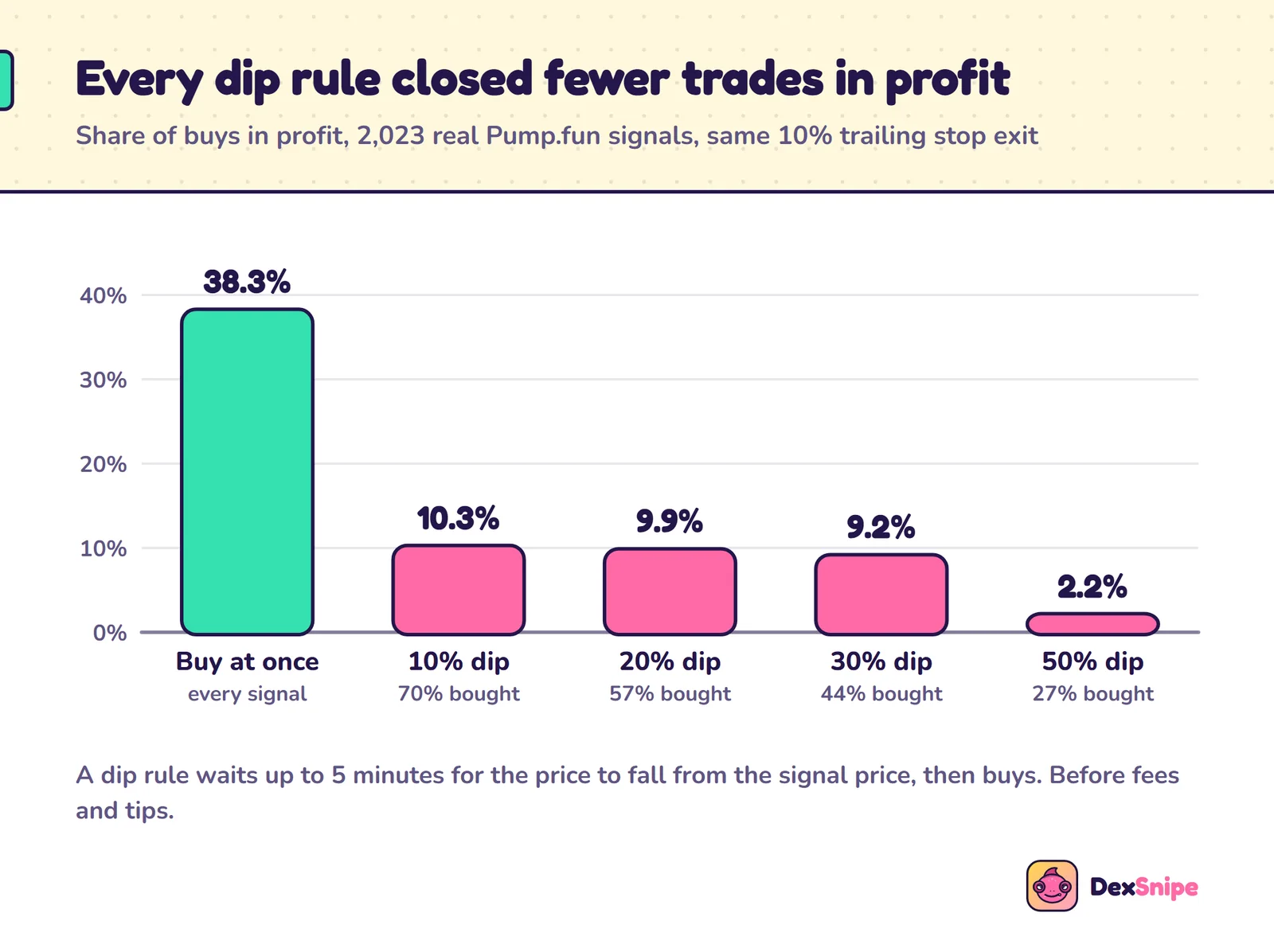
Bought at once and sold with a 10% trailing stop, these signals broke even on average, and 38% closed in profit. Every dip rule did worse. A 20% dip bought 57% of the signals, and those buys averaged -7.7% with only one in ten in profit. The last column counts a skipped signal as zero, so it compares the rules over every signal they saw. Buying at once still came out ahead.
The bigger dips look a little better per signal, but only because they buy less. A 50% dip bought a quarter of the signals and 2% of those buys made money. Waiting for a deeper dip is mostly a way of trading less.
What the dip rule skipped
The reason shows up when you split the signals by what the dip rule did with them, and price each group as if it had been bought at once.
| Group | Signals | Bought at once, average | In profit | Closed up 50%+ |
|---|---|---|---|---|
| The dip came, the rule bought | 1,160 | -10.7% | 30.3% | 32 |
| No dip in 5 minutes, skipped | 863 | +14.4% | 49.0% | 76 |
The coins that gave a 20% dip were already worse coins: bought at once they averaged -10.7%. The coins that never dipped averaged +14.4% with half in profit, and they held 76 of the 108 trades that closed up 50% or more when bought at once. A new coin that is working rarely falls 20% from where a buyer got in. The rule waits for exactly the thing that good coins do not do.
The dip is also not random. Before 39% of the 20% dips, the creator had already sold. The rest were mostly early buyers taking profit together. A 20% drop on a coin a few seconds old is information, and the rule reads it as a discount.
Two coins, two dips
Two coins from the sample show both sides. Take a sniper that saw each coin at launch and waited for a 20% dip from the first price it saw.
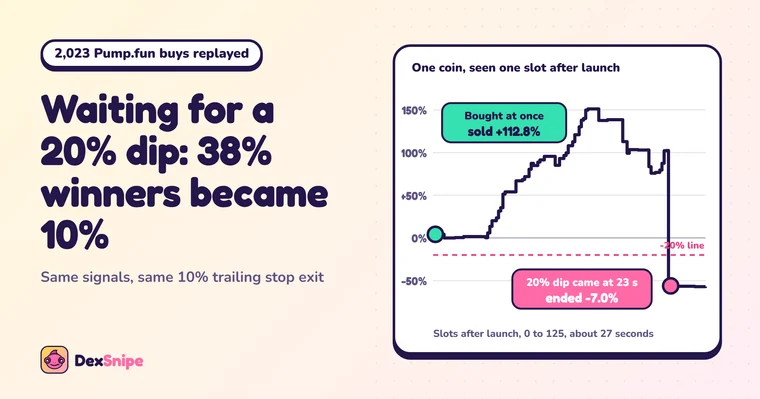
- The first coin, created at 15:19:53. It went straight up and reached +151% in 15 seconds. It never fell 20% below the first price on the way. A buyer at once who used a 10% trailing stop sold for +112.8%.
- The dip, 23 seconds in. Four sells in one slot took 35.7 SOL out of the curve, and the price fell to 56% below where the sniper first saw it. The dip rule bought there. Held to the end of the 30 minutes, that buy returned -7.0%.
- The second coin, created at 15:07:20. It climbed for 17 seconds, then sixteen trades, the creator's sell among them, landed in one slot and took 28.5 SOL out.
- The dip buy. The rule bought in the next slot, 63.5% below the first price. Thirty minutes later it was down 2.9%.
Neither dip buy lost much, and that is the pattern. A dip on a new coin is usually the dump itself, and after a dump the price sits near the bottom of the curve with few buyers left. There is little left to lose and little left to win. The run happened before the dip, and the dip rule was not in it.
Without an exit, the dip loses less
There is one case where the dip rule looks good, and it is worth being clear about why.
| Entry rule | Bought | Average | In profit | Per signal |
|---|---|---|---|---|
| Buy at once | 100% | -27.6% | 11.3% | -27.6% |
| Wait for a 10% dip | 70.3% | -19.7% | 3.6% | -13.8% |
| Wait for a 20% dip | 57.3% | -13.5% | 2.7% | -7.8% |
| Wait for a 30% dip | 44.0% | -11.3% | 2.6% | -5.0% |
| Wait for a 50% dip | 26.8% | -9.8% | 2.2% | -2.6% |
With no exit at all, buying at once lost 27.6% per signal, because most new coins fall and a buy that never sells falls with them. Waiting for a 20% dip lost only 7.8% per signal. It bought fewer coins, and the ones it bought were already near the bottom of their curve, so they had less room to fall.
That makes a dip rule a blunt way to limit losses for a sniper with no exits. It is not a way to find better coins: only 2.7% of the dip buys were in profit after 30 minutes. A trailing stop limits the same losses and keeps the winners, which is why the first table, with exits, is the one to go by.
Fresh launches rarely have a dip
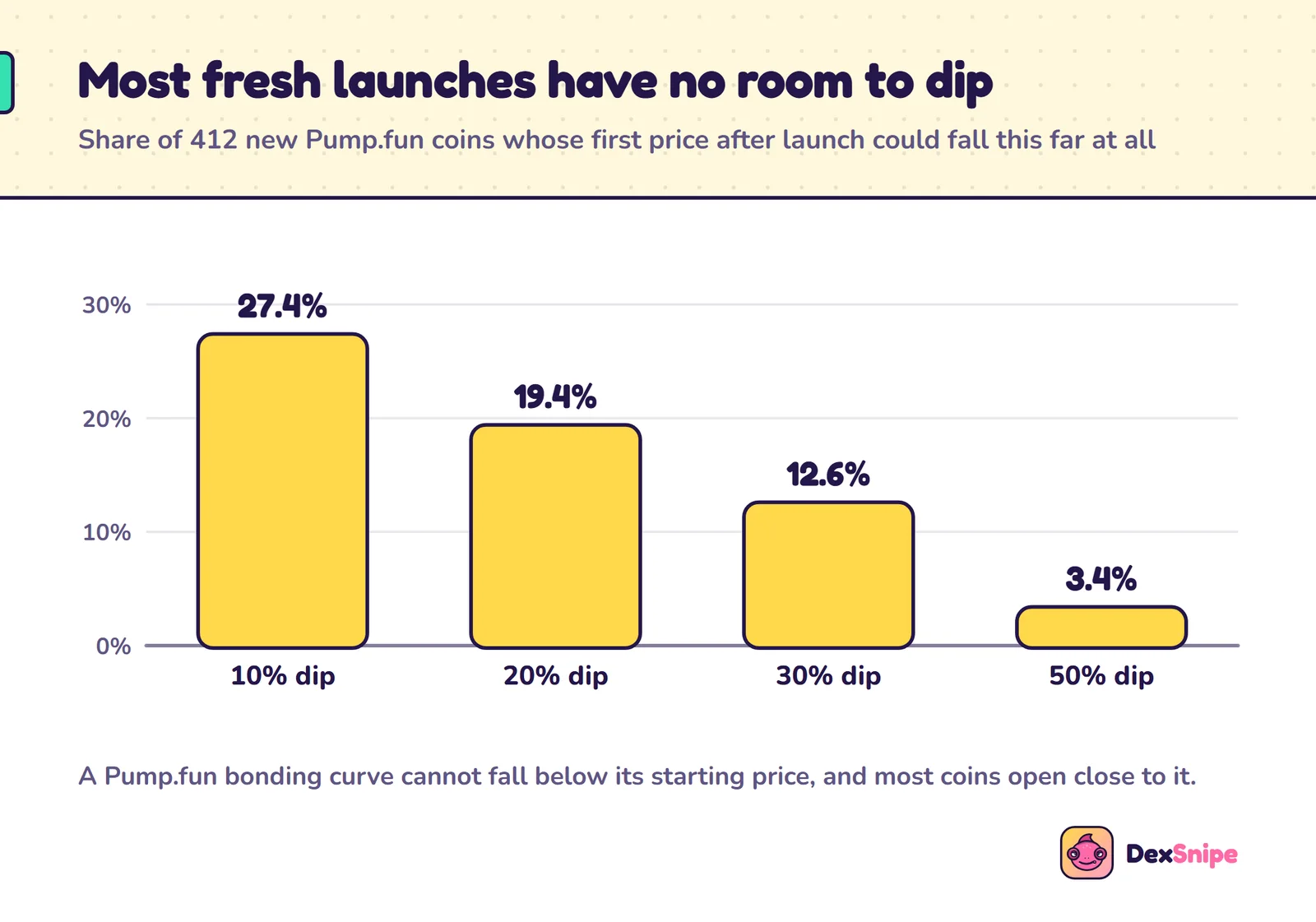
A Pump.fun launch sniper has a problem of its own. A bonding curve starts at a fixed price and moves up as tokens are bought. Selling can only take it back down toward that starting price, never below it. Most new coins open with a small creator buy and little else, so the first price a sniper sees is close to the floor, and there is no room for a dip at all.
Launch dips in numbers
Launch dips in numbers
| Dip | Could fall this far at all | Fell this far within 5 minutes |
|---|---|---|
| 10% | 27.4% | 24.3% |
| 20% | 19.4% | 17.2% |
| 30% | 12.6% | 10.9% |
| 50% | 3.4% | 2.2% |
Half of these coins could not fall even 1% from the first price a launch sniper saw. Only one in five could fall 20%. So a launch sniper with a 20% dip rule skips more than four launches in five, and on the 17% where the dip does come, it is buying a coin that early holders are leaving. With a 10% trailing stop, those launch dip buys averaged -5.1% with 5.6% in profit, against -1.3% and 8.0% for buying every launch at once.
By when the signal came
Entry age in numbers
Entry age in numbers
| Signal came | Signals | At once, average | At once, in profit | Dip came | Dip buy, average | Dip buy, in profit |
|---|---|---|---|---|---|---|
| First 3 slots | 350 | +5.7% | 32.3% | 38.6% | -3.0% | 8.1% |
| 3 slots to 16 s | 677 | -7.0% | 32.2% | 70.0% | -7.8% | 12.2% |
| 16 s to 2.7 min | 598 | +2.3% | 41.6% | 66.9% | -9.7% | 6.8% |
| After 2.7 min | 398 | +3.5% | 48.7% | 37.9% | -6.8% | 12.6% |
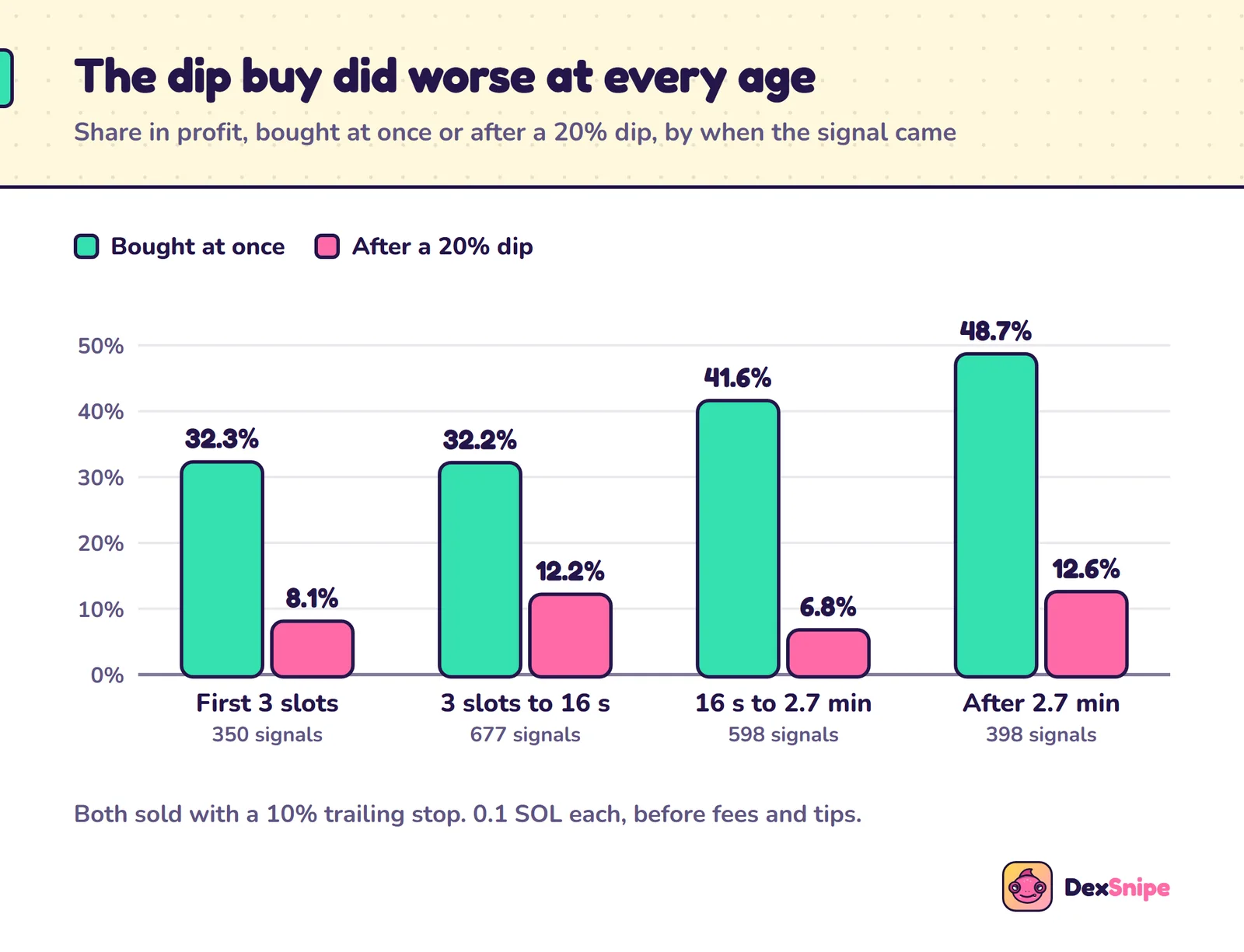
The dip rule did worse at every age. It was closest in the stretch between the third slot and the 16th second, the launch rush, where buying at once also lost money. That is the window where you would most expect a dip rule to help, and even there the dip buys averaged slightly worse than buying at once.
For signals more than about three minutes after launch, coins that are still trading by then, the dip came on only 38% of them, and those dip buys averaged -6.8% against +3.5% for buying at once. On a coin that has survived five minutes, a 20% fall is a bigger event than it is in the first seconds.
How long to wait
| Wait up to | Bought | Average | In profit | Median wait |
|---|---|---|---|---|
| 1 minute | 40.9% | -8.1% | 12.0% | 11 s |
| 5 minutes | 57.3% | -7.7% | 9.9% | 18 s |
| 30 minutes | 65.3% | -7.5% | 10.2% | 25 s |
Most dips that came at all came fast. With a five-minute limit, the median dip arrived 18 seconds after the signal. A longer wait bought more signals but did not buy better ones: the average stayed between -7.5% and -8.1% whether the rule waited one minute or thirty. If you use a dip rule on new coins, a short wait loses nothing.
What this replay does not tell you
- It is two hours on one venue. All of it is the Pump.fun bonding curve on one afternoon. On older tokens and deep DEX pools, prices wander more and a dip is less often a dump. We have not measured those here.
- It is before costs. Trading fees, network fees, priority fees and tips come off every buy and sell.
- It is generous on timing. Each dip buy went first in its slot, right after the trade that triggered it.
- The reference is the signal price. We measured the dip from the price at the moment of each real buy. A rule that measures from another point, such as a recent high, would behave differently.
- It covers 30 minutes. Positions still open were valued at the last curve price.
When to use it
The data argues against a dip rule as a way to pick better new coins. It does not make the rule useless. It tells you what it is for.
- Leave it off for launch snipes. Most launches cannot dip from the first price, so the rule mostly skips them, and the ones it buys are being sold.
- Use exits first. A trailing stop did more for these same signals than any dip rule. If you only change one thing, change the exit.
- Treat it as a brake, not a filter. If you run a sniper without exits, a dip rule cuts how much you buy and how much you lose. It does not raise the share of winners.
- Keep the wait short. A minute or a few. Longer waits only buy more of the coins that are falling.
- Read why it dipped. On a new coin, a dip after the creator sells is not a discount. Your filters and a dev-sell exit say more about a coin than its price does.
For copy trades the same logic holds. In our copy trading replay, the copy lost to the wallet mostly through timing. Waiting for a dip adds more delay, and on these coins the dip after a wallet's buy is usually other buyers leaving.
Buy the dip settings in DexSnipe
Buy the dip is one of two entry rules on every DexSnipe sniper, next to buy in parts, and it works with every trigger: fresh launch, migration, new pool, creator watch, exact mint and copy trade.
- Buy the dip. The drop, in percent, from the first price the sniper sees after its signal. 0 buys at once.
- Wait for the dip. How many minutes to wait. If the dip has not come by then, the sniper skips the token.
- Buy in parts. Splits the buy into up to 10 equal buys a set number of seconds apart, with the filters checked again before each one.
- Exits. Take-profit steps, a stop-loss, a trailing stop, a timer and a dev-sell exit, for every buy the sniper makes.
New snipers start with buy the dip at 0, buying at once. If you are comparing bots, our comparison of Solana sniper bots covers fees, entry rules and exits side by side.
Trade only what you can lose. No entry rule turns a falling coin into a good one. On new tokens most coins lose, whenever you buy them. This page is not financial advice.
Solana buy the dip questions
What is a buy the dip bot on Solana?
+
A bot that does not buy when its signal fires. It notes the price at that moment and waits for the price to fall by a percentage you set, then buys. If the dip does not come within your time limit, it skips the token. On Solana the bot has to watch the pool itself and send the buy, because a bonding curve or AMM pool has no limit orders.
Does buying the dip work on new Pump.fun coins?
+
Not as a way to pick winners, in our replay. Across 2,023 real buys on new Pump.fun coins, sold with a 10% trailing stop, buying at once averaged 0.0% with 38% of trades in profit. Waiting for a 20% dip first bought 57% of the same signals, which averaged -7.7% with 10% in profit. The coins that dipped were mostly the ones that kept falling, and the best coins never dipped.
Why did my dip buy keep falling?
+
Because on a new coin a 20% drop is rarely noise. It is usually early buyers or the creator selling. In our replay the creator had sold before 39% of the 20% dips. The dip rule buys right after that selling, when the coin is cheaper but the buyers have left.
Can a fresh launch sniper buy the dip?
+
Rarely. A Pump.fun bonding curve can never fall below its starting price, and most coins open close to it. Of 412 new coins we checked, only 19% had a first price that could fall 20% at all, and a 20% dip came within five minutes on 17%. On the rest a dip rule simply skips the launch.
How long should a buy the dip rule wait?
+
Not long. In our replay, with a five-minute limit, half of the 20% dips that came at all came within 18 seconds of the signal. Waiting 30 minutes instead of 1 bought more signals, 65% against 41%, but not better ones: the average stayed between -7.5% and -8.1% with a 10% trailing stop.
Does DexSnipe charge more for buy the dip?
+
No. Buy the dip and buy in parts are entry rules on every DexSnipe sniper, included in the flat plan: 1 SOL for 7 days, 3 SOL for 30 days or 5 SOL for 90 days, with no cut of your trades.
Sources and method
The trades come from our Pump.fun sample: 1,205 coins created between 14:56 and 16:51 on November 5, 2026, each with every bonding curve trade for its first 30 minutes, read from the chain. We used the 412 ordinary SOL-paired coins with a complete trade history and left out Mayhem coins. A signal is the first buy of a wallet other than the creator, of 0.01 to 5 SOL, whose own token balance changed with each trade: 2,023 signals by 1,383 wallets on 186 coins. The launch section uses all 412 coins, with the reference price taken at the front of the slot after creation.
We rebuilt each curve's reserves trade by trade from its SOL and token balance changes, starting from the virtual reserves in Pump's README, and priced every trade with the constant product formula. Buying at once buys 0.1 SOL at the reserves the real wallet met. A dip rule takes the marginal price at that point as its reference, checks the price after every later trade, and buys 0.1 SOL at the reserves at the front of the next slot once the price is at or below the reference minus the dip; if the wait runs out first, the signal is skipped and counts as zero per signal. The 10% trailing stop sells at the front of the slot after it triggers. Positions still open after 30 minutes are valued at the last curve price. Our trades are not added to the curve. All results are before trading fees, network fees, priority fees and tips. DexSnipe settings are taken from the product itself.
- Pump program README (Pump public docs)The bonding curve and its starting virtual reserves, which set the lowest price a curve can reach.
- Pump program IDL (Pump public docs)The BondingCurve layout we decoded for the Mayhem flag, the quote asset and the complete flag.
- Pump program on SolscanProgram 6EF8rrecthR5Dkzon8Nwu78hRvfCKubJ14M5uBEwF6P, whose curve trades we replayed.
- The first example coin, on SolscanCreated at 15:19:53 on November 5, 2026.
- The second example coin, on SolscanCreated at 15:07:20 on November 5, 2026.
- Solana terminology: slot (Solana docs)The period during which a leader ingests transactions and produces a block.
Set the entry, then the exit
Buy at once, wait for a dip or buy in parts, with a trailing stop, take-profit steps and a stop-loss on every sniper. Flat plan, no cut of your trades.