Raydium Sniper Bot
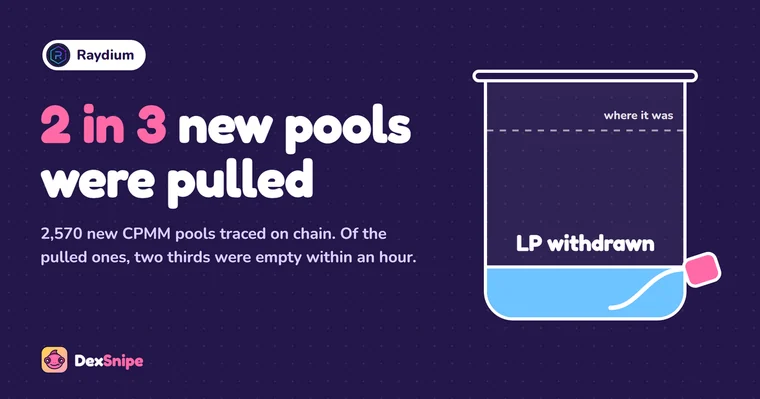
On Raydium, the person who opens a pool owns its liquidity and can take it back whenever they like. Two thirds of the new pools opened last month ended exactly that way. We traced 2,570 of them on chain, and the trades inside 209 pulled pools one by one, to answer the questions a Raydium sniper actually has: how fast the pull comes, who loses, whether a fast bot can get out first, and what the pool looked like before it happened.
79 seconds in one Raydium pool
Before the statistics, one pool, because it shows the whole pattern in a minute and a half.
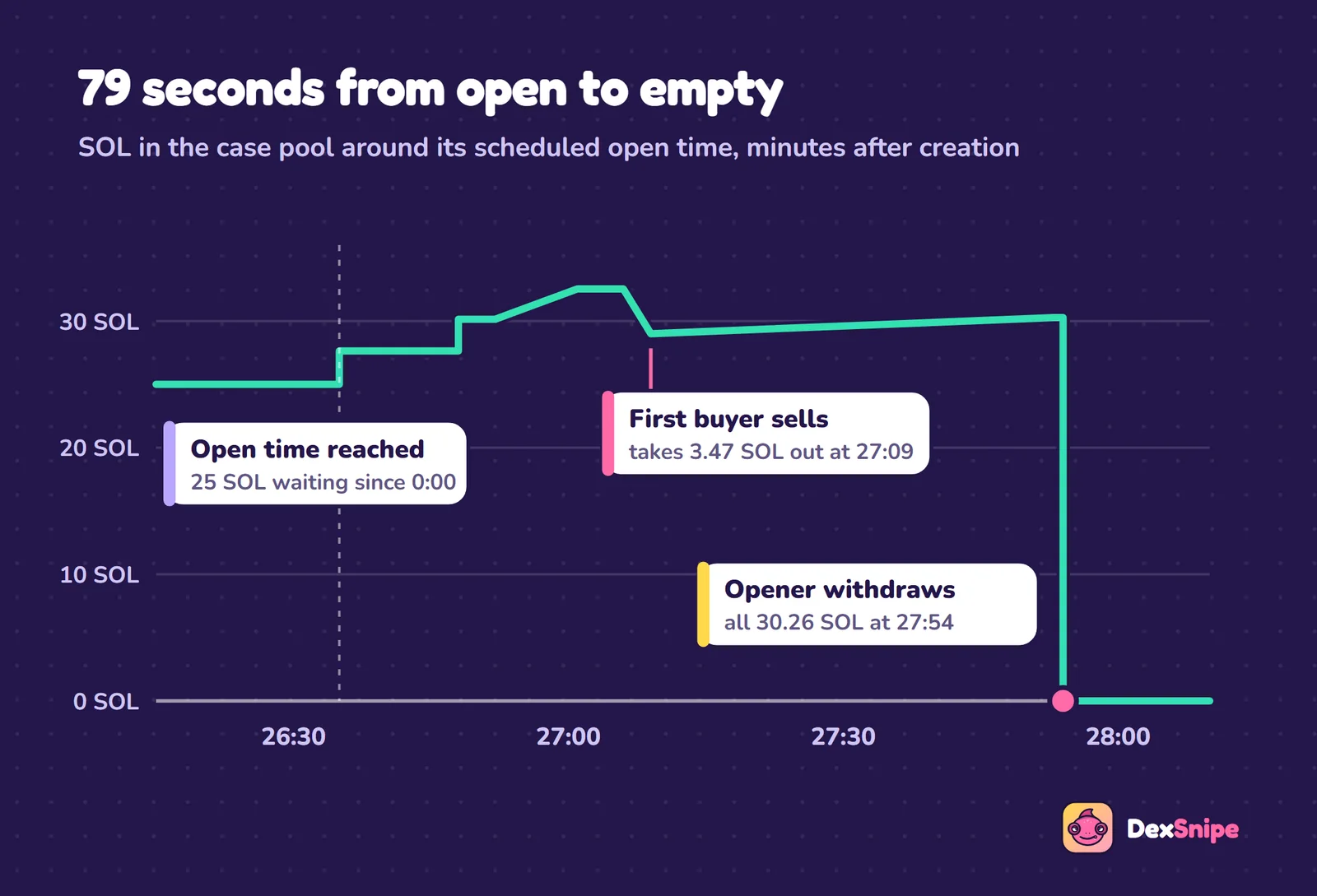
On 26 October 2026 a wallet opened a Raydium CPMM pool pairing a new token with 25 SOL. It did not let trading start right away. It set the pool's open time 26 minutes and 35 seconds into the future, so the pool sat on chain, visible to anyone reading new pools, with swaps disabled. When the clock reached the open time, a buy landed in the very first second.
Data table
The case pool, minute by minute after it was created
| Time | What happened | SOL in the pool |
|---|---|---|
| 0:00 | Pool created with 25 SOL, open time set 26:35 later | 25.00 |
| 26:35 | Open time reached. First buyer puts in 2.57 SOL in the opening second | 27.64 |
| 26:48 | A second large buyer adds 2.09 SOL | 30.14 |
| 26:52 to 27:01 | One wallet starts buying in small pieces | 32.54 |
| 27:06 to 27:09 | The first buyer sells, taking 3.47 SOL out | 29.00 |
| 27:09 to 27:53 | The small-pieces wallet keeps buying, 3.53 SOL in total; a few other trades | 30.27 |
| 27:54 | The opener withdraws all liquidity: 30.26 SOL | 0.00 |
Trading lasted 79 seconds. The opener put in 25 SOL and took out 30.26. The first buyer, almost certainly a bot, bought in the opening second, sold half a minute later and came out about a third up overall. The wallet that bought in a dozen small pieces got 0.19 SOL back from 3.53. The second large buyer got nothing back at all, because by the time it might have sold, there was nothing in the pool to sell into.
Three things in this one pool turn out to be true of hand-opened Raydium pools in general, and the rest of this page is the evidence. The pull comes early. The first fast seller can survive. And everyone who arrives after the first rush is providing the exit.
Where new Raydium pools open now
Raydium runs three pool programs. Most guides and most free snipers on GitHub were written for the oldest one, AMM v4, back when Pump.fun sent its graduates there. That is no longer where new pools open. We read the open time of every pool in each program:
| Program | Pools in total | Opened in the last 30 days |
|---|---|---|
| CPMM (standard pools) | 241,885 | 3,580 |
| AMM v4 (legacy) | 706,009 | 23 |
| CLMM (concentrated) | 196,459 | not counted |
CLMM pools store their open time differently, and new CLMM pools are mostly for established tokens, so we left them out. For a sniper the point is simple: new Raydium tokens open in CPMM pools. A bot listening only to AMM v4 runs without errors and almost never fires.
| Month | New pools |
|---|---|
| May 2026 | 3,086 |
| June 2026 | 3,125 |
| July 2026 | 3,636 |
| August 2026 | 4,530 |
| September 2026 | 7,244 |
| October 2026 | 4,118 |
Of the 3,580 pools opened in our 30 day window, 767 were LaunchLab graduations, moved into Raydium automatically when a bonding curve filled. Those behave very differently and get their own section below. The rest were opened by hand, and 2,570 of them paired a token with SOL. Those 2,570 pools, opened by 1,843 different wallets, are what this page is about.
How many new Raydium pools get pulled
Raydium's CPMM program keeps a running LP supply inside every pool. Adding liquidity raises it, withdrawing lowers it, and the program keeps a tiny amount locked forever so a pool can never reach exactly zero. When a pool's LP supply is back at that floor, everything anyone deposited has been taken out. That is a strict test: it only counts complete withdrawals, not pools that bled out through selling.
The 700 pools whose opener still holds the LP are not safe either. Most of them hold very little: across all 2,570 pools, 2,022 had less than 0.1 SOL left when we read them. A pool whose liquidity was never pulled can still be worthless because holders sold everything into it.
Age does not explain the numbers. Among the 77 pools opened in the 24 hours before our read, 48 already held under 0.1 SOL. These pools do not fade over weeks. Most are finished within the hour, as the next sections show.
How this compares with other research
Our 68% is lower than the figures you may have seen quoted, and the difference is worth understanding because it tells you what kind of risk you are filtering.
- Solidus Labs examined 388,000 pools on Raydium's older AMM v4 program and reported that about 93% showed signs of a soft rug pull: liquidity withdrawn in a way that crashed the price. Their test counts partial withdrawals that cause a large price drop, so it catches more than ours.
- An academic study published on arXiv in 2026 labelled 76,469 of 100,063 new tokens on Orca, Raydium and Meteora in the first half of 2025 as rug pulls, using three on-chain patterns: freeze authority abuse, liquidity withdrawal and pump-and-dump. It found a median lifecycle of 0.01 days for fraudulent tokens, about a quarter of an hour, and fraud groups with a median of 36 participating wallets.
- Our count only includes pools whose liquidity was withdrawn completely, by the CPMM program's own accounting, and only hand-opened SOL pools from one recent month.
Three different methods, three different years and programs, and the same conclusion: a hand-opened pool on Raydium is a rug pull more often than not. Our median time to the pull, 23 minutes from creation, sits right next to the academic study's quarter of an hour. That is the window a sniper is trading in.
The pull clock: how fast the liquidity goes
For the timing we drew a random sample of 220 pulled pools and read their transactions from creation onwards; 209 reached a full withdrawal in what we read. Every one of the 209 withdrawals was signed by the same wallet that created the pool. In 10 of them the opener took out part of the liquidity first and the rest later; the other 199 went in one transaction.
Data table
Time from pool creation to full withdrawal, 209 sampled pulled pools
| Emptied within | Pools | Share |
|---|---|---|
| 5 minutes | 31 | 15% |
| 15 minutes | 73 | 35% |
| 1 hour | 141 | 67% |
| 4 hours | 167 | 80% |
| 24 hours | 192 | 92% |
| Longer than a day | 17 | 8% |
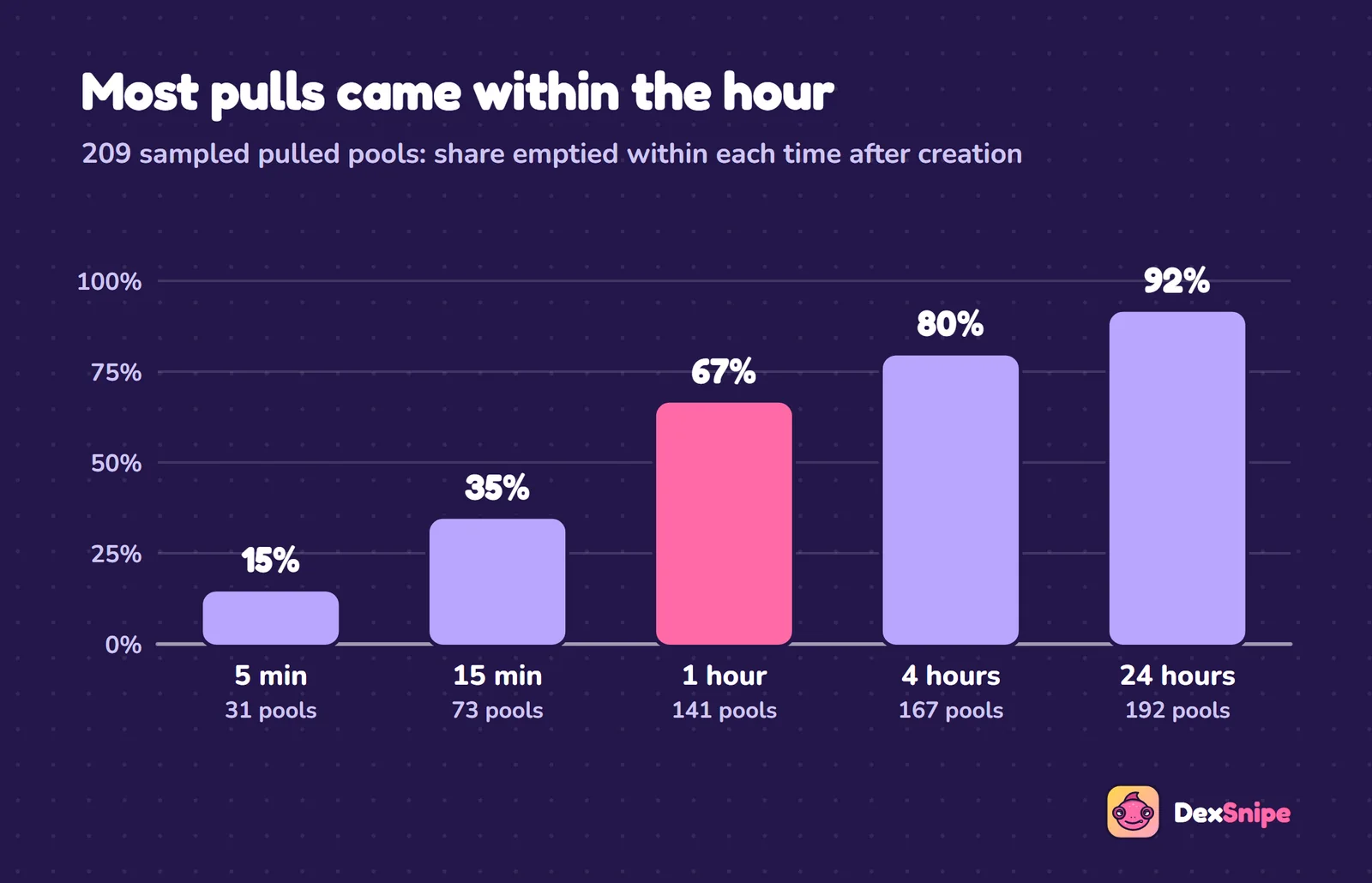
The median pool was emptied 22.8 minutes after it was created. A quarter were gone within 8.5 minutes, three quarters within 101 minutes. The median pulled pool saw 19 swaps before the end.
What this means for exits. A strategy that holds a hand-opened Raydium token for hours, waiting for a 5x, is holding through the exact window in which two thirds of these pools disappear. If you trade unprotected pools at all, your exits have to be finished inside the first quarter of an hour, not planned for the afternoon.
The busy first minute is mostly not real
A new pool that shows dozens of buys in its first minute looks like demand. In the pulled pools we traced, it mostly was not.
We counted every buy in the first 60 seconds of trading across the 209 pools: 2,313 of them. 1,862, or 80%, were smaller than 0.005 SOL. And 1,999 of them came from just 34 wallets, each of which traded in at least ten of our 209 sampled pools. The busiest one traded in 208 of the 209. Across all the pulled pools, those 34 wallets put in 9.89 SOL and took out 10.88. They are not victims. They are automated traders that touch every new pool with tiny amounts, and what they produce, intended or not, is a pool that looks active on scanners.
| Buys | Count | Share |
|---|---|---|
| All buys in the first minute | 2,313 | 100% |
| Smaller than 0.005 SOL | 1,862 | 80% |
| From the 34 wallets active in ten or more of these pools | 1,999 | 86% |
When we filtered those wallets out and only counted buys of at least 0.02 SOL from anyone else, 52 of the 209 pulled pools never had a single real buyer. They were opened, sprayed with dust trades and closed. For the other 157, the median pool had just one real buyer. The losses were concentrated in a few pools that did attract attention.
The practical lesson: transaction count, maker count and buy count in the first minute tell you almost nothing on a hand-opened Raydium pool. A sniper filter based on early activity is reading noise produced largely by other bots.
Who lost and who got out
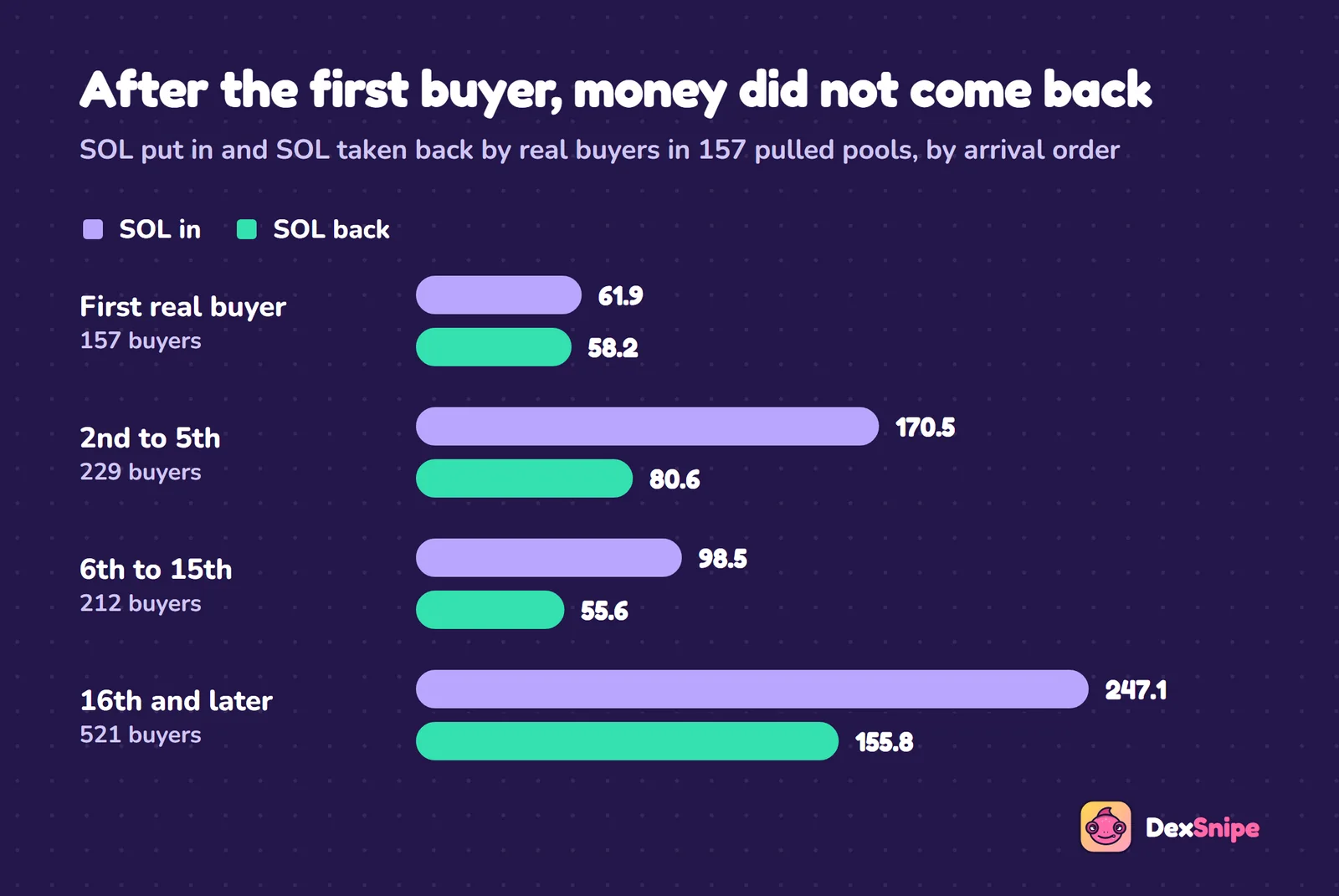
Across the 157 pulled pools that had real buyers, those buyers put in 578.0 SOL and got 350.2 SOL back before the pools were emptied. They lost 227.8 SOL, about 39% of what they spent. The pool openers' net gain across the same 209 pools was 224.0 SOL, which matches almost exactly: the money that real buyers lost is the money the openers took home.
How a buyer did depended heavily on when they arrived. We ranked real buyers in each pool by the order of their first buy and classed each one as a win (got out more than 2% above what they put in), a loss (got back less than half) or roughly flat.
Data table
Real buyers in 157 pulled pools, by the order they arrived
| Arrival order | Buyers | Won | Lost over half | SOL in | SOL back |
|---|---|---|---|---|---|
| First real buyer | 157 | 48 | 25 | 61.9 | 58.2 |
| 2nd to 5th | 229 | 47 | 118 | 170.5 | 80.6 |
| 6th to 15th | 212 | 44 | 98 | 98.5 | 55.6 |
| 16th and later | 521 | 83 | 310 | 247.1 | 155.8 |
The first real buyer, which on a new pool is usually a sniper bot, came out close to even as a group: 61.9 SOL in, 58.2 SOL back, with more winners than losers. From the second buyer onwards the picture turns. More than half of the buyers ranked 2nd to 5th lost more than half their stake, and the late arrivals, the people who presumably found the token on a chart or in a chat, lost most often of all.
Can a fast sniper outrun the pull?
Sometimes, and the case pool shows how. But look at what the price did after the first real buy. We measured the highest pool price reached before the pull, relative to the price the first real buyer paid:
| Price reached at least | Pools | Share |
|---|---|---|
| 1.25 times | 45 | 29% |
| 1.5 times | 37 | 24% |
| 2 times | 24 | 15% |
| 3 times | 13 | 8% |
In seven pulled pools out of ten, the first real buyer never saw even a 25% gain on the pool price before the end. A take-profit at +100% would have filled in about one pulled pool in seven. The first buyers who came out ahead mostly did it the way the bot in the case pool did: by selling within seconds into the buyers who came after them, at whatever gain was there.
That is a real strategy, and some bots run it deliberately. It is also a race against other bots doing the same thing, in a pool where the opener can end the game in any block. For most people, the better answer is not to be in an unprotected pool at all.
Signs that came before the pull
If two in three hand-opened pools get pulled, the useful question is which ones. We went back to the creation transaction of 2,480 of the 2,570 pools, the ones whose opening transaction we could read in full, and recorded what the opener did at the start: how much SOL they added, what share of the token supply they put in the pool, and whether anything else happened in the same transaction. Then we compared that with how each pool ended.
The opener put the whole supply in the pool
Data table
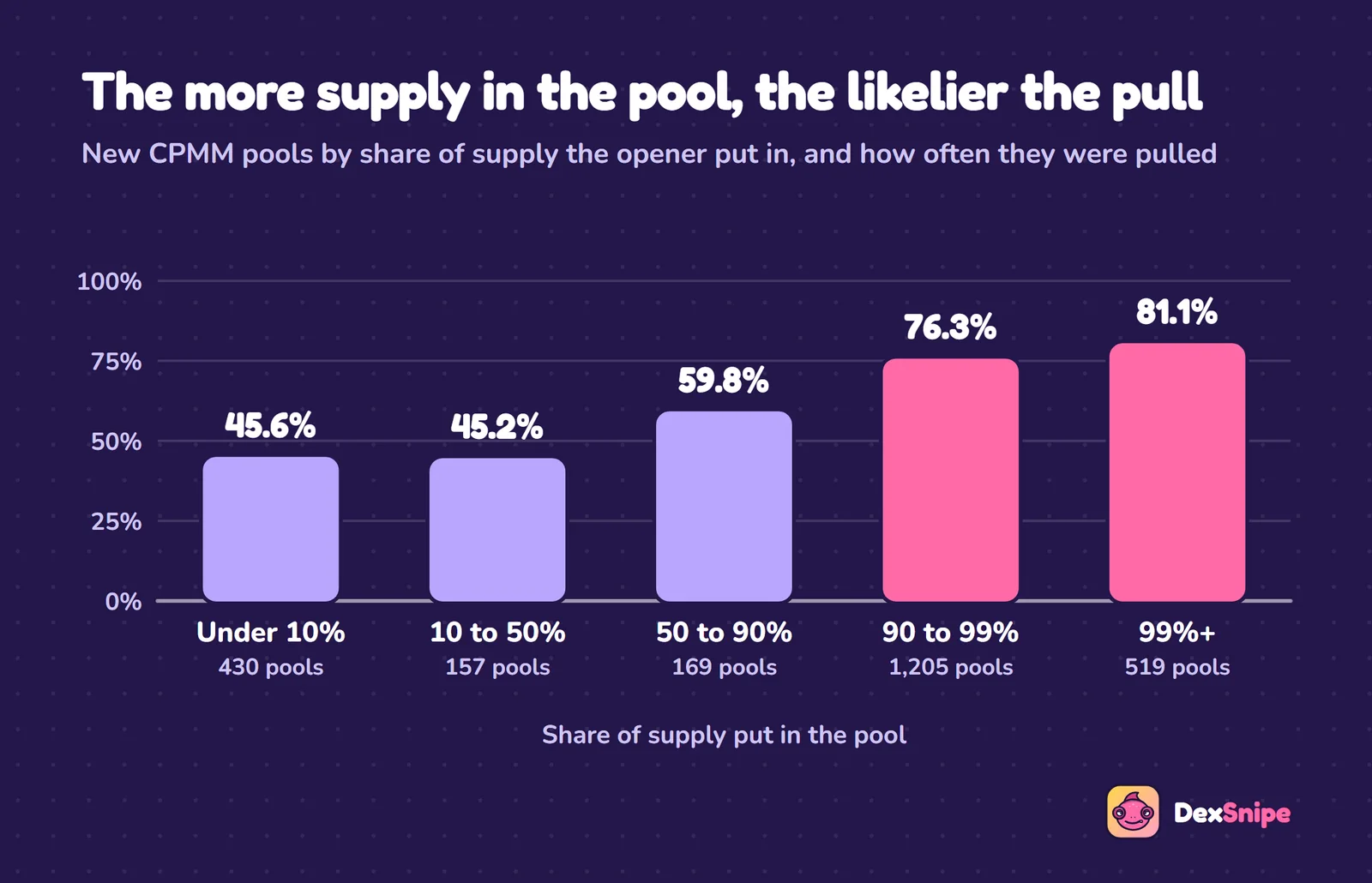
Share of the token supply the opener put into the pool, and how often the pool was pulled
| Supply put in the pool | Pools | Pulled | Still 1 SOL or more |
|---|---|---|---|
| Under 10% | 430 | 45.6% | 54 |
| 10% to 50% | 157 | 45.2% | 36 |
| 50% to 90% | 169 | 59.8% | 20 |
| 90% to 99% | 1,205 | 76.3% | 15 |
| 99% or more | 519 | 81.1% | 25 |
This was the clearest signal we found. When the opener put 90% or more of the token supply into the pool, the pool was pulled in about four cases out of five. When they kept most of the supply outside, the pull rate dropped to under half.
The logic is simple once you see it. An opener who puts the entire supply in the pool owns nothing but the LP tokens, so the only way to cash out is to withdraw the liquidity. An opener who keeps tokens outside the pool has another exit, selling, which is why a dev holding cap still matters, but pulling is not their only option. Neither case is a good sign by itself. Together with LP that has not been burned or locked, a full-supply pool is about as clear a warning as the chain gives you.
More liquidity did not mean less risk
| Opening liquidity | Pools | Pulled | Still 1 SOL or more |
|---|---|---|---|
| Under 0.5 SOL | 1,544 | 68.1% | 12 |
| 0.5 to 1 SOL | 205 | 55.6% | 9 |
| 1 to 2 SOL | 210 | 69.0% | 38 |
| 2 to 5 SOL | 153 | 74.5% | 30 |
| 5 to 10 SOL | 126 | 68.3% | 29 |
| 10 to 20 SOL | 116 | 78.4% | 17 |
| 20 to 50 SOL | 82 | 90.2% | 5 |
| 50 SOL or more | 44 | 77.3% | 10 |
Most guides tell you to look for pools with real liquidity, and that is right for a different reason: it keeps you out of dust pools and keeps slippage sane. But it does not protect you from the pull. Pools opened with 20 to 50 SOL were pulled 90% of the time, more often than anything else. A bigger pool attracts bigger buys, and a bigger pull. The case pool at the top of this page started with 25 SOL.
Note also how many pools started with less than half a SOL: 1,544, or 62% of the total. A minimum liquidity filter removes them in one go, and that alone cuts most of the noise a Raydium sniper would otherwise process.
Opener history
| Opener | Pools | Pulled |
|---|---|---|
| Opened 1 pool | 1,458 | 61.5% |
| Opened 2 to 4 pools | 797 | 79.7% |
| Opened 5 or more pools | 315 | 69.2% |
Repeat openers pulled more often, and one wallet opened 57 pools in the month. Wallets that open pool after pool are worth recognising when you see them. But a first-time opener still pulled six times out of ten, so history alone will not save you.
Checks that do not help here
Most sniper bots lead with mint and freeze authority checks. On hand-opened Raydium pools they made no difference to the pull rate:
| Token | Pools | Liquidity withdrawn |
|---|---|---|
| Mint and freeze authority both revoked | 2,236 | 68.1% |
| Mint authority still active | 287 | 66.6% |
| Token-2022 token | 227 | 63.0% |
That is not an argument for switching the authority checks off. An active mint authority lets someone print new tokens into the pool; an active freeze authority lets them freeze your tokens so you cannot sell. The academic study above lists freeze authority abuse as one of the three main rug patterns on Solana. These checks protect you from those tricks. They simply do nothing against the most common one on new Raydium pools, which needs no special token powers at all: the opener withdraws what they deposited, plus what you deposited after them.
LP burned, locked or held
When someone adds liquidity to a Raydium pool, they get LP tokens back. Whoever holds those LP tokens can withdraw the liquidity. A new pool is in one of three states:
- LP burned. The LP tokens were destroyed. Nobody can withdraw that liquidity again. On a CPMM pool you can see it by comparing the LP supply stored in the pool with the supply of the LP token mint: burned LP no longer exists as tokens.
- LP locked. The LP tokens went into Raydium's Burn and Earn locker. The liquidity can never be withdrawn, but the owner keeps earning its share of trading fees. LaunchLab uses it for the locked share of graduated pools.
- LP held. The opener kept the LP tokens in a normal wallet and can pull everything in one transaction, at any moment.
Of the new SOL pools in our count that still had liquidity, 120 had burned LP and 700 did not. A pool with burned LP can still go to zero if holders sell, and 46 of those 120 did. But the opener cannot empty it on you in one block, and none of the 120 was pulled.
Partly burned LP. An opener can burn some LP and keep the rest. A pool with 60% of its LP burned can still have 40% of its liquidity pulled. A check that only asks "was any LP burned?" misses this. Ask for most of the LP to be burned or locked, not some.
Check a Raydium pool yourself
You do not need a bot to run the most important check. With a block explorer and two minutes, you can see what a sniper should see before it buys.
- Find the pool account. Open the token on a chart site and copy the pool address, or look the token up on Solscan and open its Raydium CPMM pool.
- Read the LP supply stored in the pool and the address of its LP mint. Solscan decodes Raydium pool accounts, so both are visible in the account data.
- Open the LP mint and read its current supply. If the mint supply is close to the pool's LP supply, the LP tokens still exist. If it is a small fraction, most of them were burned.
- Look at the largest LP holders. If the LP tokens sit in a normal wallet, usually the one that created the pool, the liquidity can be pulled. If they sit in Raydium's locker, they are locked.
- Check the opening transaction. How much SOL went in, and how much of the token supply? A pool that holds the whole supply, with LP still in the opener's wallet, matches the pattern most likely to be pulled.
A sniper bot has to do the same thing in milliseconds, which is why the LP check has to be built in, not bolted on. In DexSnipe it is a single switch on every sniper: LP burned or locked.
Scheduled pools and open time
A CPMM pool can be created with an open time in the future. The pool exists, the liquidity is in, but swaps fail until that moment. Raydium's docs note that swaps only start once the open time is reached. When we read the chain, 13 CPMM pools were waiting to open, some within days and some set years ahead.
The case pool used a 26 minute delay, and that is worth thinking about. A delay gives every bot reading new pools time to see the pool, read its liquidity and prepare a buy for the opening second. It guarantees a crowd at the open. For an opener planning to pull, that crowd is the point.
None of this means every scheduled pool is a trap. Projects use open times for honest reasons too, like announcing a launch time in advance. But a scheduled pool with LP held by the opener combines the two things that made the case pool work: guaranteed buyers at a known second, and liquidity that can leave in the next block.
- If you snipe scheduled pools, expect the first block to be crowded and the price to jump within seconds. Use a smaller buy and a slippage cap you are comfortable losing to.
- A pool set to open years from now is usually a mistake or a parking spot, not a launch.
LaunchLab pools are a different market
767 of the 3,580 new CPMM pools in our window came from LaunchLab graduations. These pools are opened by Raydium's own migration, not by a person, and their LP is burned or permanently locked by the program. Of the 185 paired with SOL, 183 still held 1 SOL or more when we checked.
That is the opposite picture from hand-opened pools. If you want new Raydium tokens without the pull risk, graduations are the place to aim, and they have their own risks and their own guides: Raydium LaunchLab sniper bot and LetsBonk sniper bot. Tokens from Pump.fun graduate into PumpSwap instead; see the PumpSwap sniper bot guide. And if you are comparing venues, Meteora has a different main risk, its anti-sniper fees, covered in the Meteora sniper bot guide.
Raydium sniper settings
These settings follow from the numbers above. They are starting points, not promises.
| Setting | Careful | Balanced | Fast flip |
|---|---|---|---|
| Trigger | New pool | New pool | New pool |
| LP burned or locked | On | On | On |
| Min liquidity | 10 SOL | 5 SOL | 2 SOL |
| Buy size | 0.1 SOL | 0.25 SOL | 0.25 SOL |
| Slippage cap | 15% | 20% | 25% |
| Priority fee | 0.0005 SOL | 0.001 SOL | 0.002 SOL |
| Jito tip | 0.001 SOL | 0.002 SOL | 0.004 SOL |
| Max transfer tax | 0% | 0% | 0% |
| Dev holding cap | 5% | 10% | 10% |
| Take-profit | +50% sell 50%, +150% sell 50% | +100% sell 50%, +300% sell 50% | +25% sell 60%, +60% sell 40% |
| Stop-loss | 25% | 35% | 20% |
| Timer | 60 min | off | 5 min |
Why the LP check stays on in every column
Turning it off means buying into a market where two pools in three are emptied, usually within the hour, and where the median first real buyer never sees a 25% gain. The fast flip column is the closest thing to sniping unprotected pools sensibly, and it still keeps the check on. Its job is to take small gains quickly on the protected pools, where buyers rush in too.
Minimum liquidity: what it does and what it does not
A floor of a few SOL removes the 62% of pools that open with less than half a SOL, almost none of which ever hold anything. It also keeps your own buy from moving the price too much: a 0.25 SOL buy into a 5 SOL pool moves the price around 10% on its own. What it does not do is reduce the pull rate. That is the LP check's job.
Slippage and speed
A sniper buying in the first seconds competes with other bots for the same pool, so 15 to 25% slippage is normal on the buy. Allow more on sells, because the price can drop fast when others exit. Read new pools from the chain rather than a website feed; the pool exists on chain well before charts list it.
Exits built around the pull window
Raydium pools do not hold orders. Every take-profit, stop-loss and timer is your bot watching the pool and sending a sell. Given what the data shows, a few rules make sense for any Raydium sniper:
- Take your cost back early. The first take-profit step should return what you put in. On a protected pool that leaves you holding a free position. On anything else it is the difference between the first real buyer's result and the fifth one's.
- Use a timer. Two thirds of pulls happen within an hour. A timer exit closes positions that are going nowhere before they become part of someone's withdrawal.
- Use a trailing stop rather than a fixed far target. Peaks on new pools come early and fade. A trailing stop gives back part of a rise instead of all of it.
- Turn on the dev-sell exit. If the creator starts selling, you want to be out in the same minute.
Why can't I sell my Raydium token?
| What you see | Likely cause | What to change |
|---|---|---|
| Sell returns almost nothing | The liquidity was withdrawn | Use the LP burned or locked filter before buying |
| Sell fails on a falling token | Sell slippage too tight | Allow more slippage on sells |
| Buy fails right after the pool appears | The pool has a future open time | Wait for the open time, or skip scheduled pools |
| You receive far less than quoted | The token has a transfer tax | Set Max transfer tax to 0% |
| Sell fails with a frozen account error | The token's freeze authority was used | Keep the freeze authority filter on |
Raydium sniper bots on GitHub, in Python and on Telegram
Search for a Raydium sniper bot and most results are GitHub repositories. Many were written in 2024 for AMM v4 pools, which now get a handful of new pools a month. Before you run one, check three things:
- Which program it watches. It needs CPMM. Ask whether it reads Token-2022 tokens and their transfer taxes.
- Whether it reads LP state, including partly burned LP. Without it, the bot buys the 68% too.
- What the code does with your key. In 2025 a Solana trading bot on GitHub turned out to be malware that sent users' private keys to its author, with fake stars and forks to look popular. Anything that asks you to download a password-protected archive is a red flag.
Telegram trading bots are another route. They are quick for manual buys, and most charge a percentage on every trade. For a sniper that fires several times a day, a flat price adds up to less.
Raydium in DexSnipe
Raydium is a venue for the New pool, Creator watch and Copy trade triggers in DexSnipe. Each sniper has the LP burned or locked check, a minimum liquidity in SOL, a transfer tax cap, mint and freeze authority checks, dev and top-10 holder caps and a word blocklist for names and tickers. You can tick Raydium together with other DEXs in one sniper. The price is a flat plan from 1 SOL for 7 days with no cut of your trades, and you trade from a separate wallet you control.
Set up a Raydium sniper in DexSnipe
- Open the panel and click New sniper. Pick the New pool trigger and tick Raydium.
- Load a preset, then turn on LP burned or locked and set a minimum liquidity of a few SOL.
- Tighten the filters: mint and freeze authority revoked, max transfer tax 0%, dev cap 5 to 10%, top 10 cap around 30%, and a few blocklist words for copycat names.
- Build exits for the pull window: a first take-profit that returns your cost, a stop-loss, a timer and dev-sell.
- Connect your wallet and save. Snipers are stored on your wallet address.
- Pick a plan, add a sniper wallet and arm it. Send 1, 3 or 5 SOL to the reserved address, add the key of a separate funded wallet, arm the sniper and close the tab.
Trade only what you can lose. A sniper improves your entry and your discipline. It does not change how most new Raydium pairs end. This page is not financial advice.
Raydium sniper bot questions
What is a Raydium sniper bot?
+
A bot that watches Raydium for new liquidity pools and buys the token in the first seconds after the pool opens, then sells on rules you set. On Raydium a good one also checks, before buying, whether the person who opened the pool can still take the liquidity back out.
How many new Raydium pools are rug pulls?
+
Of 2,570 new SOL pools opened by hand on Raydium's CPMM program in 30 days, 1,750 (68%) later had all of their liquidity withdrawn. In a sample of 209 of them, every withdrawal was signed by the wallet that opened the pool, and the median pool was emptied 23 minutes after it was created.
How fast do Raydium rug pulls happen?
+
Fast. In our sample, 31 of 209 pulled pools were emptied within 5 minutes of being created, 73 within 15 minutes and 141 within an hour. Only 17 lasted longer than a day.
Can a sniper bot sell before the liquidity is pulled?
+
Sometimes. The first real buyer in a pulled pool got out with a profit in 48 of 157 cases and lost more than half in 25. Buyers who came later did much worse: among those who arrived after the fifteenth real buyer, 310 of 521 lost more than half. A sniper that is early and sells fast survives more often, but the reliable protection is not buying pools whose liquidity can be pulled.
Does a revoked mint authority make a Raydium token safe?
+
Not against a liquidity pull. Tokens with both mint and freeze authority revoked had their liquidity pulled 68% of the time, the same as everything else. Authority checks stop a different trick. Only an LP burned or locked check stops the pull.
How do I check if Raydium LP is burned?
+
Open the pool on a block explorer and compare the LP supply stored in the pool with the current supply of its LP token mint. If most LP tokens were burned, the mint supply is far lower than the pool's figure. Locked LP sits in Raydium's Burn and Earn locker instead. A sniper bot should run this check before every buy.
Does more liquidity mean a safer Raydium pool?
+
No. In our data, pools opened with 20 to 50 SOL were pulled 90% of the time, more often than tiny pools. A minimum liquidity filter removes dust pools and makes slippage manageable, but it does not protect you from a pull.
Does DexSnipe take a fee on Raydium trades?
+
No. DexSnipe is a flat plan: 1 SOL for 7 days, 3 SOL for 30 days or 5 SOL for 90 days. You pay the network fee, your own priority fee and tip, and Raydium's pool fee on each swap.
Sources and method
In November 2026 we listed every pool account of Raydium's CPMM, AMM v4 and CLMM programs through a Solana RPC node and read each pool's open time. For the 3,580 CPMM pools opened in the 30 days before our read we decoded the pool, the SOL vault balance, the LP token supply and the token mint, and matched the mints against LaunchLab graduations. A pool counts as withdrawn when the LP supply stored in the pool is down to the minimum the program keeps locked.
For the signals section we read the creation transaction of each of the 2,570 hand-opened SOL pools and recorded the SOL and tokens deposited; 2,480 had a creation transaction we could read in full. Supply share is tokens deposited divided by the mint's current supply. For the timing and buyer analysis we drew a random sample of 220 withdrawn pools and read up to 400 transactions of each from creation onwards, using the pool's vault balances before and after each transaction; 209 reached a full withdrawal within that range. A real buyer is a wallet other than the opener that bought at least 0.02 SOL and did not trade in ten or more of the sampled pools. A buyer won if they got back more than 2% above what they spent, and lost if they got back less than half. Prices are pool prices after each trade, so a take-profit fill would have been somewhat lower. How CPMM works comes from Raydium's docs and source code. DexSnipe triggers, filters and presets are taken from the product itself.
- CPMM overview (Raydium docs)How Raydium's constant product pools work, including the open time that holds swaps until a set moment.
- Create a CPMM pool (Raydium docs)The steps anyone can follow to open a new Raydium pool for any token.
- Burn and Earn (Raydium docs)Raydium's permanent LP lock, the alternative to burning LP tokens.
- LaunchLab overview (Raydium docs)How LaunchLab tokens graduate into CPMM pools with their LP burned or locked.
- raydium-cp-swap source code (GitHub)The CPMM program. Its withdraw instruction lowers the LP supply stored in the pool, which is how we identified pulled pools.
- Raydium CPMM program on SolscanProgram CPMMoo8L3F4NbTegBCKVNunggL7H1ZpdTHKxQB5qKP1C, where we read 241,885 pools.
- Raydium AMM v4 program on SolscanThe older AMM most GitHub snipers were written for. 706,009 pools, 23 of them opened in our 30 day window.
- Raydium CLMM program on SolscanConcentrated liquidity pools, 196,459 in total.
- The 79 second pool from our case study, on SolscanOpened with 25 SOL on 26 October 2026, scheduled to start trading 26 minutes later, emptied by its opener 79 seconds after the first trade.
- Solidus Labs: Solana rug pulls and pump-and-dumpsIndustry report that examined 388,000 Raydium AMM v4 pools and found about 93% showed signs of soft rug pulls.
- From Hype to Collapse: Investigating Rug Pull Scams on Solana (arXiv)Academic study of 100,063 new tokens on Orca, Raydium and Meteora in the first half of 2025; 76,469 labelled rug pulls with a median lifecycle of 0.01 days.
- Transfer fees for Token-2022 (Solana docs)How a token can charge a fee on every transfer, including your buy and your sell.
- Cointelegraph: Solana trading bot on GitHub hid wallet-draining malwareJuly 2025 report on a fake open source Solana bot that sent users' private keys to its author.
Snipe Raydium pools that cannot be pulled
Build your sniper for free, then a plan from 1 SOL switches it on. No cut of your trades.