Buy a Solana Token in Parts
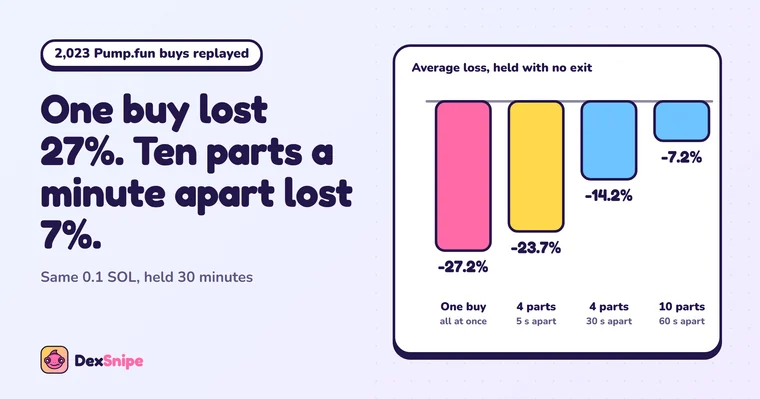
Splitting a buy into parts is the oldest trick for not going all in at the wrong moment. On a new Solana coin the wrong moment is usually the first minute, and most coins fall after it. We took 2,023 real buys on new Pump.fun coins and replayed each one as a single buy and as 2 to 10 parts, 5 seconds to 5 minutes apart. Held with no exit, slow splits lost a fraction of what one buy lost. Fast splits paid more. With a trailing stop, splitting mostly decided how much you had in when the coin turned.
The short version
- The curve does not reward splitting. Ten small buys back to back get the same tokens as one big one. Only the time between them matters.
- Slow splits average down. Most new coins fall, so parts 30 seconds or more apart usually bought cheaper, and held losses shrank, by half or more on the slowest splits.
- The cost is the winners. On coins that ran, later parts cost more, and fewer positions ended in profit.
- With a trailing stop, it sizes the bet. The stop often sold before the later parts were bought, so splitting put less SOL into coins that turned early, and less into the ones that ran.
What buying in parts does
A sniper normally spends its whole buy the moment its signal fires. With buy in parts, it spends the first part then, and the rest in equal parts a set number of seconds apart. Set a 1 SOL buy to four parts, 30 seconds apart, and the sniper buys 0.25 SOL at the signal, 0.25 SOL 30 seconds later, and so on until 90 seconds in.
On a stock or a large token this is the familiar idea of averaging in. Here it is narrower. All the parts go into the one token the sniper just caught, starting from its signal. It is not a standing plan that buys something every day, and it does not work on tokens you did not snipe.
Splitting does not change the price
A common reason to split a buy is to pay less slippage. On a Pump.fun bonding curve that does not work. The curve is a constant product of its SOL and token reserves. A 1 SOL buy moves the price along the curve from one point to another, and ten 0.1 SOL buys back to back move it between the same two points in ten steps. They receive exactly the same tokens. The percentage trading fee is taken from each part in the same proportion, so it does not change that either.
So the only thing splitting changes is time. Between your parts, other people buy and sell. If they push the price down, your later parts are cheaper. If they push it up, they cost more. Whether splitting helps comes down to which way new coins tend to move in the seconds and minutes after a buy, and that is what we measured.
2,023 buys, replayed
We used the sample behind our copy trading, trailing stop and buy the dip studies: coins created on Pump.fun between 14:56 and 16:51 on November 5, 2026, each followed trade by trade for its first 30 minutes on the bonding curve. From the 412 ordinary coins paired with SOL with a full history, we took every position opened by a wallet other than the creator with a first buy of 0.01 to 5 SOL: 2,023 signals by 1,383 wallets on 186 coins.
Each signal got a 0.1 SOL budget. As one buy, it spent it all at the price the real wallet paid. Split, the first part went in at that moment and each later part at the first trade after its scheduled time, at the reserves then. Because the size and timing of each part is the whole point here, we added our own buys to the curve, so each part moves the price for the next. That is why the one-buy figures differ slightly from our earlier studies. We judged the plans two ways: held to the end of the 30 minutes with no exit, and sold with a 10% trailing stop, where no further parts were bought once the stop had sold. Prices come from the curve formula in Pump's public docs, before fees and tips.
Held with no exit
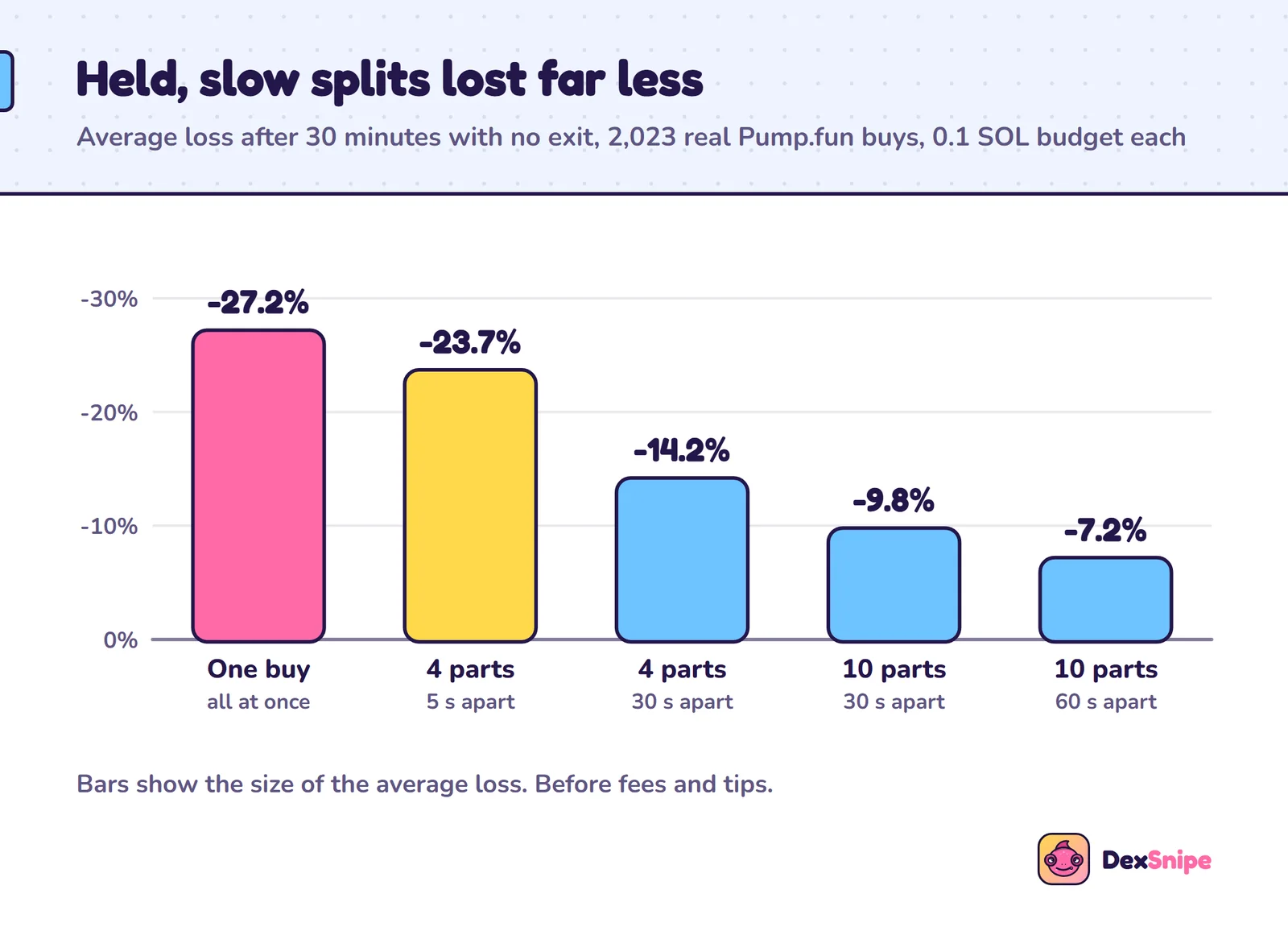
Every plan held, in numbers
Every plan held, in numbers
| Plan | Average | In profit | Average price vs one buy | Paid less than one buy |
|---|---|---|---|---|
| One buy | -27.2% | 13.4% | ||
| 2 parts, 5 s apart | -26.7% | 11.1% | +1.5% | 27.0% |
| 4 parts, 5 s apart | -23.7% | 11.1% | +0.7% | 39.4% |
| 10 parts, 5 s apart | -16.7% | 10.3% | -1.4% | 53.6% |
| 2 parts, 30 s apart | -19.5% | 11.2% | -0.8% | 52.9% |
| 4 parts, 30 s apart | -14.2% | 10.7% | -5.7% | 60.9% |
| 10 parts, 30 s apart | -9.8% | 9.3% | -15.1% | 70.6% |
| 4 parts, 60 s apart | -12.8% | 10.2% | -11.9% | 69.2% |
| 10 parts, 60 s apart | -7.2% | 9.3% | -19.9% | 78.0% |
| 4 parts, 5 min apart | -7.9% | 11.8% | -21.1% | 83.8% |
One buy held for 30 minutes lost 27.2% on average. Most new coins fall, and a position that never sells falls with them. Spreading the same budget over time cut that loss, and the slower the spread, the bigger the cut. Ten parts a minute apart averaged -7.2%. Four parts five minutes apart averaged -7.9%.
The price column says why. Ten parts a minute apart paid a median 19.9% less per token than one buy, and paid less on 78% of signals. On a falling coin each later part buys cheaper, and the average comes down with it. That is averaging down, and on new coins there is a lot of down to average.
The share in profit went the other way, from 13.4% for one buy to around 9% to 12% for the slow splits. On the coins that rose after the signal, later parts cost more, and the gain on the first part was spread over a higher average price. Splitting makes the losers smaller and the winners smaller too. Because most new coins are losers, the average improves.
Fast splits buy the rush
The top rows of the table are the exception. Two parts five seconds apart paid more than one buy on 67% of signals, with a median of 1.5% more per token. Four parts five seconds apart paid more on 57%.
The first seconds after a buy on a new coin are usually more buying. Wallets pile in after a launch, after a large buy, after a wallet that others copy. A part sent five seconds later lands in the middle of that, after the price has gone up. Waiting 30 seconds or more lets the rush pass, and the parts that follow tend to land after the first sellers. If you split, split slowly.
Two coins, one plan
Two positions from the sample, each with a 1 SOL budget, show what the split does to a coin that dumps and a coin that runs. Both compare one buy with four parts 30 seconds apart.
- The dump, created at 15:07:20. A wallet bought one second after launch. The price rose about 37%, then sixteen seconds after the buy the creator and a crowd of others sold within the same second. Held, one 1 SOL buy ended at -63.9%. Four parts 30 seconds apart bought three of them after the dump, far cheaper, and ended at -16.4%.
- The same dump with a 10% trailing stop. One buy sold in the dump for a loss of 0.63 SOL. The split had only its first 0.25 SOL part in when the stop sold, and lost 0.16 SOL. The other three parts were never bought.
- The run, created at 15:19:53. A wallet bought two seconds after launch, and the coin rose about 150% in the next 13 seconds. With a 10% trailing stop, one 1 SOL buy sold for 2.12 SOL, a profit of 1.12 SOL.
- The same run, split. The stop sold before the second part was due. The first 0.25 SOL part came back as 0.53 SOL, a profit of 0.28 SOL.
The split did not trade better or worse on either coin. It simply had less in when the coin moved. That is what splitting does on a fast coin with an exit: it is a bet size that grows only if the coin keeps going long enough to buy the next part.
With a trailing stop
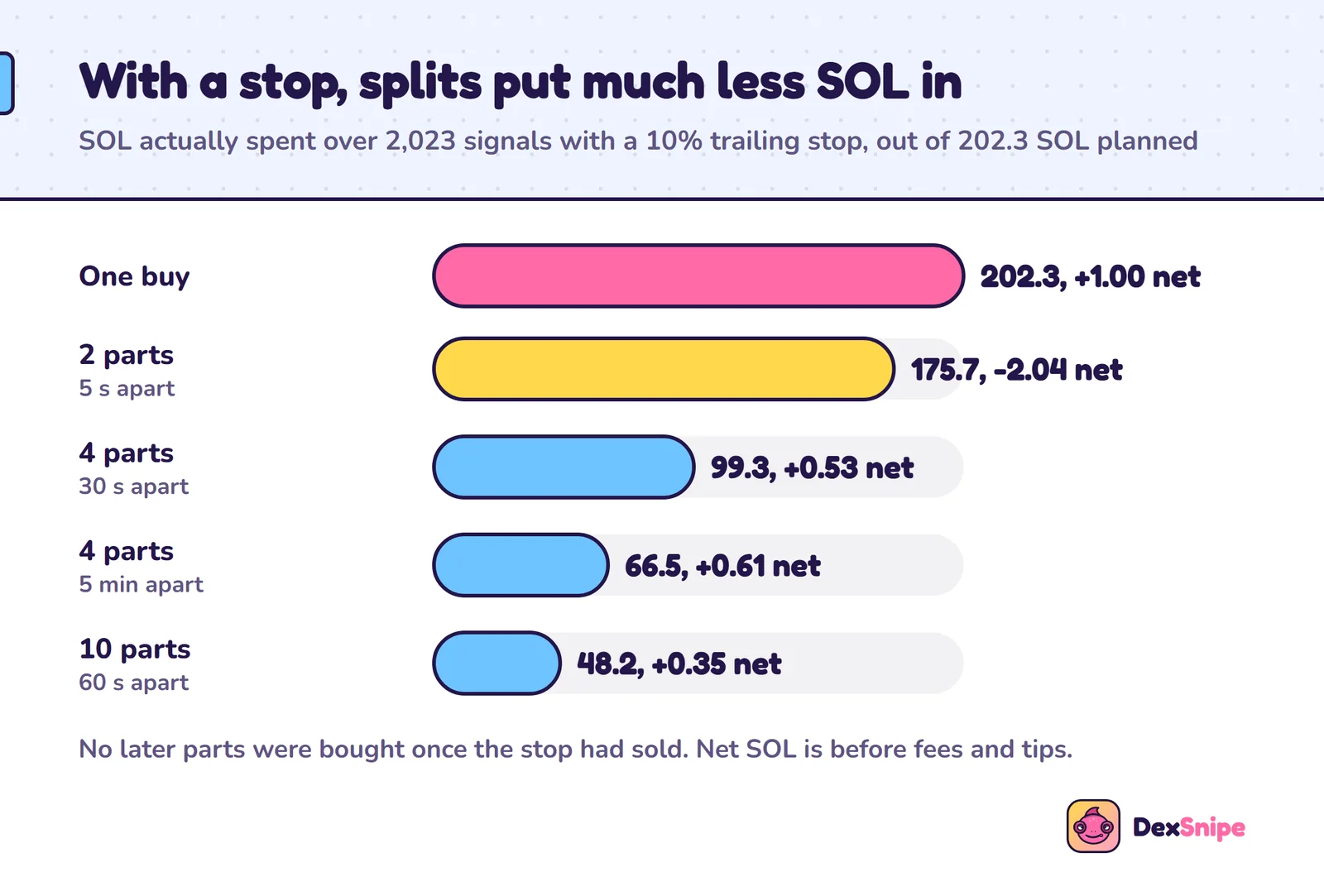
Every plan with a stop, in numbers
Every plan with a stop, in numbers
| Plan | Average | In profit | SOL spent | Net SOL | Net per SOL spent |
|---|---|---|---|---|---|
| One buy | +0.5% | 41.7% | 202.3 | +1.00 | +0.5% |
| 2 parts, 5 s apart | -2.8% | 34.0% | 175.7 | -2.04 | -1.2% |
| 4 parts, 5 s apart | -4.7% | 31.7% | 143.3 | -1.69 | -1.2% |
| 10 parts, 5 s apart | -5.9% | 29.9% | 105.1 | -0.56 | -0.5% |
| 2 parts, 30 s apart | -1.3% | 37.4% | 140.8 | +0.59 | +0.4% |
| 4 parts, 30 s apart | -2.3% | 36.0% | 99.3 | +0.53 | +0.5% |
| 10 parts, 60 s apart | -2.9% | 37.3% | 48.2 | +0.35 | +0.7% |
| 4 parts, 5 min apart | -1.1% | 40.3% | 66.5 | +0.61 | +0.9% |
With a 10% trailing stop on every position, one buy did best per position: +0.5% on average, 41.7% in profit, and a net 1.00 SOL over the 2,023 signals before costs. Every split did worse per position, because the split had less in on the coins that ran.
The SOL columns show the other side. With four parts 30 seconds apart, the stop sold before all four parts were bought on three signals in four, so the plan spent 99.3 SOL of a possible 202.3 and netted 0.53 SOL. Per SOL actually spent that is about the same as one buy. Four parts five minutes apart did a little better per SOL spent, +0.9%, with a third of the SOL in.
Fast splits lost outright: two parts five seconds apart spent 175.7 SOL and lost 2.04 SOL. The second part landed in the rush, raised the average price, and the stop then sold the whole position from there.
By when the signal came
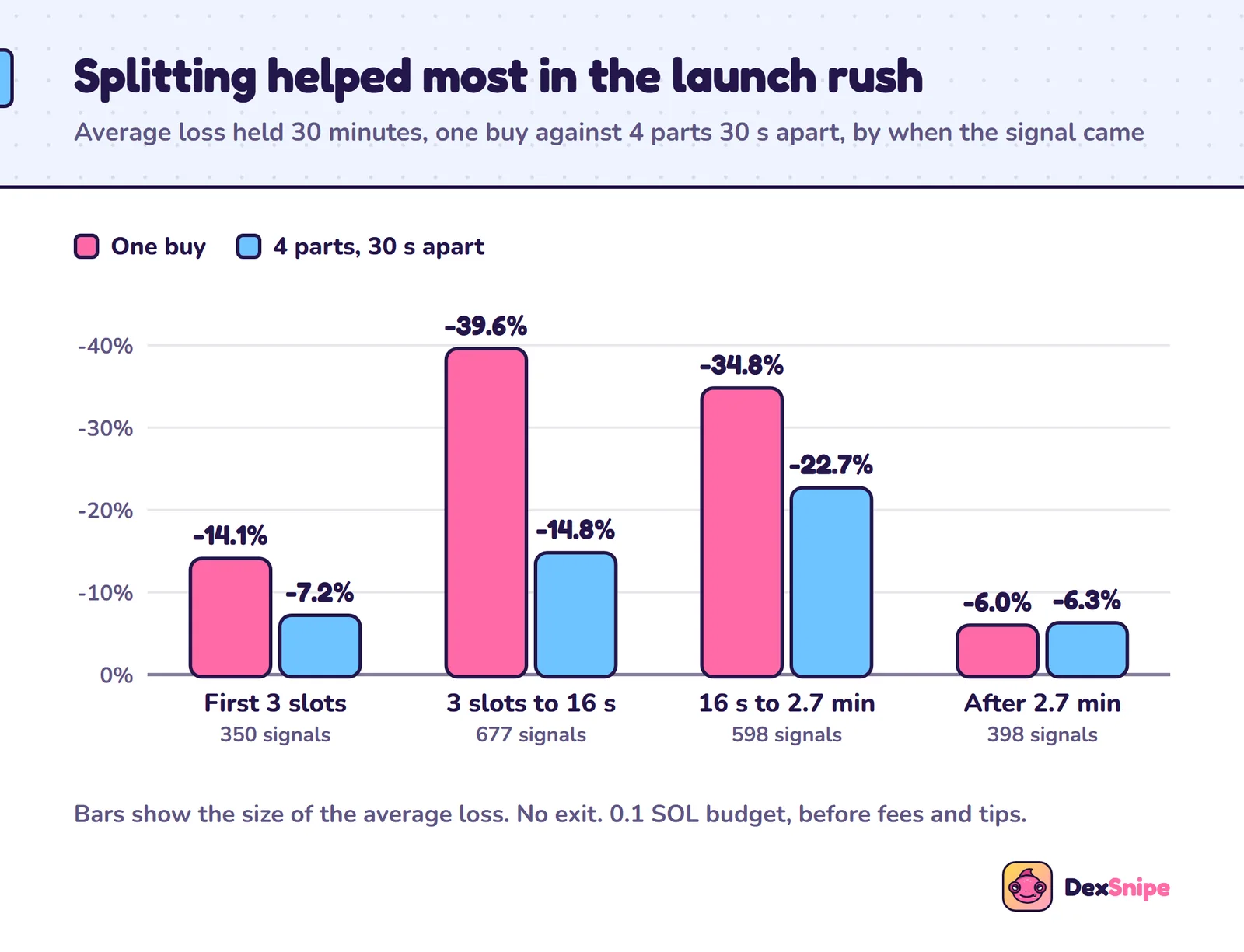
Entry age in numbers
Entry age in numbers
| Signal came | Signals | Held, one buy | Held, 4 parts 30 s | Held, 10 parts 60 s | Trail, one buy | Trail, 4 parts 30 s |
|---|---|---|---|---|---|---|
| First 3 slots | 350 | -14.1% | -7.2% | -3.4% | +6.3% | +4.6% |
| 3 slots to 16 s | 677 | -39.6% | -14.8% | -7.1% | -6.6% | -7.8% |
| 16 s to 2.7 min | 598 | -34.8% | -22.7% | -13.5% | +2.8% | -1.6% |
| After 2.7 min | 398 | -6.0% | -6.3% | -0.9% | +4.0% | -0.2% |
Held without an exit, splitting helped most between the third slot and about the third minute, the stretch where one buy lost 35% to 40%. Four parts 30 seconds apart paid a median 32% less per token than one buy on signals from the launch rush, and cut the loss from -39.6% to -14.8%. For signals after about three minutes, coins that were still trading moved slowly and the four-part split made no difference held.
With a trailing stop the split trailed one buy at every age, by one to four points. The stop was already doing the job the split does when held: getting out of the coins that turn.
Every part pays its own fees
Everything above is before costs, and costs are where splitting gets more expensive. The percentage trading fee is the same whether you buy once or ten times. The fixed costs are not. Each part is its own transaction, so it pays its own network fee, its own priority fee and its own tip. Ten parts pay them ten times.
At a few SOL per snipe that rarely matters. At 0.1 SOL split ten ways, each part is 0.01 SOL, and a priority fee and tip sized to land quickly can be a real share of that. Before you split a small buy, compare the fixed cost of one transaction with the size of one part.
What this replay does not tell you
- It is two hours on one venue. All of it is the Pump.fun bonding curve on one afternoon. On deep DEX pools, where the price moves slower, the gap between one buy and a split would be smaller.
- It is before costs. Trading fees, network fees, priority fees and tips come off every part and every sell.
- Parts land on time. Each part went in at the first trade after its scheduled time, at the reserves then.
- Filters were not re-run. A sniper that checks its filters before each part would skip some later parts, for example after the creator sells. We bought every scheduled part until the 30 minutes or the stop.
- It covers 30 minutes. Positions still open were valued at the last curve price.
How to set it
- Set the exit first. A trailing stop did more for these signals than any split. With one in place, splitting is a sizing choice, not a fix.
- Never seconds apart. Parts 5 seconds apart bought into the rush and paid more. Use 30 seconds or more.
- Use it when you will hold. On a sniper with no exit, or a loose one, slow parts cut losses on new coins sharply.
- Use it to risk less on a hunch. With a trailing stop, a split commits the full amount only to coins that keep going, at the cost of a smaller position on fast runs.
- Keep the parts big enough. Each part pays its own fees and tip. Fewer, larger parts cost less to send.
Buy in parts in DexSnipe
Buy in parts is one of two entry rules on every DexSnipe sniper, next to buy the dip, and it works with every trigger: fresh launch, migration, new pool, creator watch, exact mint and copy trade.
- Buy in parts. Splits the sniper's buy into up to 10 equal buys. 1 buys it all at once. Each part must be at least 0.01 SOL.
- Time between parts. From 5 seconds up. The next part goes in that long after the last one.
- Filters before each part. The sniper checks its filters again before every part, so a part is skipped if the token no longer passes.
- Exits. Take-profit steps, a stop-loss, a trailing stop, a timer and a dev-sell exit.
New snipers start with one part, buying all at once. If you are comparing bots, our comparison of Solana sniper bots covers fees, entry rules and exits side by side.
Trade only what you can lose. Splitting a buy changes how much you have in when a coin moves. It does not make a falling coin a good one. This page is not financial advice.
Buying in parts questions
What does buying a token in parts mean?
+
Instead of spending the whole amount in one buy, you split it into equal buys a set time apart: 1 SOL as four buys of 0.25 SOL, 30 seconds apart, for example. Some bots call this DCA. In a sniper it works inside a single snipe: the parts all go into the same token, starting when the sniper's signal fires.
Does splitting a buy get a better price on a bonding curve?
+
Not by itself. On a constant product curve like Pump.fun's, ten 0.1 SOL buys made back to back get exactly the same tokens as one 1 SOL buy, before and after the percentage fee. Splitting only changes the price you pay because other people trade between your parts.
Is it better to buy a new Pump.fun coin in parts?
+
If you hold without an exit, slow splits lost far less in our replay of 2,023 real buys: 10 parts a minute apart averaged -7.2% against -27.2% for one buy, because most new coins fall and the later parts bought cheaper. But fewer positions ended in profit, 9.3% against 13.4%, and with a 10% trailing stop one buy did best.
How far apart should the parts be?
+
Not seconds. Parts 5 seconds apart landed in the launch rush and paid more than one buy in 67% of signals with two parts. From 30 seconds apart, splitting paid less than one buy on most signals, and the gap grew with the wait.
Does buying in parts cost more in fees?
+
Yes. Every part is its own transaction, so it pays its own network fee, priority fee and tip, and ten parts pay them ten times. The percentage trading fee does not change. At small sizes the fixed costs can be larger than anything the split saves.
Does DexSnipe charge more for buying in parts?
+
No. Buy in parts and buy the dip are entry rules on every DexSnipe sniper, included in the flat plan: 1 SOL for 7 days, 3 SOL for 30 days or 5 SOL for 90 days, with no cut of your trades. You pay the network costs of each part.
Sources and method
The trades come from our Pump.fun sample: 1,205 coins created between 14:56 and 16:51 on November 5, 2026, each with every bonding curve trade for its first 30 minutes, read from the chain. We used the 412 ordinary SOL-paired coins with a complete trade history and left out Mayhem coins. A signal is the first buy of a wallet other than the creator, of 0.01 to 5 SOL, whose own token balance changed with each trade: 2,023 signals by 1,383 wallets on 186 coins.
We rebuilt each curve's reserves trade by trade from its SOL and token balance changes, starting from the virtual reserves in Pump's README, and priced every trade with the constant product formula. The first part buys at the reserves the real wallet met. Each later part buys at the reserves before the first trade at or after its scheduled time; parts scheduled after the last trade but within 30 minutes of launch buy at the final reserves. Our own buys are added to the reserves, so each part moves the price for the next and for the sell. The 10% trailing stop follows the curve price from the first part, sells the whole position at the front of the slot after it triggers, and no later parts are bought. Positions still open after 30 minutes are valued at the last curve price. Averages and shares are per signal; net SOL is the total over all signals. All results are before trading fees, network fees, priority fees and tips. DexSnipe settings are taken from the product itself.
- Pump program README (Pump public docs)The bonding curve, its constant product formula and starting virtual reserves.
- Pump program IDL (Pump public docs)The BondingCurve layout we decoded for the Mayhem flag, the quote asset and the complete flag.
- Pump program on SolscanProgram 6EF8rrecthR5Dkzon8Nwu78hRvfCKubJ14M5uBEwF6P, whose curve trades we replayed.
- The first example coin, on SolscanCreated at 15:07:20 on November 5, 2026.
- The second example coin, on SolscanCreated at 15:19:53 on November 5, 2026.
- Solana fees (Solana docs)Every transaction pays a base fee and can add a priority fee, which is why each part costs its own fees.
Choose how you get in
Buy at once, in parts or on a dip, with a trailing stop, take-profit steps and a stop-loss on every sniper. Flat plan, no cut of your trades.