Bags Sniper Bot
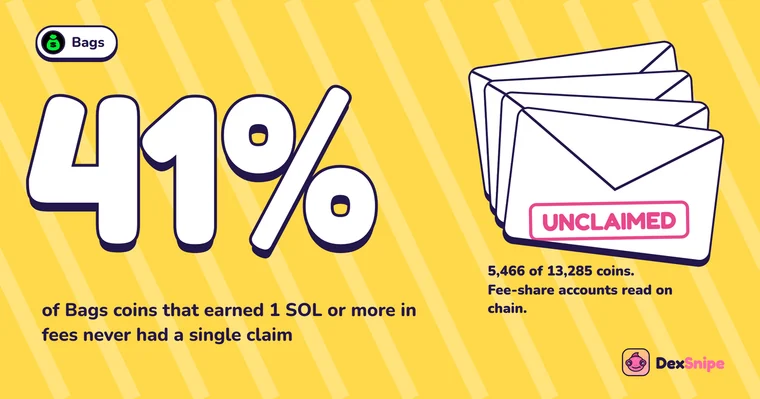
Bags is built around one idea: a coin's trading fees go to the people named on it. That is a promise you can check. We read every fee-share account of the Bags Fee Share V2 program on November 6, 2026, more than 100,000 of them, and looked at who had actually collected. On 41% of the coins that had earned 1 SOL or more, nobody named on the coin had ever claimed a cent. For a sniper, that record is one of the most useful things on the chain.
The short version
- The fee earner is often not the launcher. Bags lets anyone name an X, GitHub or other account as the earner, and that person may not know the coin exists.
- Whether they claim is public. Every fee-share account records what has been collected and what has been claimed.
- Small coins go unclaimed most. 43% of coins with 1 to 10 SOL in fees had never been claimed, against 22% of those with 100 SOL or more.
- Trading fees are part of the trade. In the default mode every buy and sell pays 2%, and some coins charge 10%. Set take-profits with that in mind.
What a Bags sniper bot does
Bags is a Solana launchpad. A new coin starts on a Meteora Dynamic Bonding Curve, where tokens are sold for SOL at a price that rises with every buy. When the curve fills, the coin migrates to a Meteora DAMM v2 pool and trades like any other pool. A sniper bot buys in the first blocks of the curve, or the moment the pool opens, and sells on rules you set.
The mechanics are close to Meteora's own launches. What makes Bags different is not the curve. It is who the coin pays. Every Bags coin carries a fee-share config that sends a share of its trading fees to named earners, and those names are often the reason people buy. A coin "for" a well-known developer, artist or project reads as a coin that person is behind. Sometimes it is. Often it is not, and the chain shows which.
This guide is about reading that part of a coin. The sniping settings come at the end, but they make sense only once you know what the fee-share record says about a launch, and how often the name on a coin has nobody behind it.
Every fee account, read on chain
On November 6, 2026 we downloaded every fee-share config and every fee-share authority account owned by the Bags Fee Share V2 program, decoded them with the program's IDL and matched each authority to its config.
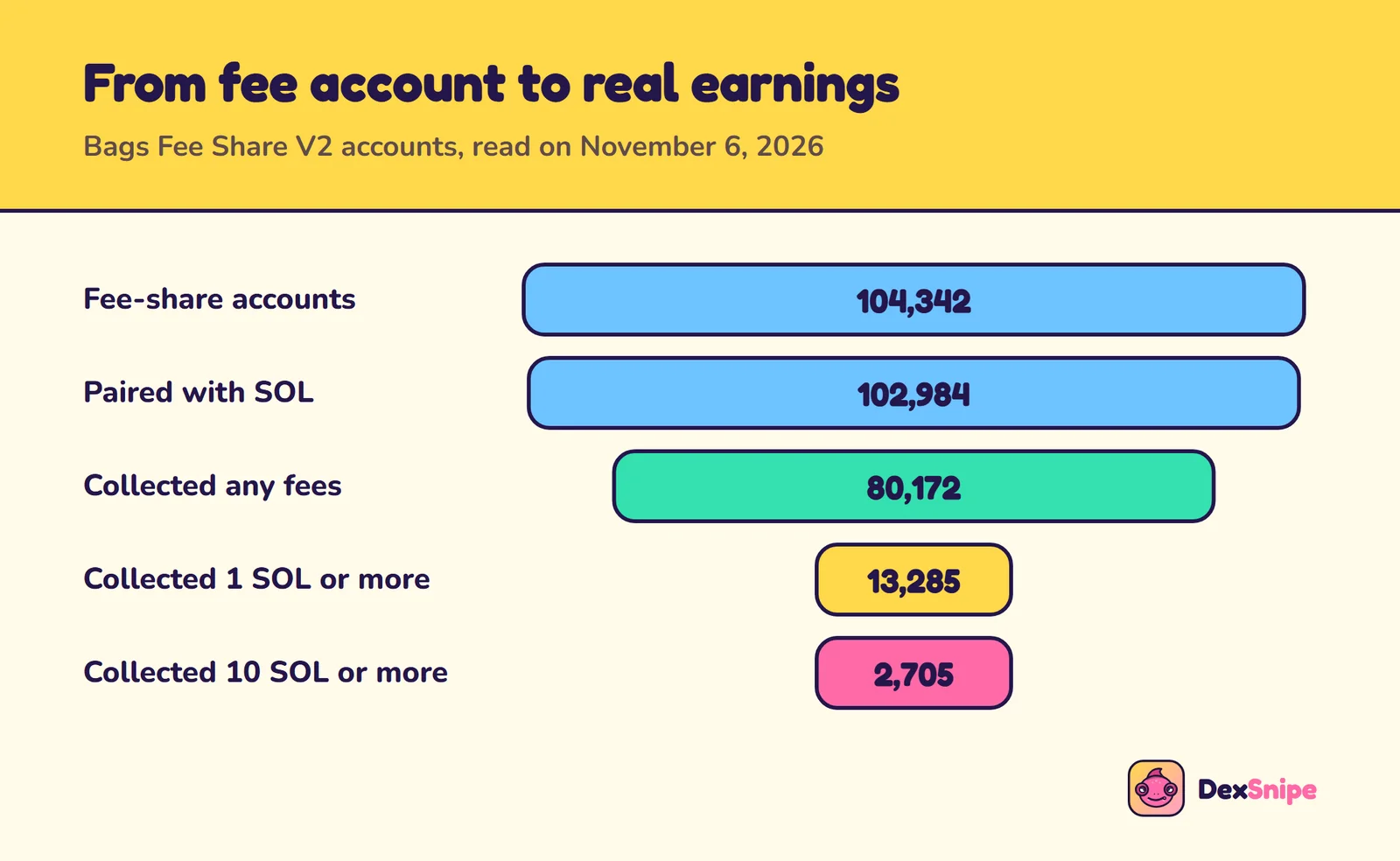
Bags Fee Share V2 accounts, November 6, 2026
| Group | Coins |
|---|---|
| Fee-share accounts | 104,342 |
| Paired with SOL | 102,984 |
| Collected any fees at all | 80,172 |
| Collected 1 SOL or more | 13,285 |
| Collected 10 SOL or more | 2,705 |
Most Bags coins earn very little. The median SOL-paired coin had collected about 0.12 SOL in fees into its account; one in ten had collected about 1.5 SOL or more, and one in a hundred about 36 SOL or more. Those are totals over the coin's whole life, platform share included, so the named earners' part is roughly half.
The 13,285 coins that collected 1 SOL or more are the ones where claiming is clearly worth the effort, so the rest of this guide uses them. Together they had collected about 255,055 SOL. Claimers had taken out 88,078 SOL and partners 25,852 SOL.
The money nobody claimed
On 5,466 of the 13,285 coins, 41%, the claimers' running total was exactly zero. Not one claimer on the coin had ever taken anything out. Those fees had not gone anywhere: on the typical one, the coin's fee-share authority still held about half of everything it had collected, the claimers' full share, in its wrapped SOL account.
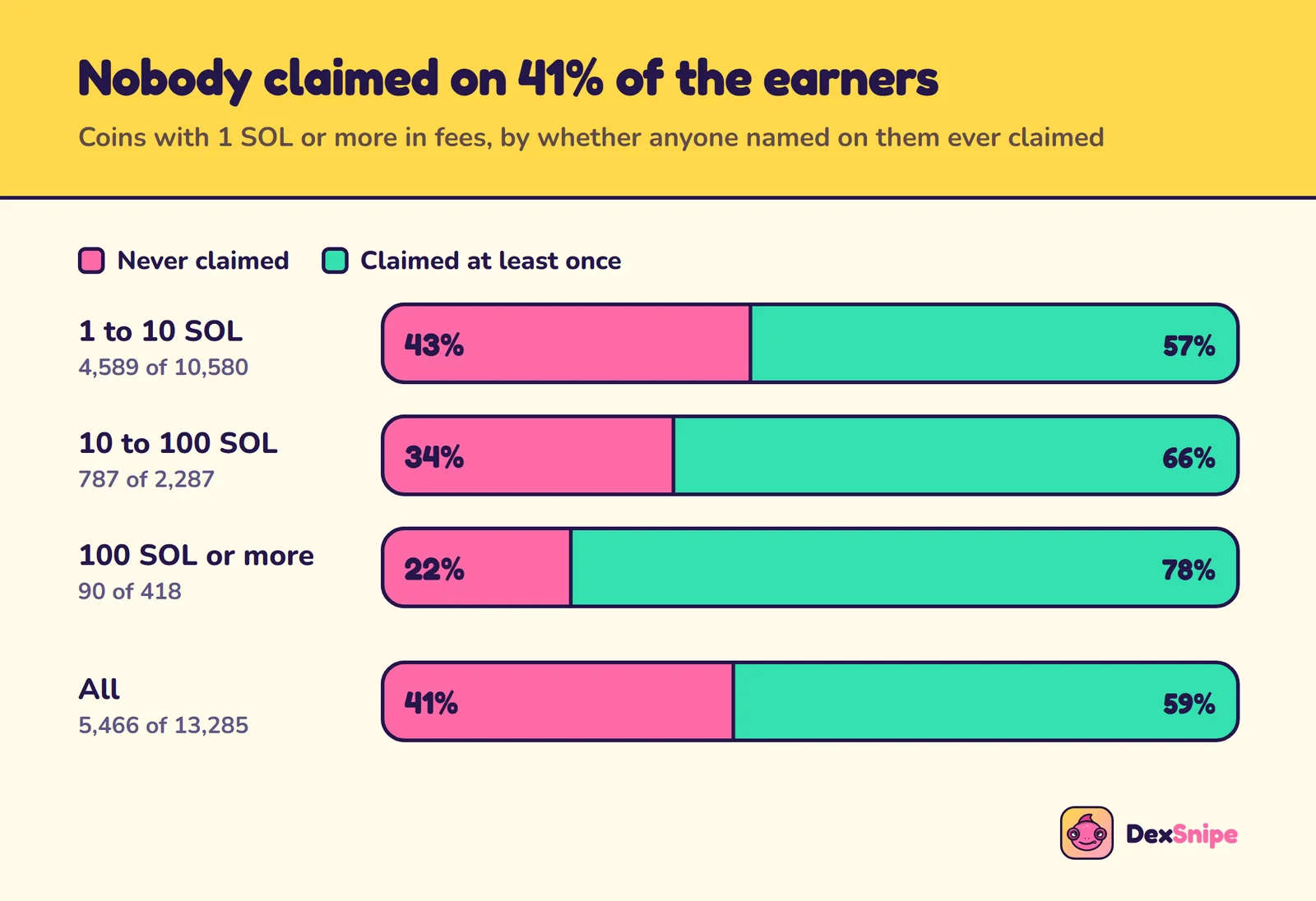
Coins with 1 SOL or more in collected fees
| Fees collected | Coins | Never claimed | Share |
|---|---|---|---|
| 1 to 10 SOL | 10,580 | 4,589 | 43% |
| 10 to 100 SOL | 2,287 | 787 | 34% |
| 100 SOL or more | 418 | 90 | 22% |
| All | 13,285 | 5,466 | 41% |
Across all 13,285 coins, about 31,780 SOL sat unclaimed in fee-share accounts, 27,282 SOL of it on coins where nobody had ever claimed. On 470 never-claimed coins, the unclaimed balance was 10 SOL or more.
The pattern by size makes sense. A person who knows they are named on a coin earning a few hundred SOL has every reason to sign in and collect. A coin that earned 3 SOL in its first day and then went quiet may never be noticed by the person it names. But even among the biggest coins, more than one in five had never been claimed, and 90 coins had each collected 100 SOL or more without a single claim.
Claimer count
87% of the coins, 11,531, named a single claimer with 100% of the claimers' share. Coins with one claimer were unclaimed 44.5% of the time. Coins with two claimers, 21%, and with three or more, 12%. More names on a coin usually means more people who know about it, and only one of them has to claim.
One coin, 430 SOL waiting
The coin is called NOCODE. Its first transaction was on January 18, 2026, and by November 6 its fee-share authority had collected about 1,115 SOL.
- One claimer, 100%. The config names a single wallet as the only claimer.
- A partner who collects. The coin's partner had claimed about 266 SOL.
- A claimer who never has. The claimer's running total is zero. The wallet itself holds no SOL and has not been active since February 20, 2026.
- 430 SOL sitting in the account. The authority's wrapped SOL account held about 430 SOL, waiting for that claimer.
- Collection kept running. Fees were still being collected from the pool into the account in September 2026.
Everything here is visible on Solscan from the links in the sources. We do not know who the claimer is; an untouched embedded wallet is consistent with a social account whose owner has never signed in, but the chain alone cannot tell us. What we do know is that the coin earned hundreds of SOL for the person it was set up to pay, and none of it was ever picked up.
NOCODE is not an outlier in shape, only in size. Among the ten never-claimed coins with the most fees waiting, nine named a single claimer, and the largest balance was about 441 SOL, on a coin named after a popular open-source web framework.
The coins that earned the most
The other end of the list looks very different. These are the five coins with the most fees collected into their accounts, by November 6:
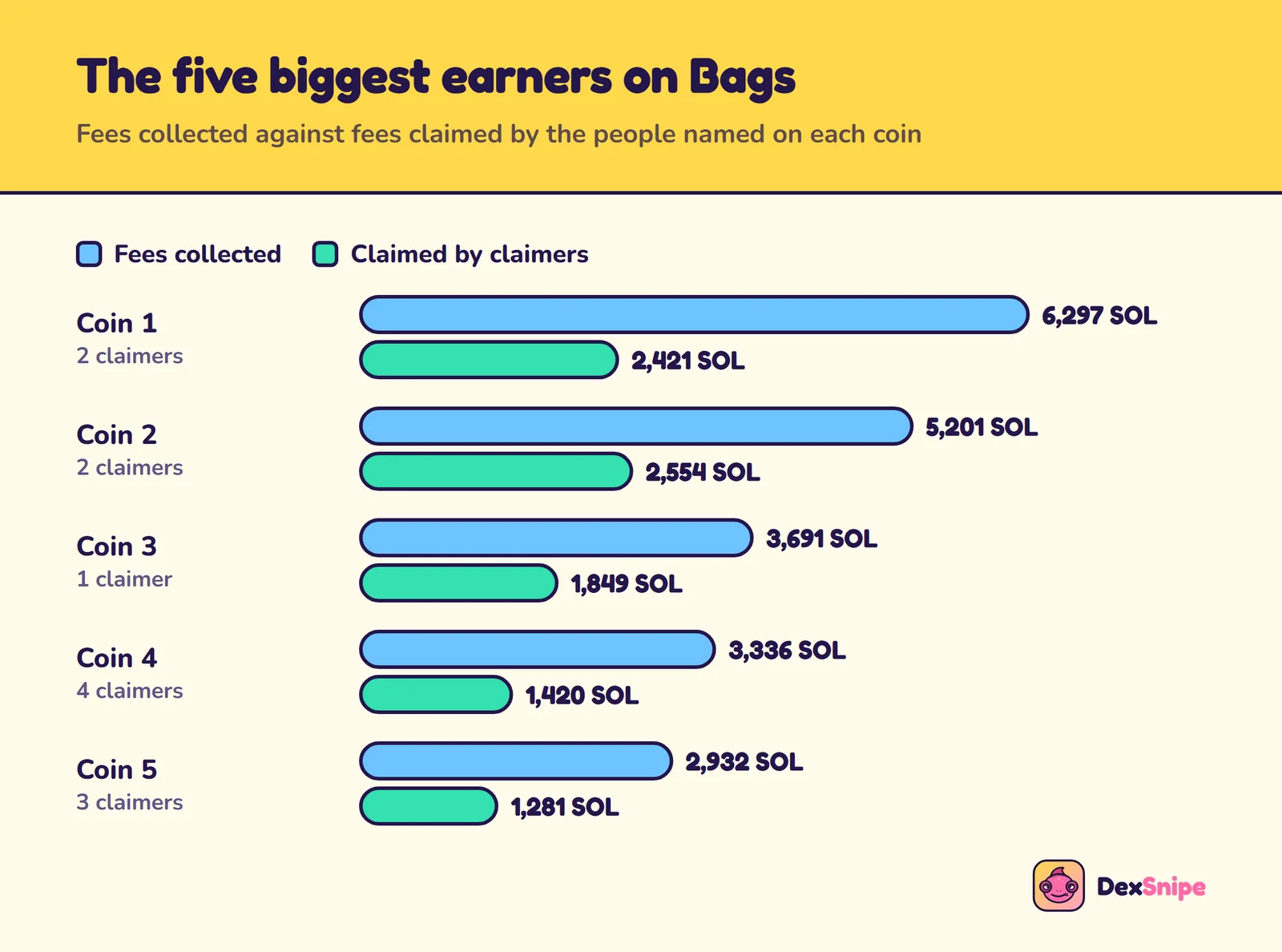
Top five Bags coins by fees collected, Fee Share V2
| Fees collected | Claimers | Claimed by claimers |
|---|---|---|
| 6,297 SOL | 2 | 2,421 SOL |
| 5,201 SOL | 2 | 2,554 SOL |
| 3,691 SOL | 1 | 1,849 SOL |
| 3,336 SOL | 4 | 1,420 SOL |
| 2,932 SOL | 3 | 1,281 SOL |
Every one of them had been claimed, most of them close to in full: the claimers' share is about half of what is collected, and on these coins most of that half had already left the account. The coins that earn the most are, nearly always, coins where someone named on them is paying attention. That is not a coincidence. A named person who claims is usually a person who talks about the coin, and a coin people talk about trades.
The lesson for a sniper is about direction, not prediction. A claimed coin is not guaranteed to grow, and an unclaimed coin is not guaranteed to die. But the coins that went the distance on Bags almost all had a real earner behind them, and four in ten coins of any size never did.
Partners: the apps behind the launches
Apps can launch coins through Bags and take a partner share, paid out of the platform's half of the fee, not out of the claimers' half. On 8,537 of the 13,285 coins, 64%, a partner had claimed something, and on the typical one the partner had taken about 12.5% of everything collected.
Partners claim far more reliably than named earners do. On the NOCODE coin above, the partner had collected 266 SOL while the claimer collected nothing. A partner is a business that runs claims as part of its operation; a named earner is a person who may not know the coin exists. When a coin shows partner claims and no claimer claims, it is a coin someone is making money from, just not the person on its label.
Who the fee earners are
The 13,285 coins named 8,744 different claimer wallets. Most appear once. A few appear constantly:
- 146 wallets were claimers on 10 or more coins, and together they appear on 4,810 coins, 36% of the group.
- The three busiest were named on 877, 732 and 554 coins, and almost always claimed: across those 2,163 coins, only 38 had never seen a claim.
- Other repeat names claim about half the time. One wallet named on 103 coins had gone unclaimed on 51 of them.
A wallet named on hundreds of coins that claims every time is almost certainly a service: an app that launches coins for users, a launch group, or a creator who launches constantly and collects. A wallet named on dozens of coins and never claiming is more likely a well-known account that launchers keep naming without its owner's involvement.
Neither tells you a coin will go up. Both tell you something about who is behind it, and that is the information a sniper usually lacks in the first seconds of a launch.
What it tells a sniper
Snipers buy on thin information: a name, a picture, a curve that just opened. On Bags, the fee-share config adds a line most launchpads do not have: the wallets that are supposed to earn from the coin, and their record of actually doing so.
Tribute coins
A large share of Bags launches are coins named after someone, launched by someone else, with the named person set as fee earner. The pitch is that the person will notice, claim, and maybe talk about the coin. Our numbers show how often that does not happen: on four coins in ten, nobody named ever claimed. A sniper buying a tribute coin is betting on a person who, four times in ten, never shows up.
The deployer share matters here. On newer configs, the wallet that launches the coin is paid a quarter of the claimers' pool whether or not the named person ever claims. The launcher is paid for the launch either way. That is not wrong, and Bags documents it plainly, but it means a launcher has a reason to keep launching tribute coins regardless of whether the people named on them care.
The named person needs no wallet
This is the detail that makes tribute coins so easy to launch. To name someone as a fee earner, a launcher needs only their handle. Bags resolves the handle to an embedded wallet on its side, so the named person does not need a Solana wallet, does not need to have heard of Bags, and does not need to agree. Bags has also added payouts that send a coin's fees as cash to an X Money, Cash App or Venmo account, which lowers the bar further.
Nothing about that is hidden, and for a real creator it is convenient. For a sniper it means the name on a coin is the cheapest part of it. Anyone can put any name there in seconds. What costs something, and therefore says something, is a claim: the named person signing in and taking the money, on the record.
A claim is a signal
When a named earner claims for the first time, that is a public act by the person whose name is on the coin. It does not guarantee anything about the price. It does tell you the coin now has a real person connected to it, which is the one thing a tribute coin lacks at launch.
Repeat launchers and earners
Wallets that launch, or earn on, dozens of coins have records you can read. A launcher whose past coins mostly went quiet will probably launch another that goes quiet. A launcher whose coins kept trading for weeks is worth following. This is what a Creator watch sniper is for.
The fee you pay to trade
The same fee that pays the earners is paid by you, on every buy and every sell. It is easy to forget in a sniper, because it is not a tax on the token and does not show up as one.
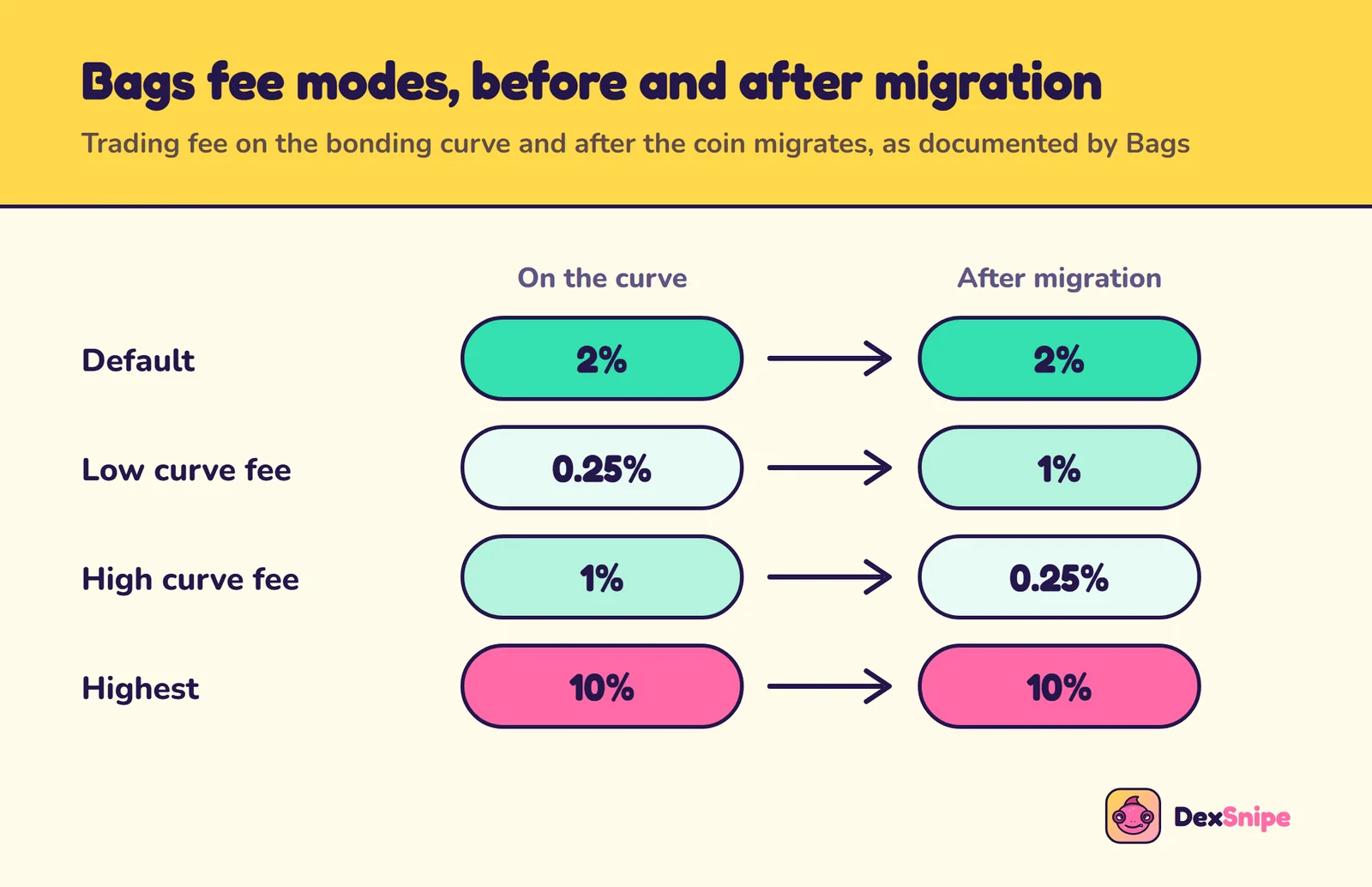
Some Bags fee modes, as documented by Bags
| Mode | On the curve | After migration |
|---|---|---|
| Default | 2% | 2% |
| Low curve fee | 0.25% | 1% |
| High curve fee | 1% | 0.25% |
| Highest | 10% | 10% |
On a default-mode coin, a buy and a sell together pay about 4% in Bags fees before any network fee, priority fee or tip. A take-profit of +10% is closer to +6% in your wallet. On a 10% coin, a round trip costs about a fifth of the position, and a quick flip is almost impossible to win. Know the mode before you set targets, and treat a 10% coin as a long hold or a skip.
After migration
In the default mode, the fee stays at 2% after a coin moves to its DAMM v2 pool, but a quarter of it is compounded back into the pool's liquidity instead of being paid out. The pool gets deeper the more it trades, which helps a larger position get out later. For a migration sniper this is a small point in Bags' favour: the pools of coins that keep trading thicken on their own.
Reading a Bags launch in a minute
None of this needs special tools. For a coin you are thinking of sniping, or a launcher you are thinking of following:
- Who is named? Bags lists each coin's fee earners and the social accounts behind them, and its API returns the same list. Is the named person the one launching, or a tribute?
- Has a named earner ever claimed on another coin? Bags publishes claim events per coin through its API, and every claim is on chain. A person who has claimed before is far more likely to notice a new coin than one who never has.
- Who launched it? Look at the launcher's wallet on Solscan. How many coins, how often, and what happened to them?
- What is the fee mode? It changes every target you set.
- How much did the launcher buy? As on any launchpad, a large creator buy is a position that can be sold into you.
A sniper fires faster than any of this, so the work happens before the launch: you build a list of launchers and earners worth following, and let the bot act on that list.
Checking a claim yourself
You do not need Bags' API to check a coin. Its fee-share authority is a public account owned by the Fee Share V2 program, and Solscan shows its wrapped SOL balance and its transactions. A large balance that keeps growing while no claim transaction ever appears is the pattern described above. A balance that drops to near zero every few days means someone is claiming. It takes a minute, and it works for any coin you are thinking of following.
What this data does not tell you
- It is a snapshot. A coin unclaimed on November 6 may be claimed tomorrow. Accounts were read once.
- Collected is not earned. The totals count fees Bags had moved into each coin's account. Fees still sitting in a pool are not included, so recent coins look smaller than they will.
- We cannot see social accounts on chain. Claimers are wallets. Which handle a wallet belongs to comes from Bags, not the chain, and we did not use it.
- Older programs are not included. We read Fee Share V2 only. Coins configured under earlier Bags programs are not in these numbers.
- Deployer payouts run separately. On newer configs the launcher's own share is paid through a separate deployer flow, so a launcher may be collecting on a coin where the named claimers never did. Our never-claimed count is about the named earners only.
- Unclaimed is not bad. A person may simply not need the money yet, or may claim through a payout service. Read it as evidence about involvement, not about honesty.
- Price is not measured here. We did not test whether unclaimed coins trade worse. The point is what a sniper knows at launch, not a price prediction.
Filters for Bags launches
The fee-share record shapes which launches you want; the usual safety filters decide which you can buy.
- Creator watch over Fresh launch. On Bags, who is behind a coin carries more information than on most launchpads. Following chosen launcher wallets uses it; firing on every launch ignores it.
- Dev holding cap. A launcher who buys a big share at launch can sell it into the first buyers. Keep the cap at 5 to 10%.
- Skip bundled launches. Other wallets buying in the launcher's own block are often the launcher's.
- Top 10 holder cap. Catches a position spread over several wallets.
- Socials. Require at least one link; tribute coins often borrow the named person's links, so treat this as a minimum, not proof.
- Blocklist words. Names of people or projects you know are launched in tribute without involvement.
Bags sniper settings
Two snipers for two jobs. Starting points, not promises.
| Setting | Creator watch | Fresh launch |
|---|---|---|
| Trigger | Creator watch, one sniper per wallet | Fresh launch, Bags |
| Buy size | 0.2 to 0.5 SOL | 0.05 to 0.1 SOL |
| Slippage cap | 20% | 15% |
| Priority fee | 0.001 SOL | 0.0005 SOL |
| Jito tip | 0.002 SOL | 0.001 SOL |
| Dev holding cap | 10% | 5% |
| Skip bundled launches | On | On |
| Top 10 holder cap | 35% | 25% |
| Take-profit | +50% sell 50%, +150% sell 50% | +30% sell 50%, +80% sell 50% |
| Stop-loss | 30% | 25% |
| Timer | 60 minutes | 15 minutes |
| Dev-sell exit | On | On |
Why the targets are wider than on other venues
Every buy and sell on a default-mode coin pays 2%. A first take-profit at +30% nets about +25% after the round trip; at +15% about a third of the gain goes to fees, before slippage. On Bags, wider targets and fewer trades beat many small flips.
Take profit, stop loss and selling
The curve does not hold orders, so every exit is the bot watching the price and sending a sell. DexSnipe gives each sniper up to four take-profit steps, a stop-loss, a trailing stop, a timer and a dev-sell exit, all running on the server after you close the tab.
- Count the fee in every target. A stop-loss of 25% on a default-mode coin is closer to 28% after both fees.
- Use the timer. Most Bags coins earn under 0.2 SOL in fees over their life, which means little trading. A timer frees the SOL.
- Keep the dev-sell exit on for later sells, knowing a launcher who sells in the first seconds will be ahead of it.
- Migration is a separate trade. After a coin moves to its DAMM v2 pool, fees and liquidity change. A Migration sniper with its own settings handles that better than stretching a launch sniper.
| What you see | Likely cause | What to change |
|---|---|---|
| Small wins vanish | Two Bags fees on every round trip | Widen the first take-profit |
| Coins go quiet after launch | Tribute coin with no one behind it | Switch to Creator watch |
| Price drops right after your buy | Launcher sold the launch buy | Lower the dev holding cap |
| Positions held for hours | Thin trading | Shorten the timer |
Choosing a Bags sniper bot
- Does it support Bags launches and migrations on Meteora's bonding curve and DAMM v2 pools?
- Can it follow chosen wallets, so you can snipe the launchers whose record you have checked?
- Does it check holdings before the buy, with a dev cap, a top 10 cap and a bundle check?
- Do exits run on a server, including a timer, when you are offline?
- Is the price flat? Bags already charges a trading fee on every trade. A bot that adds its own cut on top makes wide targets wider still.
Bags in DexSnipe
Bags is a venue for the Fresh launch, Migration, Creator watch and Copy trade triggers. Every sniper has a dev holding cap, a top 10 holder cap, a bundled launch check, a socials check, mint and freeze authority checks and a word blocklist, and up to four take-profit steps with a stop-loss, trailing stop, timer and dev-sell exit. The price is a flat plan from 1 SOL for 7 days with no cut of your trades.
Set up a Bags sniper in DexSnipe
- Open the panel and click New sniper. Choose Creator watch, paste a launcher wallet you have checked and tick Bags. Add one sniper for each wallet you follow.
- Set the buy: size, a slippage cap of about 20%, and a modest priority fee and tip.
- Set the filters: dev holding cap 10%, skip bundled launches on, top 10 holder cap 35%.
- Build exits wide enough for the fee: two take-profit steps, a stop-loss, a timer and dev-sell on.
- Connect your wallet and save. Snipers are stored on your wallet address.
- Pick a plan, add a sniper wallet and arm it. Send 1, 3 or 5 SOL to the reserved address, add the key of a separate funded wallet, arm the sniper and close the tab.
Trade only what you can lose. Most new coins on any launchpad lose value. Knowing who is behind a coin improves your choices; it does not make new coins safe. This page is not financial advice.
Bags sniper bot questions
What is a Bags sniper bot?
+
A bot that buys new Bags coins in their first blocks on the Meteora bonding curve, or when they migrate to a DAMM v2 pool, and sells on rules you set: take-profit steps, a stop-loss, a timer and an exit when the creator sells. It can also follow chosen wallets and buy their next launch.
Who earns the trading fees on a Bags coin?
+
The fee earners named at launch. A Bags coin carries a fee-share config listing up to 100 claimers with a share each in basis points. A claimer can be a Solana wallet or a social account, such as an X or GitHub handle, which Bags resolves to an embedded wallet. Newer configs also give the wallet that paid for the launch a separate deployer share.
How often do Bags fee earners never claim their fees?
+
Many. We read every fee-share account of the Bags Fee Share V2 program on November 6, 2026. Of 13,285 SOL-paired coins that had collected 1 SOL or more in fees, 5,466, or 41%, had never seen a single claim by any of their claimers. About 27,282 SOL was sitting unclaimed on those coins, out of 31,780 SOL unclaimed across all 13,285.
Does an unclaimed fee mean a Bags coin is a scam?
+
No. It means the named fee earner has not collected. Often that is because the coin was launched in someone's name without their involvement, and they either do not know or do not want it. For a sniper it is information: nobody official is behind the coin, and the launcher is not the person named on it.
What does it cost to trade a Bags coin?
+
It depends on the fee mode chosen at launch. In Bags' default mode, documented in its API docs, every trade pays 2% before and after migration. Other modes range from 0.25% on the curve to 10%. A buy and a sell together pay the fee twice, so a sniper needs to know the mode before setting a take-profit.
Can a sniper see who earns fees on a Bags coin before buying?
+
Yes. The fee-share config is a public account tied to the coin's mint, and it lists the claimer wallets and their shares. Bags' API also returns the social accounts behind them. A DexSnipe Creator watch sniper can follow a launcher wallet whose record you have checked, one wallet per sniper.
How do I check if a Bags coin's fees have been claimed?
+
Find the coin's fee-share authority, a public account of the Bags Fee Share V2 program, on Solscan. Its wrapped SOL balance is the unclaimed fees. A balance that only grows, with no claim transactions, means nobody has claimed. A balance that keeps dropping back means someone is collecting.
Do the biggest Bags coins have active fee earners?
+
In our data, yes. All five coins with the most fees collected had been claimed, most of them close to in full. Unclaimed coins were common at every size, but they were rarest among the coins that earned the most.
Does DexSnipe take a fee on Bags trades?
+
No. DexSnipe is a flat plan: 1 SOL for 7 days, 3 SOL for 30 days or 5 SOL for 90 days. You pay the network fee, your priority fee and tip, and the coin's own Bags trading fee.
Sources and method
On November 6, 2026 we listed every account owned by the Bags Fee Share V2 program with the discriminator of a fee-share config or a fee-share authority, using the layouts in the program's published IDL. Each authority records its config, its total collected fees, its total claimed by users and its total claimed by the partner. We matched each authority to its config, kept configs whose quote asset is wrapped SOL, and read the claimer list and basis points of every config whose authority had collected 1 SOL or more. For those 13,285 coins we also read the balance of each authority's wrapped SOL token account, which holds fees collected but not yet claimed.
"Never claimed" means the authority's user-claimed total was zero. Fee mode figures come from Bags' documentation and can change; check a coin's own mode before trading it. For the example coin we read its authority's transaction history and its claimer's balance and history directly. DexSnipe triggers, filters and exits are taken from the product itself.
- Bags docs: Program IDsThe Solana programs Bags uses, including Fee Share V2, and where their IDLs are published.
- Bags SDK IDLs on GitHubThe Fee Share V2 IDL we used to decode the fee-share config and authority accounts.
- Bags docs: Customize Token FeesThe fee modes, the split between the platform pool and the claimers pool, and the deployer and partner shares.
- Bags docs: Create Fee Share ConfigUp to 100 claimers per coin, and the 25% deployer share on newer SOL configs.
- Bags docs: Get Fee Share WalletHow a social handle such as an X or GitHub account resolves to an embedded wallet.
- Bags docs: Pay Fees to X MoneyFees paid out as cash to an X Money, Cash App or Venmo account.
- Bags docs: Deployer FeesThe separate entitlement paid to the wallet that funded the launch.
- Bags Fee Share V2 program on SolscanThe program whose accounts we read.
- Meteora Dynamic Bonding Curve program on SolscanThe bonding curve Bags coins launch on.
- Meteora DAMM v2 program on SolscanThe pool program Bags coins migrate to.
- The example coin, NOCODE, on SolscanFirst transaction January 18, 2026.
- Its fee-share authority, on SolscanHolds about 430 SOL of unclaimed fees in its wrapped SOL account.
- Its only claimer, on SolscanEntitled to 100% of the claimers' share. Holds no SOL and has never claimed.
Snipe the launchers with a record
Build your snipers for free, then a plan from 1 SOL switches them on. No cut of your trades.