Solana Copy Trading Bot
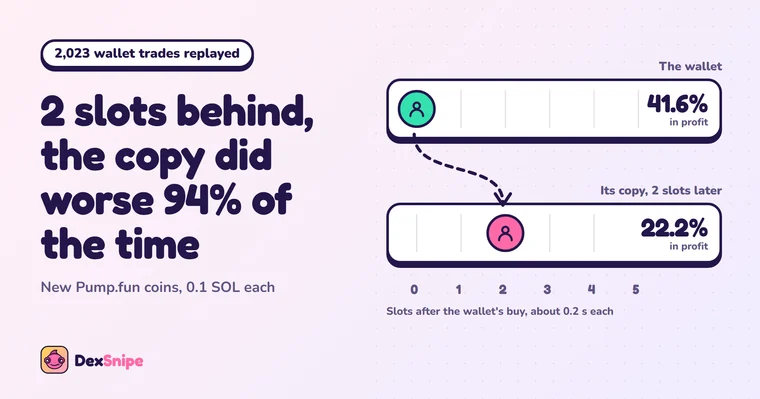
Copy trading sells a simple idea: find a wallet that wins and do what it does. On Solana the catch is time. A copy can only start after the trade it copies has landed, and on a new token the price moves between those two moments. We took 2,023 real trades by 1,383 wallets on new Pump.fun coins and replayed each one with a copy a few slots behind. At 2 slots, about 0.4 seconds, the copy did worse than the wallet 94% of the time. That does not make copy trading useless. It tells you which wallets are worth following and which settings matter.
The short version
- A copy pays more and sells for less. Two slots behind, the copy's buy cost a median 2.6% more per token, and its sell landed after the wallet's own sell had pushed the price down.
- Launch snipers are the worst wallets to copy. Their entries in the first blocks won 55% of the time; the copies won 16%.
- Wallets that buy later copy far better. On buys made about three minutes or more after launch, copies kept 44% winners against the wallets' 55%.
- Copying the sells matters as much as the buys. Copies that held instead of following the wallet out averaged -31%.
What a Solana copy trading bot does
A copy trading bot follows wallets you pick. When one of them buys a token, the bot sees the trade on chain and sends a buy of its own for the same token from your wallet. When the followed wallet sells, the bot can sell too. Most bots let you choose how much to buy: a fixed amount every time, or a share of what the followed wallet spent.
The pitch is that you borrow someone else's judgement. The part the pitch skips is that you cannot borrow their timing. A Solana transaction is public only once it lands in a block, and in November 2026 a block came about every 0.21 seconds. Your bot sees the trade, builds its own and gets it into a later block. On a large, liquid token that delay barely moves the price. On a coin a few seconds old, where every buy shifts the bonding curve, it is the whole game. We wanted a number for it.
2,023 trades, replayed
We started from the same sample as our Pump.fun sniper bot study: coins created on Pump.fun between 14:56 and 16:51 on November 5, 2026, each followed trade by trade for its first 30 minutes on the bonding curve. We kept the 412 ordinary coins paired with SOL whose full trade history we had, leaving out Mayhem coins, whose built-in trading agent behaves like no human wallet.
On those coins we took every wallet other than the creator that opened a position with a first buy between 0.01 and 5 SOL, and held the tokens in the wallet that signed. That gave 2,023 positions held by 1,383 different wallets across 186 coins. For each position we know every buy and sell the wallet made on the curve in the 30 minutes, at the slot it landed.
Then we added a copy. The copy buys 0.1 SOL of the same coin a set number of slots after the wallet's first buy, and every time the wallet sells, it sells the same share of its own tokens the same number of slots later. Anything either of them still holds at 30 minutes is valued at the last curve price. To keep the comparison fair, we also priced the wallet as if it had bought 0.1 SOL at its own moment, so the two differ only in timing. Prices come from the curve formula in Pump's public docs, before trading fees, network fees and tips.
We were generous to the copy. We put every copy at the front of its slot, ahead of all the other trades landing there, and we did not add the copy's own trades to the curve. A real copy can only do worse than this.
What each slot of delay costs
Wallet and copy results at each delay
Wallet and copy results at each delay
| Who traded | Average | Median | In profit | Copy did worse |
|---|---|---|---|---|
| The wallet itself | -10.5% | -3.6% | 41.6% | |
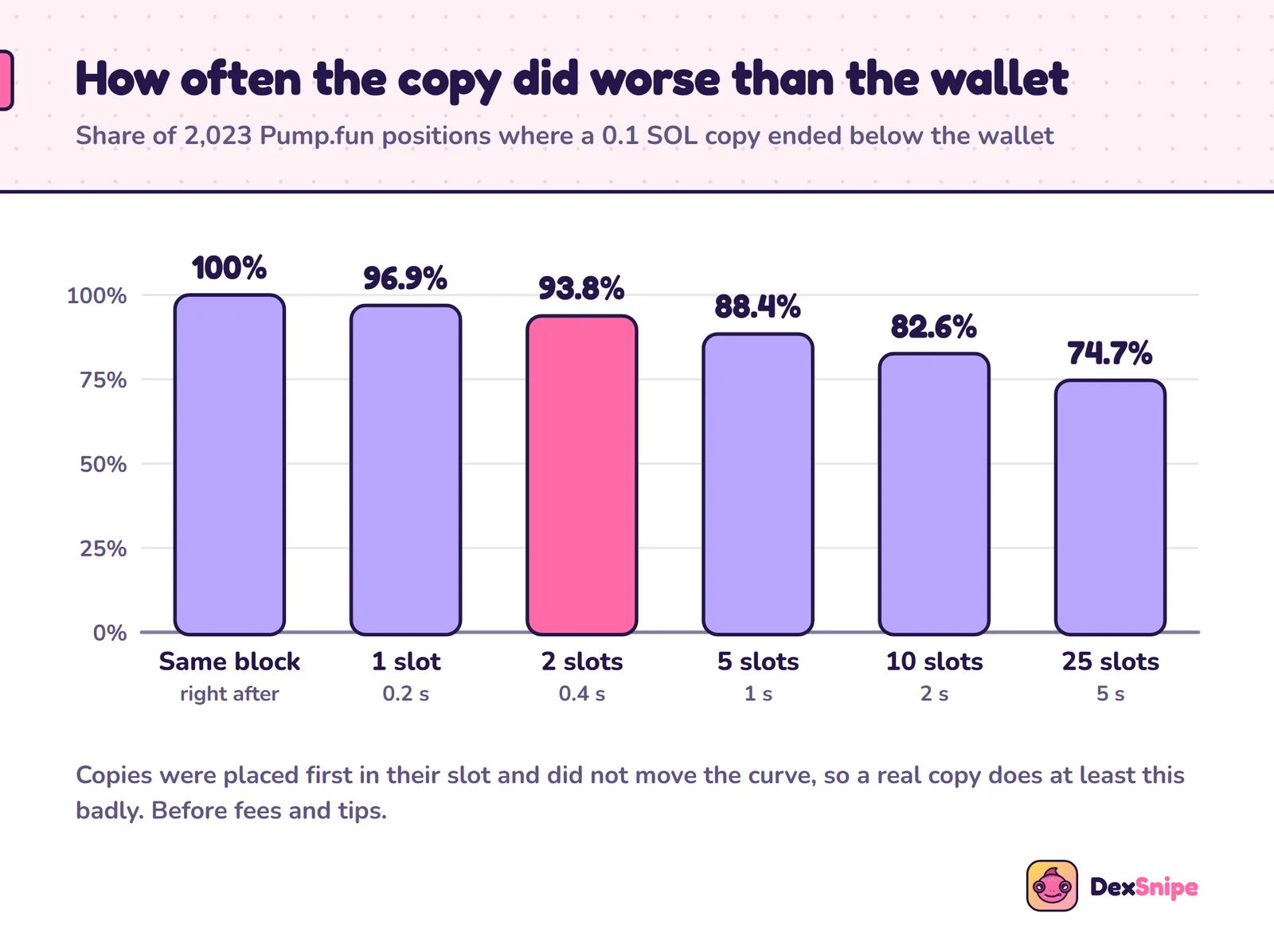
| Same block, straight after | -15.4% | -9.0% | 27.7% | 100% |
| 1 slot behind | -18.3% | -12.3% | 23.7% | 96.9% |
| 2 slots behind | -19.0% | -12.6% | 22.2% | 93.8% |
| 5 slots behind | -18.8% | -12.1% | 21.5% | 88.4% |
| 10 slots behind | -17.8% | -9.8% | 20.8% | 82.6% |
| 25 slots behind | -15.1% | -6.3% | 19.0% | 74.7% |
Start with the first row. These are ordinary wallets trading new coins, and at a flat 0.1 SOL they averaged -10.5%, with 41.6% of positions in profit. That is roughly what new Pump.fun coins pay their early buyers before costs. A copy of a random wallet starts from there and goes down.
The second row is the best case any copy trading bot can reach: landing in the same block as the wallet, right behind it. Even that copy did worse than the wallet on every single position, because it always buys after the wallet's buy has moved the price up and always sells after the wallet's sell has moved it down. One slot behind, the average falls to -18.3% and fewer than a quarter of copies make money.
The share that did worse drops as the delay grows, from 94% at 2 slots to 75% at 25 slots, about 5 seconds. That is not because waiting helps, and it is why the averages in the table move around too. A slow copy misses more of the moves the wallet caught, the bad ones as well as the good, so it lands closer to or further from the wallet more or less at random. The win rate is the steadier measure, and it keeps falling the whole way, from 27.7% in the same block to 19.0% at 25 slots.
One copy, slot by slot
Here is a single coin from the sample, picked because it shows the mechanism cleanly, not because it is the worst case.
- Slot 0, 15:30:26. A wallet creates the coin and buys 3.02 SOL of it in the same transaction. In the same block, three other wallets buy 0.87, 0.96 and 1.12 SOL. The 1.12 SOL wallet is the one we copy.
- Slot 1. Another wallet buys 2.95 SOL.
- Slot 8, about two seconds after launch. Our wallet sells everything for 1.30 SOL, a gain of 16.1%.
- Slot 9. The creator sells all of their tokens for 3.85 SOL, and two of the other launch buyers sell with them.
A copy of the same 1.12 SOL that landed one slot behind, at the very front of slot 1, got in before the 2.95 SOL buyer and closed with a 3.0% gain. A copy two slots behind bought after that 2.95 SOL buy, paid 24% more per token than the wallet, and sold in slot 10, after the creator's dump. It got back 0.73 SOL, a loss of 35.1%. The 2.95 SOL buyer itself lost 29%.
Notice who the wallet was. It bought in the same block as the creator and sold one slot before the creator did. It may be a sharp bot, or it may know the creator. We cannot tell from the chain, and neither can a copy trading bot. A copy cannot reproduce a position like that, because the position exists only in the block it was made in.
Launch buys copy worst
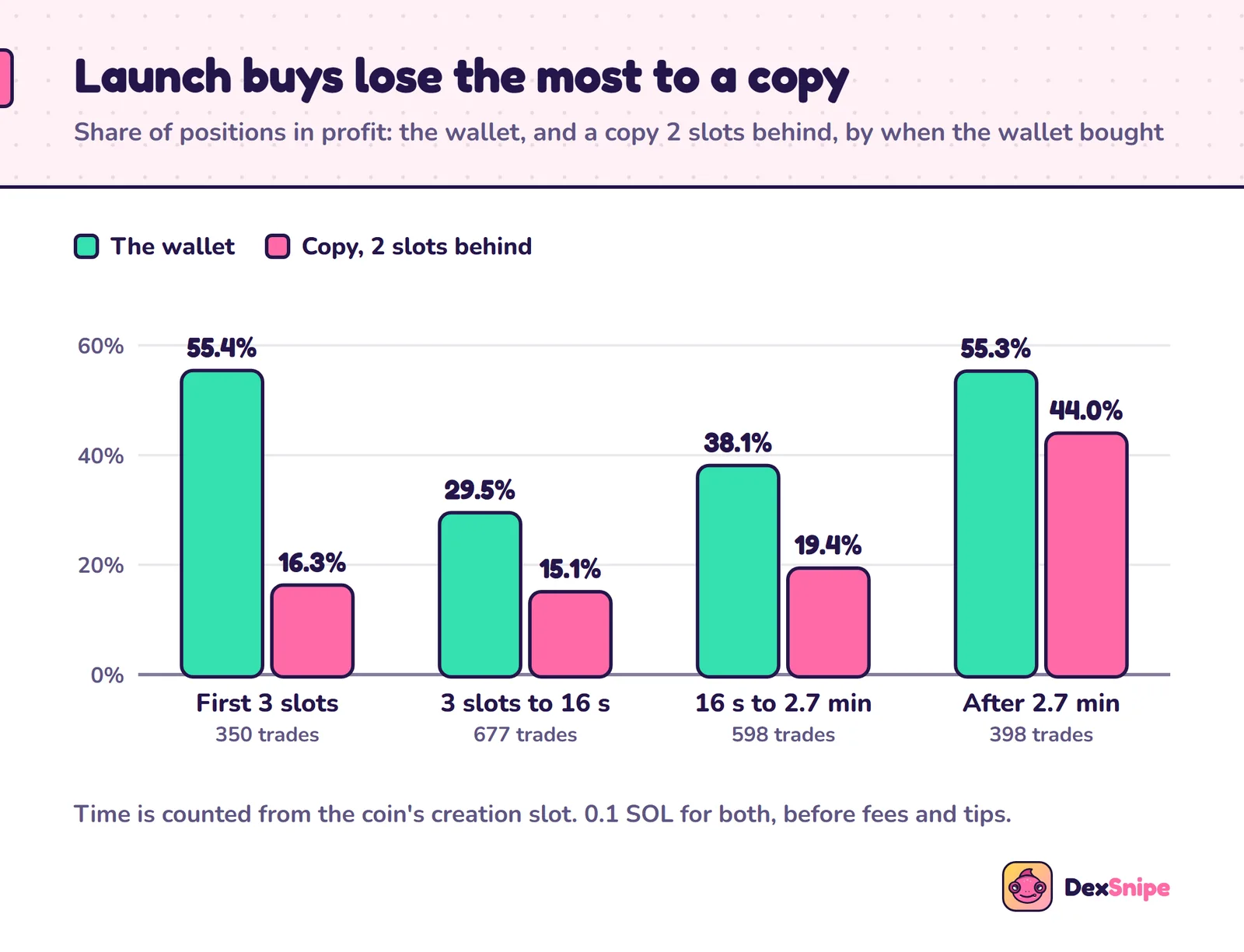
The single factor that most changed the gap was how old the coin was when the wallet bought. We split the 2,023 positions by the slot of the wallet's first buy, counted from the coin's creation.
Averages and price paid, by entry time
Averages and price paid, by entry time
| Wallet bought | Trades | Wallet avg | Wallet in profit | Copy avg | Copy in profit | Copy paid more |
|---|---|---|---|---|---|---|
| First 3 slots | 350 | +6.0% | 55.4% | -9.9% | 16.3% | 5.8% |
| 3 slots to 16 s | 677 | -24.3% | 29.5% | -30.9% | 15.1% | 1.7% |
| 16 s to 2.7 min | 598 | -14.8% | 38.1% | -22.2% | 19.4% | 2.1% |
| After 2.7 min | 398 | +5.2% | 55.3% | -2.1% | 44.0% | 3.7% |
Wallets that bought in the first three slots did well: an average of +6.0% and 55% in profit. Those are the positions copy trading tools love to show off. Their copies, two slots behind, averaged -9.9% and only 16% made money. The last column explains part of it: in the first blocks a copy paid a median 5.8% more per token than the wallet, and a quarter paid 14% or more. The launch rush moves the curve that fast.
Wallets that bought about three minutes or more after launch did almost as well, +5.2% and 55% in profit, and their copies held up far better than on launch buys: -2.1% on average and 44% in profit. The middle of the table is the bad news for everyone: the first few minutes after the launch rush were the worst time to buy, with or without a copy.
Where the gap comes from
A bonding curve prices a coin by the SOL and tokens in its reserves, so every buy raises the price for the next buyer and every sell lowers it for the next seller. A copy is always the next buyer after the wallet and the next seller after the wallet. It pays for both moves.
The buy side is the smaller part. Two slots behind, the median copy paid 2.6% more per token than the wallet across all trades. The sell side hurts more, because sells on new coins come in clusters. When a wallet sells, others with the same idea, or the same signal, often sell in the same slot or the next one, and the copy arrives after all of them. That is why the copy's average fell much further than its entry price alone would suggest: from -10.5% for the wallet to -19.0% for the copy, with a buy that cost only 2.6% more.
Fees make it worse again. Everything in this article is before costs, and a copy pays its own network fee, priority fee and tip on every buy and sell. A copy that tries to close the gap with a bigger tip pays more for each trade it makes.
Copy the sells too
Some copy traders follow a wallet in and then manage the exit themselves. The data argues against that on new coins. We ran the same 2,023 positions with a copy two slots behind that bought the same way but never copied a sell, holding to the end of the 30 minutes instead.
Copies that followed the sells averaged -19.0% with 22.2% in profit. Copies that held averaged -31.1%, with a median of -36.5%, and only 10.3% were in profit. The wallet's exit is half of what you are copying, and on a new coin it is usually the better half.
Time to the first sell
Time to the first sell
| First sell came | Positions | Share |
|---|---|---|
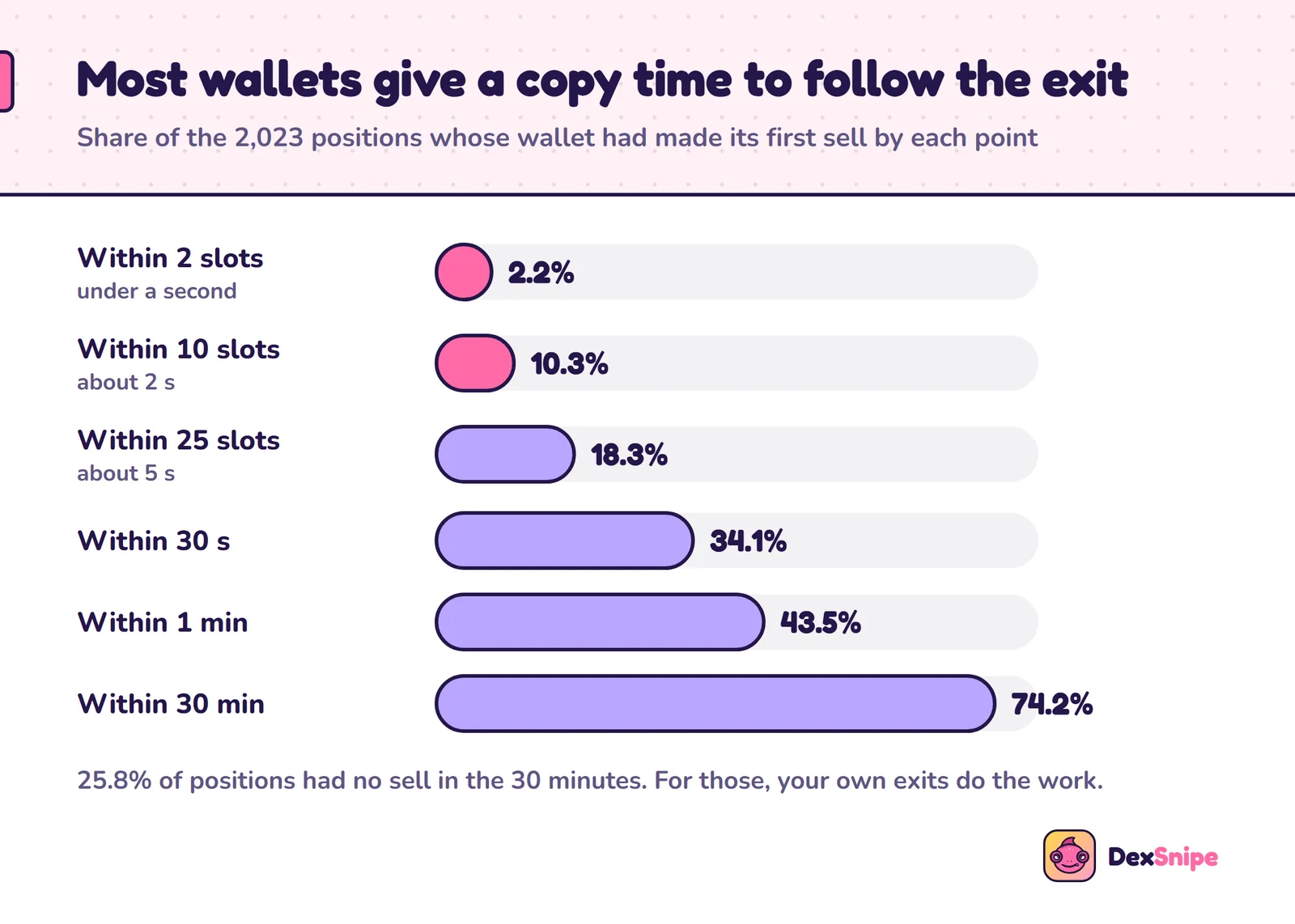
| Within 2 slots, under a second | 45 | 2.2% |
| Within 10 slots, about 2 s | 208 | 10.3% |
| Within 25 slots, about 5 s | 371 | 18.3% |
| Within 30 s | 689 | 34.1% |
| Within 1 min | 881 | 43.5% |
| Within 30 min | 1,501 | 74.2% |
| Not in the 30 minutes | 522 | 25.8% |
Most wallets were not flipping in the same second. Only 2.2% sold within two slots and 18% within 10 seconds, so a copy usually has time to follow the exit. But a quarter of the positions were still open after 30 minutes. For those, copying sells does nothing, and your own exits do the work: a take-profit step, a stop-loss, a trailing stop or a timer.
Copy small, not their size
The two common sizing modes are a fixed amount and a share of the wallet's buy. We compared a 0.1 SOL copy with a copy that bought exactly what the wallet bought, both two slots behind.
| Wallet's first buy | Trades | Wallet, its own size | Copy, same size | Copy, 0.1 SOL |
|---|---|---|---|---|
| 0.01 to 0.25 SOL | 965 | -15.9% | -23.2% | -20.3% |
| 0.25 to 1 SOL | 712 | -7.8% | -21.7% | -19.6% |
| 1 to 2 SOL | 222 | -1.8% | -26.2% | -20.9% |
| 2 to 5 SOL | 124 | +18.7% | -14.6% | -2.0% |
These are pooled results, total SOL out against total SOL in, so the wallet column is weighted by what each wallet actually spent. Two things stand out. Wallets that bought 2 to 5 SOL did much better, +18.7%, than wallets that bought small. And copying them at their own size threw all of it away and more, -14.6%: a 2 to 5 SOL copy, landing two slots later, moves the curve itself and pays for its own buy. The same trades copied at 0.1 SOL lost only 2.0%.
The small buys are worth noticing too. Positions that opened with less than 0.25 SOL lost 15.9% for the wallets themselves. Skipping a followed wallet's small buys, which are often tests or scattered bets, removes the weakest part of what you copy.
A good hour is not a record
The obvious fix is to copy only winners. We tried the simplest version. We split the sample into two halves by launch time, found every wallet with at least two positions in the first half that came out ahead overall, and looked at what those wallets did in the second half.
Of 139 wallets with two or more positions in the first half, 56 were up. Twenty-five of them traded again in the second half, 95 positions in all. Those positions came out at -2.3% for the wallets and -3.6% for a 0.1 SOL copy two slots behind, with 41% and 32% in profit. That is better than the sample as a whole, but it is a small group, and an hour of profit did not carry over into an hour of profit.
The honest reading is that two good trades tell you very little. Judge a wallet over weeks and hundreds of trades, and look at how it wins, not only that it wins. A wallet whose profits all come from the creation block is a wallet you cannot copy, however good its record looks.
What this replay does not tell you
- It is two hours on one venue. All of it is the Pump.fun bonding curve on one afternoon. On older tokens with deep pools, a few slots cost far less.
- It is generous to the copy. Copies went first in their slot and did not move the curve for anyone else. Real copies compete with other copies of the same wallet.
- It is before costs. Pump.fun's trading fee, network fees, priority fees and tips come off every trade, the copy's and the wallet's.
- It covers 30 minutes. Positions still open were valued at the last curve price, which is not what they finally sold for.
- It copies random wallets. Nobody copies a random wallet. The point of the replay is the gap between wallet and copy, which applies to good wallets as much as bad ones.
How to pick a wallet to copy
Everything above points the same way. The gap between a wallet and its copy is fixed by mechanics you cannot change, so the wallet has to beat that gap on its own. Look for these things before you add one.
- It buys after the rush. Wallets that buy minutes into a coin, or on tokens already trading, lose little to a copy. Wallets that live in the first block lose most of their edge to one.
- It holds for more than a few seconds. Check how long its trades last. Sells within a second or two cannot be followed in time.
- It has a long record. Hundreds of trades over weeks, not a lucky afternoon. Look at the losers as well as the winners.
- It does not sit next to the creator. A wallet that keeps buying in the creation block and selling just before the creator is a pattern, not a skill you can copy.
- It is not copied by everyone. A well-known wallet with many copies has a queue of bots buying behind it. You are in that queue.
If you would rather follow creators than traders, the LetsBonk guide shows how to judge a creator's record from their past launches, and a Creator watch sniper buys their next launch instead of a trader's next buy.
Copy trade settings in DexSnipe
Copy trade is one of the six triggers in the DexSnipe panel, next to Fresh launch, Migration, New pool, Creator watch and Exact mint. A copy trade sniper follows up to 10 wallets and works on every venue the panel supports.
- Fixed size or a share of their buy. Fixed buys your size every time. Share of their buy takes a percentage of what they spent, capped at your buy size, so a large buy by them never turns into a large buy by you.
- Skip their buys under. Ignores their buys below an amount you set. From the size table, 0.25 SOL is a reasonable start.
- Copy their sells. Sells the same share of your position when they sell. Leave it on for new coins.
- Your filters still run. Dev holding cap, top 10 holder cap, bundled launch check, mint and freeze authority checks and the word blocklist apply before every copied buy, so a followed wallet cannot pull you into a coin your rules would skip.
- Your exits run as well. Up to four take-profit steps, a stop-loss, a trailing stop that can wait for a gain before it starts, and a timer, for the positions the wallet keeps holding.
- Entry rules. Buy in parts splits a copied buy into smaller buys 30 seconds or more apart, so the later parts land after the first rush.
None of this removes the delay. What it does is let you copy only the trades where the delay costs little, at a size where your own buy does not move the price. If you are also choosing between bots, our comparison of Solana sniper bots covers fees and features side by side.
Set up a copy trade sniper
- Open the panel and click New sniper. Choose Copy trade under What to catch.
- Paste the wallets. Up to 10 Solana addresses, one per line.
- Choose the size. A small fixed amount, or a share of their buy with your buy size as the cap. Set a minimum buy to copy.
- Set the filters. The same ones you would use for any new coin: dev holding cap, bundled launch check, top 10 holder cap.
- Build the exits. Turn Copy their sells on, and add a stop-loss and a timer for positions they never close.
- Connect your wallet, pick a plan and arm it. Add the key of a separate funded sniper wallet, arm the sniper and close the tab. It runs on our side.
Trade only what you can lose. Copying a wallet does not copy its results. In our replay most copies of most wallets lost money on new coins, before costs. This page is not financial advice.
Solana copy trading questions
What is a Solana copy trading bot?
+
A bot that watches one or more wallets you choose and repeats their trades from your own wallet. When a followed wallet buys a token, the bot buys the same token, at a fixed size or a share of their buy, and it can sell when they sell. It runs on its own, so it reacts faster than a person watching a block explorer.
How much does copy trading delay cost on Solana?
+
In our replay of 2,023 wallet trades on new Pump.fun coins, a copy that landed 2 slots, about 0.4 seconds, after each buy and each sell did worse than the wallet it copied 94% of the time. At the same 0.1 SOL per trade, the wallets averaged -10.5% and the copies -19.0%, before fees. Even a copy in the same block, straight after the wallet, did worse every time.
Is copy trading on Solana profitable?
+
Only when the wallet you copy makes more than the copy gives up. The win-rate gap was smallest on wallets that bought minutes after launch, where copies kept 44% winners against 55% for the wallets, and largest on wallets that bought in the first blocks, where 55% winners became 16%. Copying a launch sniper mostly copies their entry, not their result.
Should a copy trading bot copy sells?
+
Yes, for new tokens. Copies that sold when the wallet sold averaged -19.0% in our replay. Copies that bought the same way but held to the end of the 30-minute window averaged -31.1%, with only 10% of them in profit. The wallet's exit is half of what you are copying.
How many wallets can DexSnipe copy?
+
Up to 10 wallets per copy trade sniper. Each sniper buys at your fixed size or at a share of the followed wallet's buy capped at your size, can skip their buys below a minimum, runs your filters before every buy, and can sell the same share when they sell, alongside take-profit steps, a stop-loss, a trailing stop and a timer.
Does DexSnipe take a fee on copied trades?
+
No. DexSnipe is a flat plan: 1 SOL for 7 days, 3 SOL for 30 days or 5 SOL for 90 days, with copy trading included. You pay the network fee, your own priority fee and tip, and the venue's trading fees.
Sources and method
The trades come from our Pump.fun sample: 1,205 coins created between 14:56 and 16:51 on November 5, 2026, each with every bonding curve trade for its first 30 minutes, read from the chain. We used the 412 ordinary SOL-paired coins with a complete trade history and left out Mayhem coins. A position is a wallet other than the creator whose first buy on the coin was 0.01 to 5 SOL and whose own token balance changed with each trade, which leaves out trades signed by one account for tokens held by another. That gave 2,023 positions by 1,383 wallets on 186 coins.
We rebuilt each curve's reserves trade by trade from its SOL and token balance changes, starting from the virtual reserves in Pump's README, and priced every buy and sell with the constant product formula. A copy a given number of slots behind buys at the reserves left by every trade before that slot, and sells the same share as the wallet the same number of slots after each of the wallet's sells. "Same block, straight after" uses the reserves right after the wallet's own trade. Holdings at 30 minutes are valued at the last curve price. The copy's trades are not added to the curve. All results are before trading fees, network fees, priority fees and tips. Pooled results are total SOL out over total SOL in; averages and medians are per position. DexSnipe settings are taken from the product itself.
- Pump program README (Pump public docs)The bonding curve and its starting virtual reserves, which we used to price every copy.
- Pump program IDL (Pump public docs)The BondingCurve layout we decoded for the Mayhem flag, the quote asset and the complete flag.
- Pump program on SolscanProgram 6EF8rrecthR5Dkzon8Nwu78hRvfCKubJ14M5uBEwF6P, whose curve trades we replayed.
- The example coin, on SolscanCreated at 15:30:26 on November 5, 2026 with a 3.02 SOL creator buy.
- Its creation transaction, on SolscanCreateV2 and the creator's own buy in one transaction.
- Solana terminology: slot (Solana docs)The period during which a leader ingests transactions and produces a block; we count delay in slots.
Copy the trades the delay cannot ruin
Up to 10 wallets, your filters before every buy, their sells and your exits. Flat plan, no cut of your trades.