Believe Sniper Bot
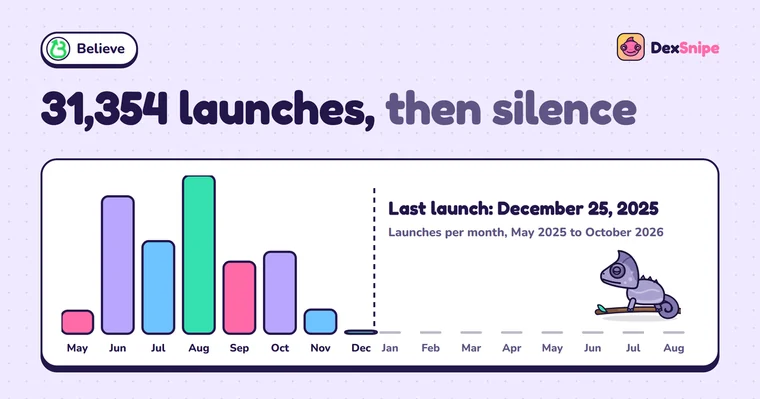
Believe was the launchpad where you made a coin by replying to a post on X. For a few months in 2025 it was one of the busiest places on Solana. We read every pool created under Believe's Meteora fee claimer, all 31,354 of them, to see what sniping it actually looked like: who launched, what the first buyers paid, when the money peaked and when it stopped. The answer to the last question is the one most Believe sniper guides leave out. The final launch was on Christmas Day 2025.
The short version
- Believe's money peaked in June 2025. Its curves collected about 33,400 SOL in trading fees that month, and 15 SOL in December.
- Launch counts lied. August had the most launches of any month, but more than half came from wallets launching ten coins or more, and fees were a twelfth of June's.
- Being first was expensive by design. 93% of launches charged 50% on the opening trade. Speed was the one thing Believe's curves were built to tax.
- There is nothing new to snipe today. No pool has been created under Believe's fee claimer since December 25, 2025.
What a Believe sniper bot does
Believe coins launched on Meteora's Dynamic Bonding Curve, the same curve Bags and many smaller launchpads use. A sniper bot watches for new pools, buys in the first moments of the curve, and sells on rules you set. When a curve completed, the coin migrated to a Meteora pool, where a migration sniper could buy the moment it opened.
Most pages about Believe sniping were written during its boom and describe it as if it were still running. This one is written from the chain, after the fact. It covers what sniping Believe was really like, why the usual sniper advice did not fit it, and what is left of it now. If you came here to set up a Believe sniper, the honest summary is in the last few sections: you can, it will fire if Believe launches again, and in the meantime the same lessons apply on launchpads that are still running.
How a Believe launch worked
Believe's idea, as Bankless described it in May 2025, was to turn posts on X into coins. Anyone could reply to Believe's launch account with a ticker and a name, and a coin was created on the spot. A "scout" could also reply to someone else's post, tagging an idea or a project, and launch a coin for it. The founder behind an idea could claim half of the coin's trading fees even if they had not launched it themselves.
On chain, every launch was a Meteora bonding curve pool created with one of Believe's pool configs. Each config names a fee claimer, and every Believe config we found named the same one. That makes the whole history readable: list every pool on the Dynamic Bonding Curve program, keep those whose config belongs to that fee claimer, and you have Believe.
Believe also gave its coins a recognisable signature. Of the 31,354 mints, 28,800 end in the letters BLV. If you see a mint ending in BLV on an explorer, it is very likely a Believe coin.
Every Believe launch, on chain
On November 6, 2026 we downloaded every pool of the Meteora Dynamic Bonding Curve program, about 1.85 million, and every pool config. We kept the configs whose fee claimer is Believe's and read every pool created with them.
| Measure | Value |
|---|---|
| Pool configs | 712 |
| Pools, one per coin | 31,354 |
| Mints ending in BLV | 28,800 |
| Different creator wallets | 17,908 |
| Curve trading fees collected | about 59,600 SOL |
| First launch | May 13, 2025 |
| Last launch | December 25, 2025 |
Each pool keeps running totals of the trading fees it has collected. We use those totals as the measure of money moving through Believe, because they come from the pools themselves and cannot be inflated by counting the same launch twice. They include the anti-sniper part of the fee, which matters later.
Eight months, month by month
Pools record the slot they opened in. We converted slots to dates with block times read from the chain at 41 points across the period.
| Month | Launches | Creator wallets | Curve fees, SOL |
|---|---|---|---|
| May 2025 | 1,217 | 764 | 8,026 |
| June 2025 | 7,274 | 6,680 | 33,439 |
| July 2025 | 4,900 | 4,630 | 11,299 |
| August 2025 | 8,378 | 2,339 | 2,720 |
| September 2025 | 3,810 | 1,811 | 2,066 |
| October 2025 | 4,336 | 1,863 | 1,908 |
| November 2025 | 1,276 | 558 | 163 |
| December 2025 | 163 | 102 | 15 |
The shape is a sharp peak and a long tail. Believe went from 1,217 launches in its first half month to 7,274 in June, with nearly as many different creators as launches: almost every coin that month came from a new wallet. That is what a platform looks like when real people are trying it. Fees, the best measure of trading, peaked in June at about 33,400 SOL, more than half of everything Believe's curves ever collected.
From July the money fell faster than the launches did. By October Believe was still seeing more than 4,000 launches a month, but its curves collected under 2,000 SOL in fees, about 0.44 SOL per launch against 4.6 SOL per launch in June. November and December were the end: 1,276 launches, then 163, then none.
August: more launches, less money
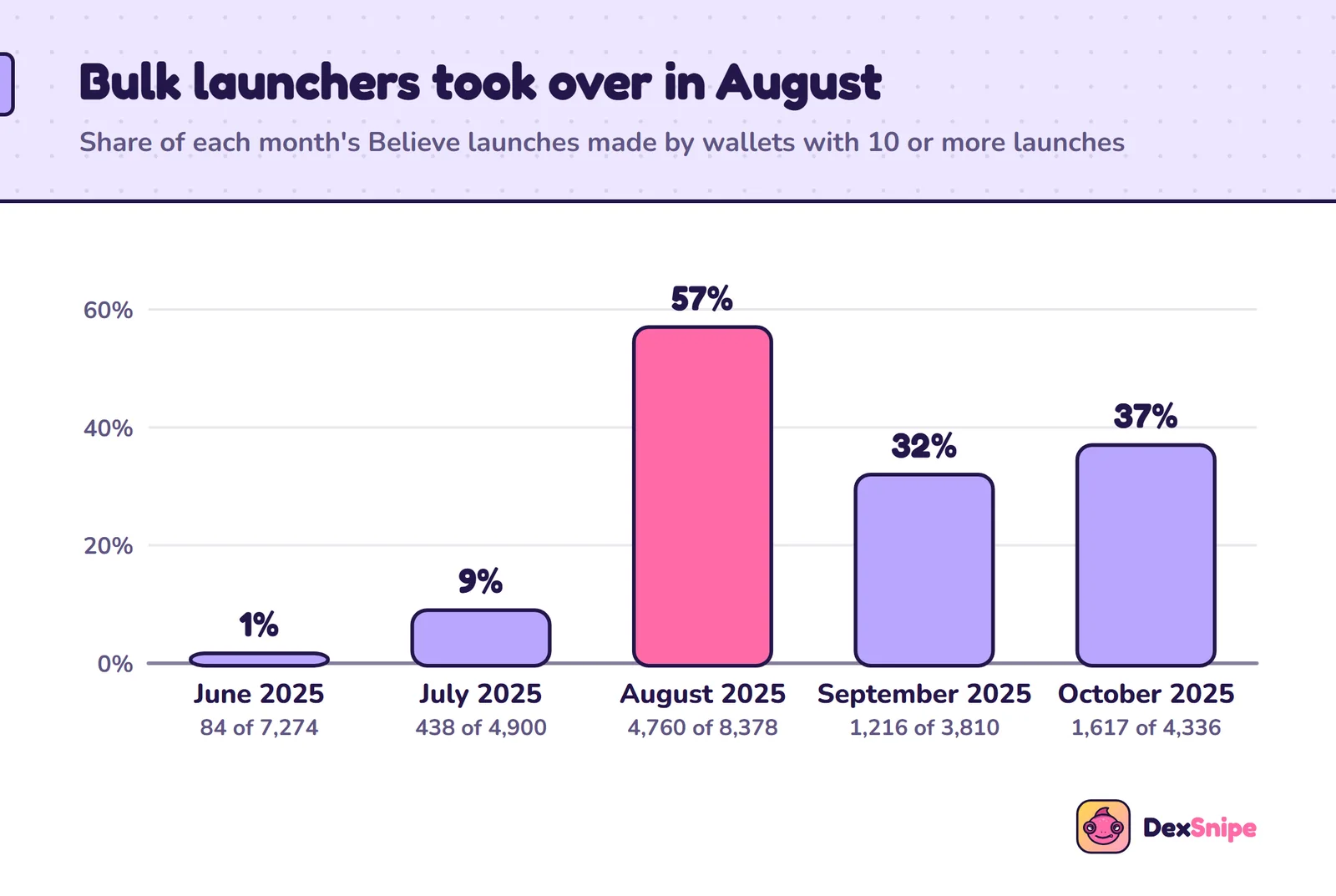
August 2025 is the month to study if you snipe any launchpad. It had more launches than any other month, 8,378. A sniper bot set to fire on every new Believe coin would have been busier than ever. And it would have been trading in a market that had already mostly left.
Data table
Share of Believe launches by wallets with 10 or more launches
| Month | Launches | From 10+ launch wallets | Share |
|---|---|---|---|
| June 2025 | 7,274 | 84 | 1% |
| July 2025 | 4,900 | 438 | 9% |
| August 2025 | 8,378 | 4,760 | 57% |
| September 2025 | 3,810 | 1,216 | 32% |
| October 2025 | 4,336 | 1,617 | 37% |
In June, 1% of launches came from wallets that launched ten or more coins. In August it was 57%. Six wallets that launched more than 100 coins each made 1,066 of August's launches between them. The launch count went up because a small number of wallets were launching in bulk, not because more people were trading. Fees that month were about 2,700 SOL, a twelfth of June's.
Bulk launching has a purpose, and it is rarely good for the buyer. Each launch is a lottery ticket for the launcher, and a sniper that buys all of them is paying for the tickets. The lesson generalises: on any launchpad, a rising launch count with a falling number of creators is a warning, not an opportunity.
Who launched
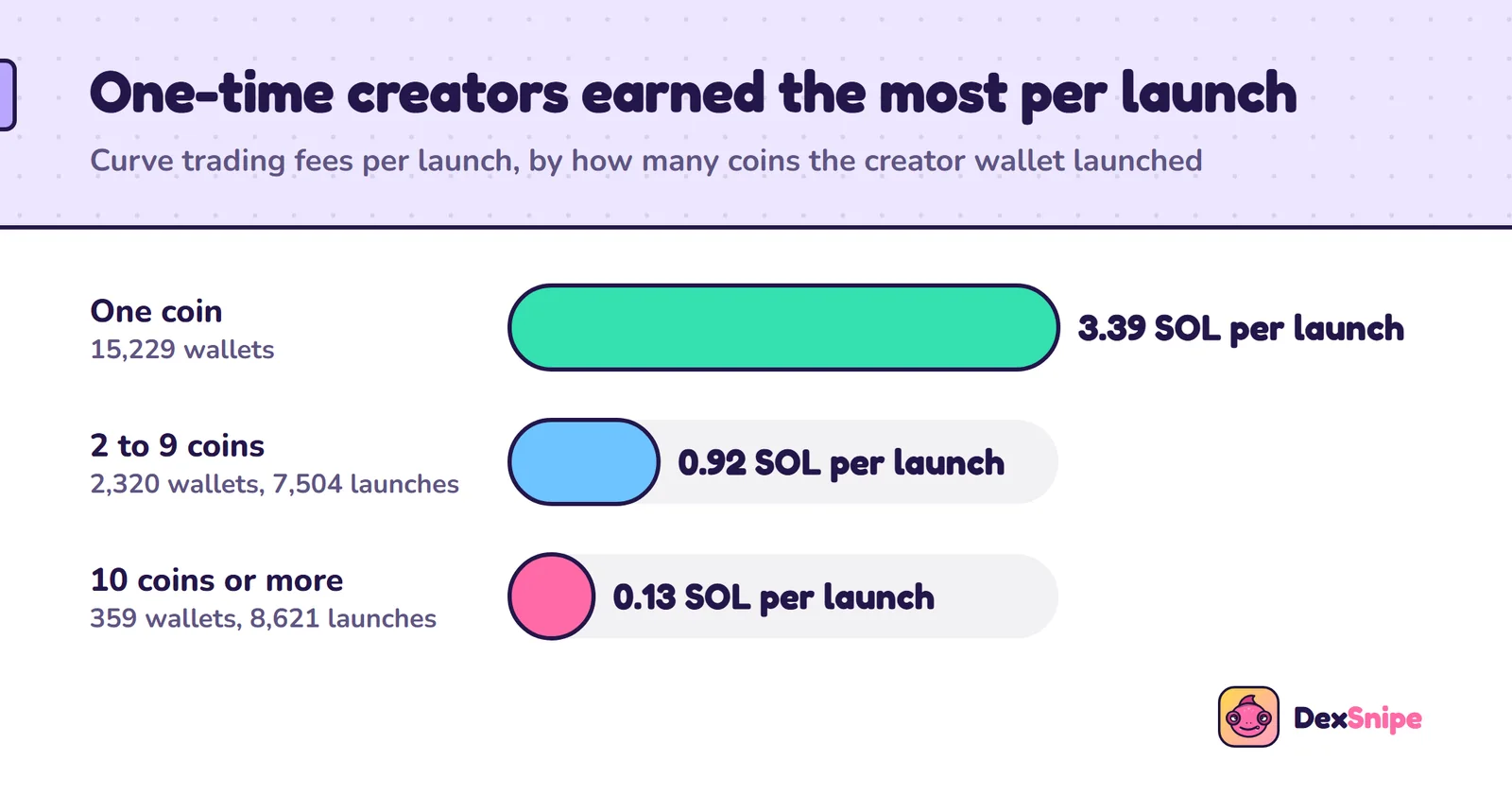
17,908 wallets launched at least one Believe coin. Most launched exactly one. Here is how the three kinds of creator compared over the whole period:
Data table
Believe creators by number of launches
| Creator launched | Wallets | Launches | Curve fees per launch |
|---|---|---|---|
| One coin | 15,229 | 15,229 | 3.39 SOL |
| 2 to 9 coins | 2,320 | 7,504 | 0.92 SOL |
| 10 coins or more | 359 | 8,621 | 0.13 SOL |
The pattern is stark. A coin from a wallet that launched once collected, on average, 26 times the trading fees of a coin from a wallet that launched ten or more. Coins from one-time creators also reached their migration threshold more often: 509 of 15,229, against 13 of 8,621 from the bulk launchers.
The six busiest wallets launched 775, 560, 444, 432, 141 and 126 coins. Not one of their 2,478 coins completed its curve. Three of them kept launching for three months or more. A sniper with no creator filter would have bought every one.
The one filter that would have mattered most. Skip creators with a long launch history and nothing to show for it. On Believe, wallets with ten or more launches made more than a quarter of all launches and less than 2% of all curve fees.
The launch fee that punished speed
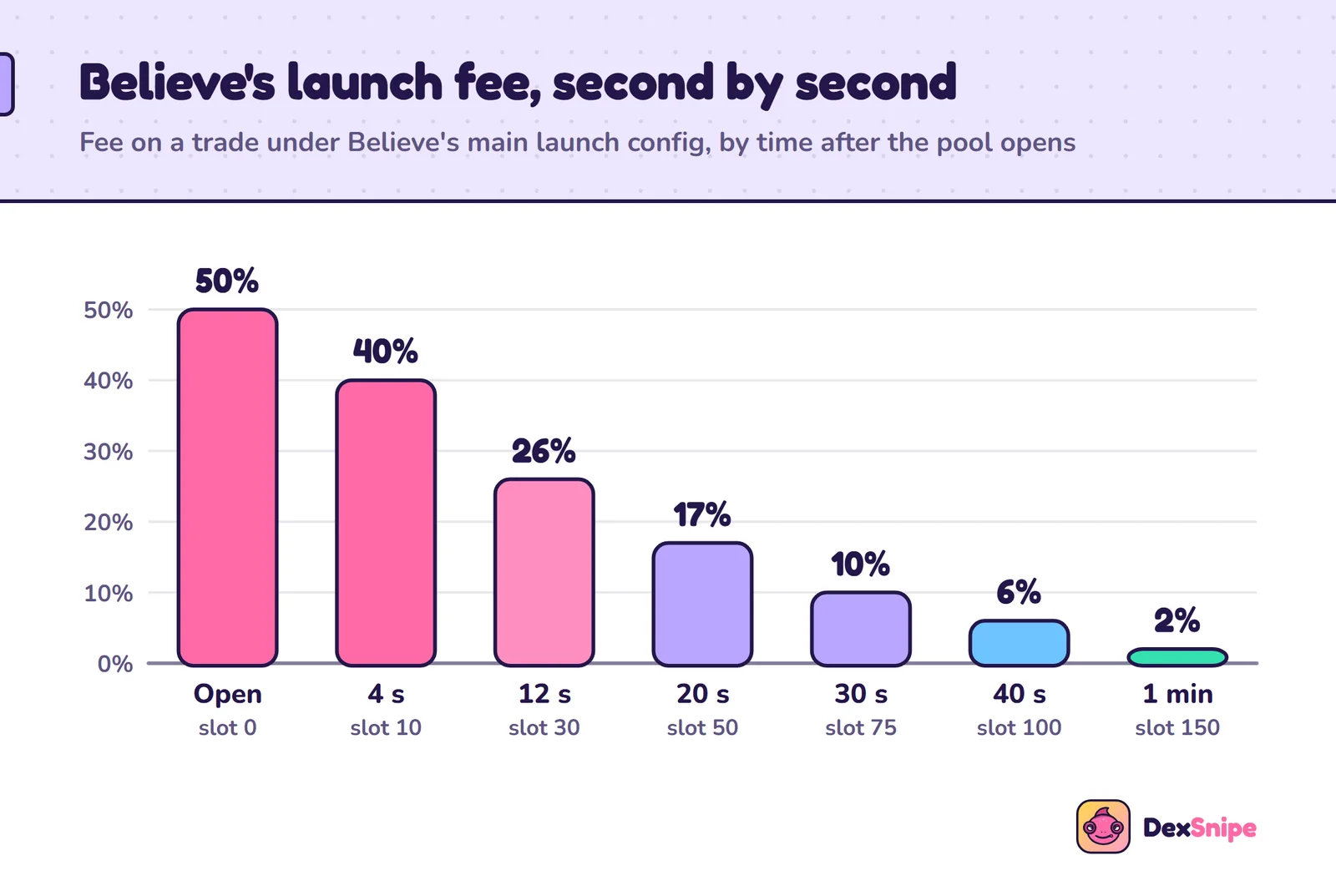
Meteora's bonding curve lets a launchpad set a fee schedule: a high cliff fee at opening that falls each period. Believe used several, but one dominated. 29,025 of the 31,354 pools, 93%, opened with a 50% fee that fell exponentially, by 2.12% of the current fee every slot, for 150 slots.
Data table
Believe's main launch fee, by time after opening
| Time after opening | Slots | Fee on a trade |
|---|---|---|
| At opening | 0 | 50% |
| About 4 seconds | 10 | 40% |
| About 12 seconds | 30 | 26% |
| About 20 seconds | 50 | 17% |
| About 30 seconds | 75 | 10% |
| About 40 seconds | 100 | 6% |
| About a minute | 150 | 2% |
The figures follow from Meteora's exponential formula, cliff fee times one minus the reduction factor to the power of the slots passed, with Believe's parameters read from its configs. Times assume about 0.4 seconds per slot, Solana's pace while Believe was busy; since October 2026 slots run about twice as fast.
Think about what this does to a sniper. A bot that lands in the first slot pays half of its buy as a fee. To break even, the price has to roughly double before the bot can sell, and the sell pays a fee too. Waiting 30 seconds cuts the fee to 10%. Waiting a minute cuts it to 2%. On Believe, the fastest buyer was not the winner. The fastest buyer was the one who paid for everyone else's protection.
Reading a Meteora config yourself
Every Meteora curve pool points to its config account, and the config holds the fee schedule: the cliff fee, the number of periods, how long each period lasts and the reduction factor. Meteora's SDK decodes it, and the fee scheduler page in Meteora's docs gives the formula. Five minutes with one pool tells you how every pool on the same config will charge its first buyers, which is worth knowing before you point a sniper at a launchpad.
Smaller groups of pools used other schedules. 1,780 opened at 99% and fell much faster, down to a few percent or less within about six seconds. 481 opened at 90%. A handful charged a flat 2% from the start. The lesson is the same for all of them: on a Meteora curve, read the config before you decide how fast to be.
Migration on Believe
A Believe coin migrated when its curve had taken in a set amount of SOL, written into its config. Bankless described the target in May 2025 as a market cap of about $100,000. On chain, the thresholds are in SOL, and they were not all the same.
| Threshold | Pools | Completed |
|---|---|---|
| Under 100 SOL | 34 | 18 |
| 100 to 130 SOL | 1,538 | 23 |
| 130 to 200 SOL | 9,428 | 406 |
| 200 SOL or more | 20,354 | 131 |
The median pool needed about 203 SOL to complete, and two thirds of pools needed 200 SOL or more. For a migration sniper the useful fact is not how many completed, which was always a small share, but when. Completions followed the money: they peaked with June's fees and dwindled with them. After November 9, 2025, no Believe launch went on to complete its curve.
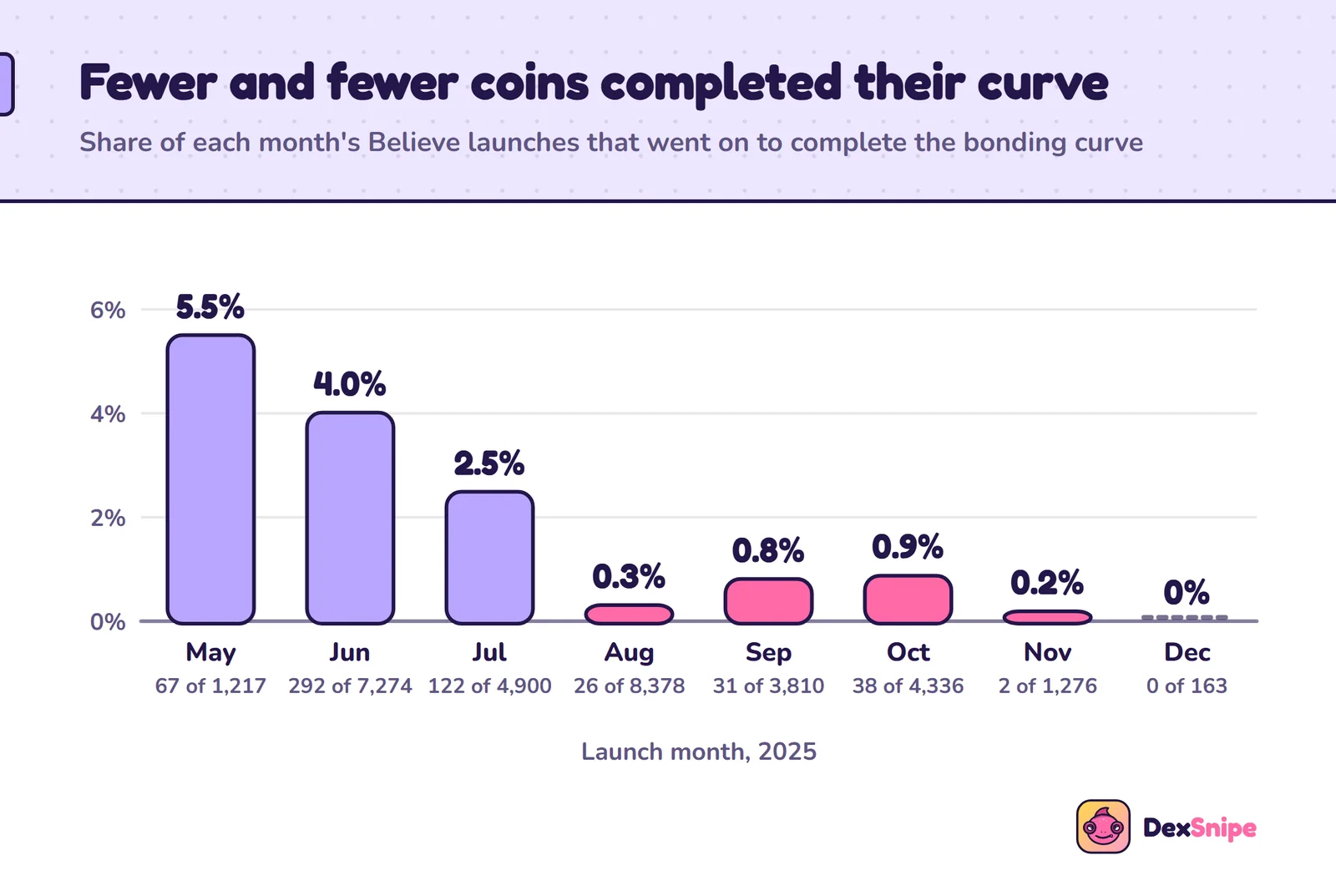
Data table
Believe launches that went on to complete their curve, by launch month
| Launch month | Launches | Completed |
|---|---|---|
| May 2025 | 1,217 | 67 |
| June 2025 | 7,274 | 292 |
| July 2025 | 4,900 | 122 |
| August 2025 | 8,378 | 26 |
| September 2025 | 3,810 | 31 |
| October 2025 | 4,336 | 38 |
| November 2025 | 1,276 | 2 |
| December 2025 | 163 | 0 |
A migration sniper on Believe would have had its busiest month in June 2025 and very little to do from August on, even while the launch feed was at its fullest. Launch counts and migration counts tell different stories, and on Believe it was the migrations that told the truth.
Launching by reply, and what it cost
Believe made launching a coin almost free of effort. A reply on X was enough. That was the point, and for a few weeks it worked: in June, nearly every launch came from a different wallet, and those coins drew most of the money Believe ever saw.
The same ease made bulk launching trivial. A wallet that can launch a coin with a reply can launch a hundred, and by August a few wallets were doing exactly that. Nothing in the launch flow made a coin from a bulk launcher look different from a coin from a founder. The difference was only visible in the creator's history, which is exactly where a sniper should look.
This is not unique to Believe. Every launchpad that lowers the cost of launching invites the same pattern. The ones still running today, Pump.fun, LetsBonk, Bags and others, all have wallets that launch in bulk. Believe simply shows the pattern from start to finish, with nothing cut off.
The coins that earned the most
The Believe coins with the most trading fees were not jokes about celebrities. The top five were called Text Behind Image, hedgemony, JustWatched, Drilled and NeuroCheck, and each collected between about 184 and 353 SOL in curve fees before completing its curve. They read like app and startup names, which is what Believe set out to attract: founders launching coins for things they were building.
| Coin | Curve fees, SOL | Completed curve |
|---|---|---|
| Text Behind Image | 353 | Yes |
| hedgemony | 206 | Yes |
| JustWatched | 189 | Yes |
| Drilled | 186 | Yes |
| NeuroCheck | 184 | Yes |
Fees on these coins came from trading on the curve before migration, including whatever the first buyers paid under the launch fee. Part of each total came from the launch window, when the fee was far above 2%, so fees are not a direct measure of volume. They do show which coins kept drawing buyers long enough to fill their curves, and that is the scale a founder-backed coin could reach on Believe at its peak. The bulk launchers, across 2,478 coins from their six busiest wallets, never filled one.
That is the second lesson Believe teaches. The coins that drew real trading were, more often than not, tied to something with a product or a person behind it. The coins that drew nothing were, overwhelmingly, from wallets launching in bulk. A sniper cannot read intentions, but it can read creator history and, on platforms that show them, the identity behind a launch.
How it ended
The last Believe coin that went on to complete its curve was launched on November 9, 2025. The last Believe launch of any kind was on December 25, 2025. Since then, through November 2026, no pool has been created with any of Believe's 712 configs.
The fee claimer account itself stayed active longer: its most recent transactions were in late July 2026. But no new pool has used its configs since December.
We also checked whether Believe-style coins had simply moved to another config. Among the roughly 1.85 million Dynamic Bonding Curve pools, 207 pools outside Believe's configs had mints ending in BLV, spread over more than two dozen different fee claimers and mostly dated to 2025. None of them looks like a continuation of Believe. One group belongs to a separate project with a similar name.
What matters for a sniper is the on-chain fact: as a source of new launches, Believe has been silent for more than ten months.
What Believe teaches a sniper
A launchpad that has stopped still has something to offer: a complete record, from first launch to last, with no survivors cherry-picked. Four lessons stand out, and all of them apply on launchpads that are still running.
1. Measure money, not launches
Believe's launch count stayed above 3,800 a month until October, long after its fees had collapsed. If you judge a launchpad by how many coins appear, you will keep sniping it after the buyers have left. Fees or volume per launch tell you whether there is anyone to sell to.
2. Count creators, not coins
When a few wallets start launching hundreds of coins, the launch feed fills with tickets someone else is buying. A creator filter, or a creator watch list built from wallets with a real record, is worth more than any speed setting.
3. Read the fee schedule
On Meteora curves the first buyer can pay a cliff fee of 50%, 90% or 99%. Speed is only an edge where the fee lets it be one. On a Believe-style schedule, the right move is not to be first.
4. Watch the platform, not only the coin
Launchpads do not last forever. A sniper armed on a single launchpad stops earning when that launchpad stops launching, and nothing on screen tells you. Spread snipers across venues, and check now and then that each one is still producing launches.
Before you arm a launchpad sniper
Believe's decline was visible on chain months before the launches stopped. Five checks would have caught it, and they take a few minutes on any launchpad:
- Is it still launching? Look at the most recent pools or mints for the venue. A launchpad with no launches in the last day is not one to arm a sniper on.
- Is money still moving? Fees or volume per launch matter more than the number of launches. On Believe they fell by a factor of ten between June and October.
- Who is launching? If a handful of wallets make most of the launches, the feed is mostly lottery tickets.
- What does the first buyer pay? Read the curve's fee schedule. A 50% opening fee changes every speed and slippage setting.
- Are coins still completing? Migrations are a slow signal, but a launchpad where none complete for weeks has few buyers left.
None of these needs a paid tool. They need an explorer and the habit of checking. A sniper that runs on a venue that has quietly emptied does not lose money, but it does not earn any either, and it gives a false sense of being in the market.
Sniping Believe today
Believe is still a venue in DexSnipe, for the Fresh launch, Migration, Creator watch and Copy trade triggers. If launches resume under Believe's configs, a sniper armed on it will pick them up with the filters and exits you set. Until then, a Believe-only sniper will sit idle.
The more useful move is to take what Believe taught to the launchpads that are still active. The closest relative is Bags, which also launches on Meteora's curve and also pays trading fees to named people, including people who did not launch the coin. Our Bags guide shows how often those people never claim. The Meteora guide covers launch fee schedules across every launchpad on the curve.
Coins from Believe that completed their curves trade in Meteora pools. They are ordinary pools now, and any trading in them is outside the launch window a sniper is built for.
What this data does not tell you
- Months are approximate at the edges. Pools record slots, not dates. We converted with block times at 41 points, so a launch near midnight on the last day of a month may land in the wrong one.
- Fees are not profit. A pool's fee total measures trading. It does not tell you who made or lost money.
- Only Believe's own fee claimer is counted. If Believe ever launched coins with a config naming a different fee claimer, those are not here. Our scan for BLV mints elsewhere found nothing that looked like it.
- Wallets are not people. One person can use many wallets, and a launch service can use one wallet for many people. Creator counts are wallet counts.
- Launch fee figures are schedules, not receipts. We read the fee each config was set to charge. What individual buyers paid depends on when their trades landed.
Filters for social launchpads
These are the filters Believe's record supports, for Believe if it returns and for any launchpad built on the same model.
- Creator watch over Fresh launch. Coins from one-time creators collected 26 times the fees of coins from bulk launchers. Following creators with a record captures that difference.
- Blocklist words. Bulk launchers reuse themes. A word blocklist trims them cheaply.
- Dev holding cap. A creator who buys a big share at launch can sell it into the first buyers. Keep the cap at 5 to 10%.
- Skip bundled launches. Wallets buying in the creator's own block are often the creator's.
- Socials. On a launchpad built around X posts, a coin with no link back to a real account is missing the one thing the model is about.
Believe sniper settings
For a Believe sniper armed in case launches resume, or a sniper on a launchpad with the same fee schedule. Starting points, not promises.
| Setting | Creator watch | Fresh launch |
|---|---|---|
| Trigger | Creator watch, one sniper per wallet | Fresh launch, Believe |
| Buy size | 0.2 to 0.5 SOL | 0.05 to 0.1 SOL |
| Slippage cap | 15% | 10% |
| Priority fee | 0.0005 SOL | 0.0005 SOL |
| Jito tip | 0.001 SOL | 0.001 SOL |
| Dev holding cap | 10% | 5% |
| Skip bundled launches | On | On |
| Top 10 holder cap | 35% | 25% |
| Take-profit | +50% sell 50%, +150% sell 50% | +30% sell 50%, +80% sell 50% |
| Stop-loss | 30% | 25% |
| Timer | 60 minutes | 15 minutes |
| Dev-sell exit | On | On |
Why the tip is low
Paying for priority makes sense when landing first is an edge. Under a schedule that charges 50% to the first buyer, it is the opposite. A low tip keeps the bot from paying extra to land in the most expensive slot, and a slippage cap guards the price, not the fee.
Take profit, stop loss and selling
The curve does not hold orders, so every exit is the bot watching the price and sending a sell. DexSnipe gives each sniper up to four take-profit steps, a stop-loss, a trailing stop, a timer and a dev-sell exit, all running on the server after you close the tab.
- Count the fee in every target. After the launch window, Believe curves charged 2% a trade, so a round trip costs about 4% before network costs.
- Use the timer. Most launches in Believe's later months saw very little trading. A timer frees the SOL.
- Keep the dev-sell exit on for creators who sell after minutes, not seconds.
- Check your venues monthly. A sniper on a venue that stopped launching never fires. That is cheap, but it is also a sniper doing nothing.
| What you see | Likely cause | What to change |
|---|---|---|
| Buys fill but start deep in loss | Bought inside the launch fee window | Snipe the migration instead of the launch |
| Dozens of coins from one wallet | Bulk launcher | Switch to Creator watch |
| Sniper never fires | Venue has stopped launching | Add an active venue |
| Positions sit for hours | Thin trading | Shorten the timer |
Choosing a Believe sniper bot
- Does it cover more than one venue? Believe showed how quickly a launchpad can go quiet. A bot locked to one is a bet on that one.
- Can it follow chosen wallets, so you buy creators with a record instead of every launch?
- Does it check holdings before the buy, with a dev cap, a top 10 cap and a bundle check?
- Do exits run on a server when you are offline?
- Is the price flat? A bot that takes a cut of every trade costs more on exactly the kind of small, frequent trades that launch sniping produces.
Believe in DexSnipe
A Creator watch or Copy trade sniper can cover Believe together with any of the other venues: Pump.fun, LetsBonk, LaunchLab, Bags, Boop, Jupiter Studio and Heaven, plus pools on PumpSwap, Raydium, Meteora and Orca. Every sniper has a dev holding cap, a top 10 holder cap, a bundled launch check, a socials check and a word blocklist, and up to four take-profit steps with a stop-loss, trailing stop, timer and dev-sell exit. The price is a flat plan from 1 SOL for 7 days with no cut of your trades.
Set up a Believe sniper in DexSnipe
- Open the panel and click New sniper. Choose Creator watch or Fresh launch.
- Tick Believe, and at least one active launchpad such as Bags, so the sniper has launches to act on.
- Set the buy: a small size, a tight slippage cap and a low tip.
- Set the filters and exits: dev holding cap, bundle check, two take-profit steps, a stop-loss, a timer and dev-sell on.
- Connect your wallet and save. Snipers are stored on your wallet address.
- Pick a plan, add a sniper wallet and arm it. Send 1, 3 or 5 SOL to the reserved address, add the key of a separate funded wallet, arm the sniper and close the tab.
Trade only what you can lose. Most new coins on any launchpad lose value, and launchpads themselves can stop. This page is not financial advice.
Believe sniper bot questions
What is a Believe sniper bot?
+
A bot that buys new Believe coins in the first moments on their Meteora bonding curve, or when they migrate to a Meteora pool, and sells on rules you set. It can also follow chosen creator wallets and buy their next launch.
Is Believe still launching coins?
+
Not on chain, as of November 2026. We read every pool created under Believe's Meteora fee claimer. The first launched on May 13, 2025 and the last on December 25, 2025. No new pool has been created under it since. A sniper set to Believe will fire if launches resume, but for now there is nothing new to buy.
How many coins were launched on Believe?
+
31,354 under Believe's main Meteora fee claimer, by 17,908 different creator wallets. 28,800 of the mints end in the letters BLV, which makes them easy to recognise on an explorer.
What was Believe's anti-sniper fee?
+
For 93% of launches, the curve charged a 50% fee on the first trade, falling by about 2.1% of the current fee every slot until it reached 2% after 150 slots, about a minute. A buy in the first seconds paid close to half its value in fees; a buy after a minute paid 2%.
When was Believe busiest?
+
June 2025 by money: Believe curves collected about 33,400 SOL in trading fees that month. August 2025 had the most launches, 8,378, but more than half came from wallets that launched ten or more coins, and fees fell to about 2,700 SOL.
Can I still trade Believe coins?
+
Yes. Coins that completed their curve migrated to Meteora pools and trade there like any other pool. Coins that never completed stay on their bonding curve, where they can still be bought and sold if anyone is trading.
How do I recognise a Believe coin?
+
Most Believe mints end in the letters BLV: 28,800 of the 31,354 we found. On chain, every Believe pool is a Meteora Dynamic Bonding Curve pool whose config names Believe's fee claimer, so the config is the certain test.
How much SOL did a Believe coin need to migrate?
+
It depended on the config. The median Believe pool needed about 203 SOL in its curve to complete, and two thirds needed 200 SOL or more. Completed coins moved to Meteora pools.
Does DexSnipe take a fee on Believe trades?
+
No. DexSnipe is a flat plan: 1 SOL for 7 days, 3 SOL for 30 days or 5 SOL for 90 days. You pay the network fee, your priority fee and tip, and the coin's own trading fee.
Sources and method
On November 6, 2026 we listed every pool config and every pool of the Meteora Dynamic Bonding Curve program. We kept the 712 configs whose fee claimer is Believe's, decoded their fee schedules and migration thresholds with the program's IDL, and read every pool created with them: its creator, base mint, opening slot, migration flag and running fee totals. Opening slots were converted to dates using block times read at 41 points between May and December 2025. To look for Believe launches under other configs, we read the base mint of every Dynamic Bonding Curve pool and checked those ending in BLV.
Curve fees are each pool's total trading fees in SOL. Launch fee figures are computed from each config's cliff fee, period frequency, number of periods and reduction factor with the exponential formula in Meteora's documentation. Coin names come from token metadata. DexSnipe triggers, filters and exits are taken from the product itself.
- Bankless: Believe, the Solana token launcherMay 13, 2025. Launching by reply on X, founders claiming 50% of trading fees, and graduation to a Meteora pool.
- Meteora docs: DBC fee schedulerThe cliff fee, number of periods, period frequency and reduction factor, and the exponential formula we used.
- Meteora docs: What is DBCThe Dynamic Bonding Curve that Believe coins launched on.
- Meteora Dynamic Bonding Curve program on SolscanThe program whose pools we read.
- Believe's fee claimer on SolscanThe fee claimer of all 712 Believe pool configs we found.
- The first Believe pool, on SolscanMay 13, 2025.
- The last Believe pool, on SolscanDecember 25, 2025.
- The Believe coin with the most fees, on SolscanText Behind Image, about 353 SOL in curve trading fees.
- Bitget Academy: creating crypto by replying on X with BelieveA walk-through of the reply-to-launch flow.
One sniper, every active launchpad
Build your snipers for free, then a plan from 1 SOL switches them on. No cut of your trades.