Heaven Sniper Bot
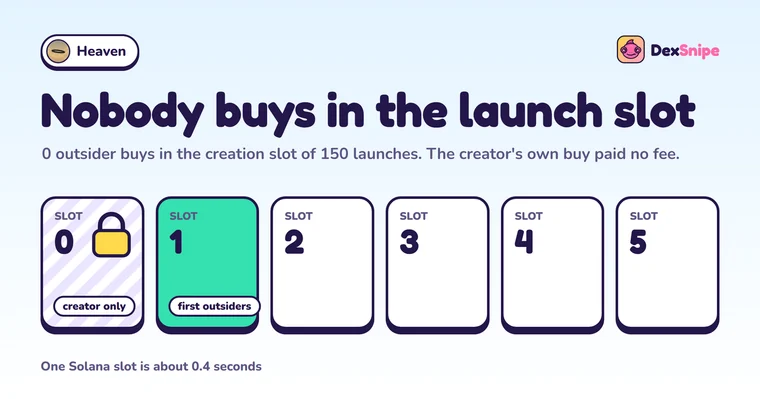
On most Solana launchpads, the race for a new coin is decided inside the slot the coin is created. On Heaven, that slot is closed. We decoded all 50,217 Heaven pool accounts with Heaven's published IDL and read the opening trades of 150 launches. No outsider completed a buy in the launch slot. The creator usually did, and paid no fee for it. Everyone else paid the same fee from the first slot to the last.
The short version
- The first slot belongs to the creator. Same-slot trading is switched off on almost every standard pool. Outsiders start one slot later, about 0.4 seconds after the pool exists.
- The creator buys first, and buys free. The median creator took about 1.5% of supply in the launch transaction. 38% took 5% or more.
- There is no launch fee to wait out. Buys one slot after launch paid the same 1.1% or 2% as buys a minute later. Being early on Heaven is not taxed.
- New standard launches are switched off. Both standard configs had pool creation disabled when we read them on November 6, 2026.
What a Heaven sniper bot does
Heaven is a launchpad and an AMM in one. There is no bonding curve and no migration: a coin trades on Heaven's own pool from its first second to its last. A sniper bot watches for new pools, buys in the first moments, and sells on rules you set. A Creator watch sniper narrows that to chosen wallets. There is no real migration either, but Heaven marks every coin that passes $100k of market cap as virtually migrated, and a Migration sniper can act on that mark instead of the launch.
That sounds like the simplest possible venue to snipe. It is not quite. Heaven made a few design choices that change who gets the first price and what everyone after them pays, and almost none of the guides written about Heaven sniping mention them. This page reads them from the chain, using the IDL Heaven publishes in its own docs.
A launch with no bonding curve
Heaven's docs explain the model plainly. Each pool "moves algorithmically as though it was seeded with 35 SOL", even though nobody deposits SOL to launch. That virtual SOL sets a floor. You cannot sell into it, so the price cannot fall below where it started. Every coin starts with a supply of one billion tokens, and every standard launch uses exactly the same parameters.
Since the pool is the coin's permanent home, there is nothing to graduate to. Heaven keeps a "virtual migration" mark at $100k of market cap so that trading terminals built around graduation can show Heaven coins the way they show others. On chain this is a flag in the pool account, set once the coin crosses the mark. 423 pools have it.
For a sniper, the mark is a second entry point. Only 423 coins reached it, under 1% of all launches, and crossing it lowers the protocol fee, so a coin that has just passed $100k is both rarer and cheaper to trade than a fresh one. A Migration sniper on Heaven buys proven coins, not new ones.
The LP side is simple too. All 50,210 standard pools record their LP tokens as locked. There is no liquidity for a creator to pull. The risk on Heaven sits in the supply, not the pool.
Every Heaven pool, on chain
On November 6, 2026 we downloaded every pool account of the Heaven AMM program and decoded each with the IDL from Heaven's docs: creator, launch time, protocol config, reserves, LP lock, fee brackets, allowlist, feature flags, creator fee totals and the virtual migration flag. We also decoded the three protocol configs listed on Heaven's addresses page.
| Measure | Value |
|---|---|
| Pool accounts | 50,217 |
| Standard launches | 50,210 |
| Community config launches | 48,924 |
| Creator config launches | 1,286 |
| Pro Pools | 7 |
| Different creator wallets | 10,254 |
| Pools past the $100k mark | 423 |
| Mints ending in 777 | 50,213 |
| First pool | August 11, 2025 (LIGHT) |
| Last standard pool | September 1, 2026 |
The first pool on Heaven was LIGHT itself, Heaven's own token, launched on August 11, 2025. Heaven's docs note that the LIGHT launch ran on the same rails as every coin after it. The launchpad opened to everyone a few days later, and the rush that followed was enormous: 8,971 pools on August 19 alone.
The closed first slot
Every Heaven pool account carries an allowlist with five switches: swap, remove liquidity, deposit liquidity, same-slot trading and creator fee updates. On 50,215 of the 50,217 pools, same-slot trading is off. Heaven's Pro Pools page describes the toggle as allowing a buy and a sell in the same slot, and suggests switching it off to prevent wash trading.
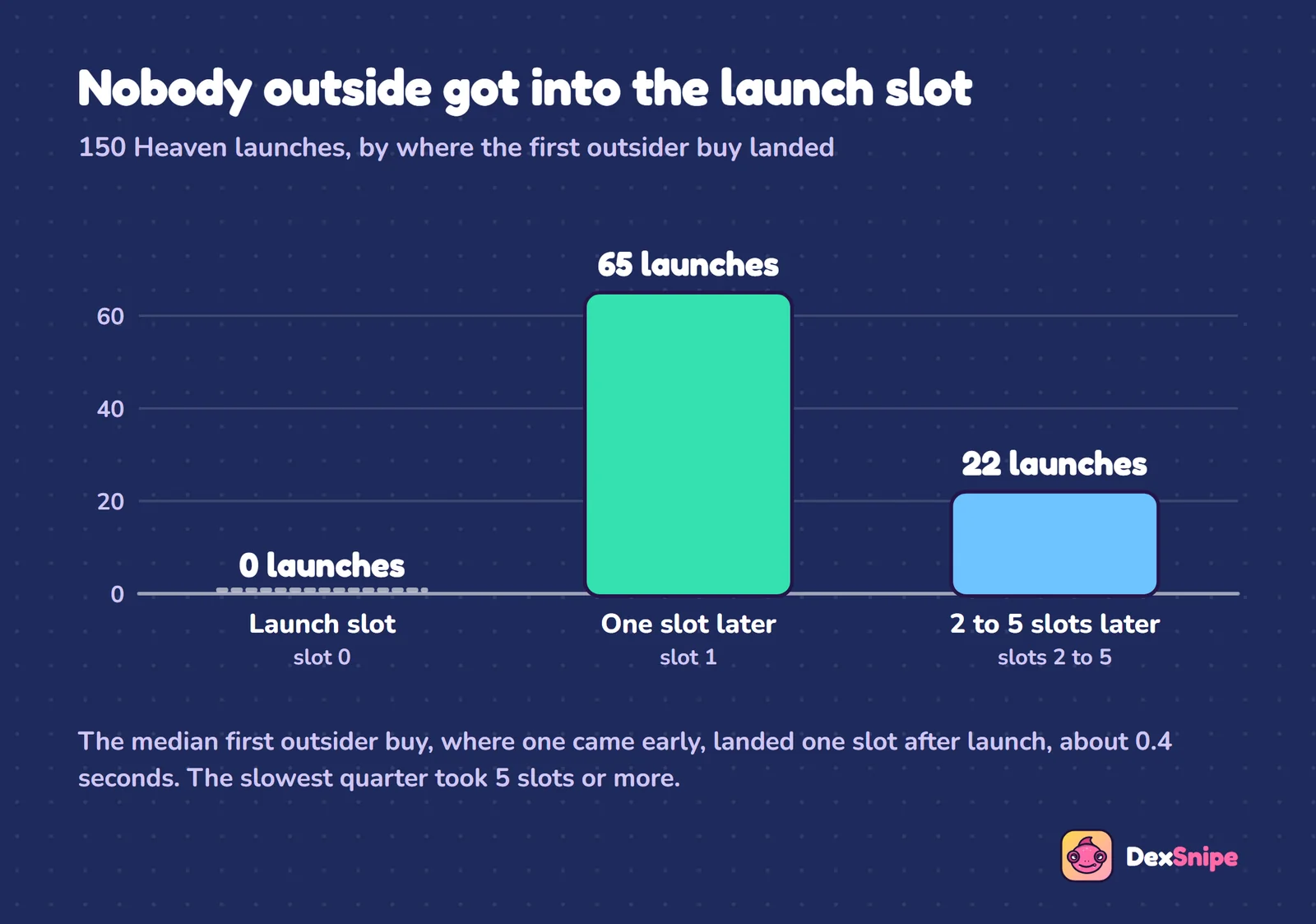
Whatever the exact rule inside the program, the effect at launch is easy to measure. We took 150 standard launches spread evenly across August and September 2025, when Heaven was busiest, and read the first 40 transactions on each pool.
Data table
The first slots of 150 Heaven launches
| Measure | Value |
|---|---|
| Outsider buys completed in the launch slot | 0 |
| Launches with an outsider buy one slot later | 65 |
| Launches with the first outsider buy 2 to 5 slots later | 22 |
| Median first outsider buy, where one came early | 1 slot, about 0.4 seconds |
| Slowest quarter of first outsider buys | 5 slots or more |
We also counted failures. On 60 further launches there were 69 failed transactions inside the launch slot itself, and not one successful trade by anyone other than the creator. Some of those failures were buys hitting an account that did not exist yet; others were the program refusing the trade. Bots were trying to buy in the launch slot. None got through.
Why this matters. On launchpads where the launch slot is open, the fastest bots land in the same block as the creator and buy at the creator's price. On Heaven the fastest possible outsider buy comes one slot later, after the creator's own buy has already moved the price. Paying a large tip to be first in the launch slot buys nothing here.
Who buys first
The slot after launch is where the race really happens, and the same wallets kept turning up in it. Among the first five outsider buyers on our 150 launches, six wallets each appeared on between 13 and 19 different launches. At least one of the six was among the first five buyers on 43 of the 150 launches, more than a quarter.
That is the usual signature of automated snipers: wallets that buy almost every launch the moment it is allowed, take a small position and sell within seconds. The worked example below shows one of them in action. A sniper you set up yourself is competing with these wallets for the slot after launch, and on the busiest days of August 2025, when thousands of coins launched a day, the queue for that slot was long.
The speed of the competition also shows in timing. Where an outsider bought within the first 40 transactions, the median first buy came about one second after the launch, as block times are rounded to the second. A quarter came in the same second as the launch block, which on Heaven means the very next slot.
One launch, second by second
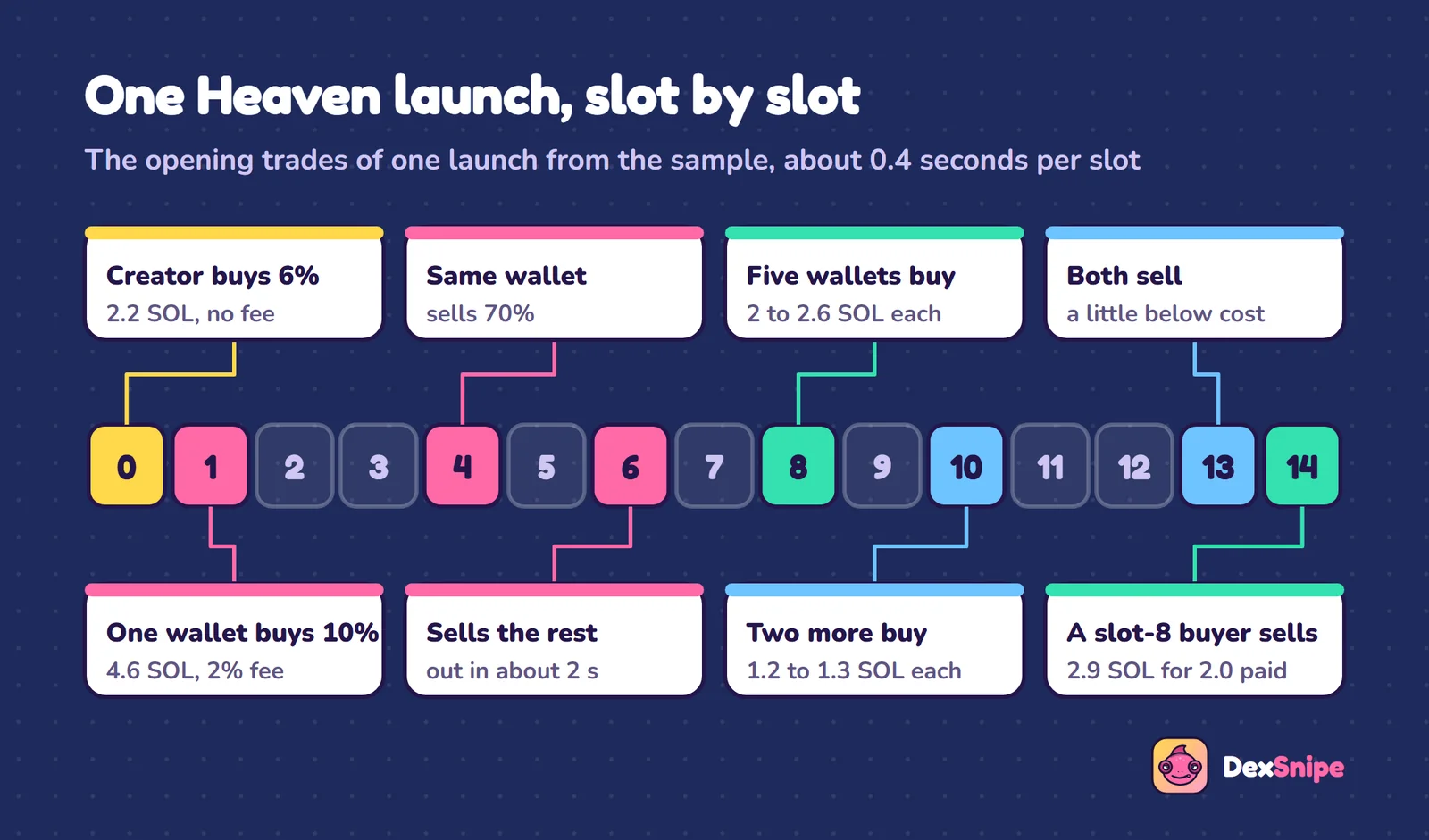
Alpha Group launched on Heaven on September 14, 2025, under the creator config, so every trade paid 2%. The launch transaction is on Solscan; the rest is the pool's history.
Trade log of the launch, slot by slot
Trade log of the launch, slot by slot
| Slot | What happened |
|---|---|
| 0 | Pool created. In the same transaction the creator bought about 59.7 million tokens, 6% of supply, for about 2.2 SOL, and paid no trading fee. |
| 1 | One wallet bought about 101.6 million tokens, about 10% of supply, for about 4.6 SOL. Fee: 2%. |
| 4 | The same wallet sold 70% of its tokens. |
| 6 | It sold the rest. In and out in about two seconds. |
| 8 | Five different wallets bought in the same slot, about 2 to 2.6 SOL each. |
| 10 | Two more wallets bought about 1.2 to 1.3 SOL each. |
| 13 | Both sold everything, each a little below what they paid. |
| 14 | One of the slot-8 buyers sold for about 2.9 SOL, against about 2.0 SOL paid. |
Read in order, the first six seconds contain the whole Heaven launch story. The creator holds the first price alone and pays nothing for it. The fastest outsider arrives one slot later, buys big and leaves within two seconds. A cluster of buyers lands together a few slots later. Some of the next buyers lose a little on the round trip, and one makes close to half again on two SOL. None of that depended on beating the creator, because nobody could.
The creator's free buy
Heaven's docs say creators "can buy as much dev supply as they want". The chain adds a detail the docs leave out: the buy made inside the launch transaction pays no trading fee. In 120 more sampled launches we decoded the trade event of each creator buy we could read from the launch transaction, 50 in all. Every one recorded a fee of zero.
| Measure | Value |
|---|---|
| Launches with no creator buy | 9 |
| Median creator buy | about 1.5% of supply |
| Top quarter | 6% of supply or more |
| Launches with 5% or more | 57 |
| Launches with 10% or more | 8 |
| Largest | about 14.3% of supply |
Put the two findings together. The creator buys alone in the launch slot, at the floor price, with no fee. Every outsider buys afterwards, at a higher price, with a fee. The creator's share is the single biggest block of supply any outsider has to worry about, and on more than a third of launches it was 5% or more.
That makes the dev holding cap the most important filter on Heaven. A sniper without one will buy behind creators holding a tenth of the supply and happy to sell it into the first wave of buyers.
What everyone else pays
Heaven's fees depend on two things: which config the launch used, and whether the coin's market cap is under $100k. Each pool account carries its own fee brackets, so we read them directly.
| Config | Pools | Protocol fee under $100k | Protocol fee above | Creator fee |
|---|---|---|---|---|
| Community | 48,924 | 1% | 0.25% | 0.1% |
| Creator | 1,286 | 1% | 0.5% | 1% |
So a buy on a fresh community coin costs about 1.1%, and on a fresh creator coin about 2%. That matches what we saw in the trade events: the median fee on outsider buys in the first 60 slots was 1.10%, and the creator-config launches paid 2.00%. A round trip on a fresh community coin costs about 2.2% before network costs, and on a creator coin about 4%.
Once a coin passes $100k, the protocol fee drops. On a community coin above the mark, a trade costs about 0.35%. That is one of the lowest costs of any Solana launchpad for a coin that has made it, and it changes how tight a take-profit can be on a coin that is already established.
The decay that was not there
Heaven's Pro Pools page compares standard pools with Pro Pools in a table. For sniper resistance, it lists standard pools as having a "6 second linear decay". That reads like a launch fee that starts high and falls to normal over six seconds, the kind of schedule Meteora's launchpads and Jupiter Studio use.
We could not find it. The slot fee brackets on every standard pool and on both standard configs are empty. More to the point, the trades do not show one. We decoded the trade event of every successful trade in the first 60 slots of 120 launches from 2025 and 60 from 2026, and grouped the fees by slot.
| Slots after launch | 2025 launches | 2026 launches |
|---|---|---|
| 1 | 1.10% | 1.10% |
| 2 to 5 | 1.10% | 1.10% |
| 6 to 15 | 1.09 to 1.10% | 1.10% |
| 16 to 60 | 1.09 to 1.10% | 1.09 to 1.10% |
The highest fee in any slot was 2%, which is simply the creator-config rate. There is no 50% opening fee, no 10% step, and no visible fall over six seconds. Whatever the docs mean by the decay, it did not change what buyers paid on these launches.
Pro Pools are different. Their page shows a configurable schedule, 50% for the first five slots and 10% up to slot 15 in its example. One of the seven Pro Pools on chain has a schedule like that set. If Heaven ever opens Pro Pools to new coins at scale, those schedules will matter, and a sniper will have to read them before it fires.
The $100k review
Heaven's creator fee is not automatic. According to its docs, every launch that passes $100k in volume is reviewed by Heaven's team and put into one of three groups. A "Creator" coin, with a real builder or artist behind it, pays its creator 1%. A "Community" coin pays 0.1%. A "Blocked" coin, judged a scam or a larp, sends its creator fees to LIGHT buybacks instead.
The deployer picks a side at launch. Choosing Community skips the review. Choosing Creator puts the coin "In review" and holds the 1% until Heaven decides. On chain, the two choices are the two standard configs. Only 1,286 launches, about one in forty, chose Creator.
Those that did reached the $100k mark far more often: 81 of 1,286, about 6.3%, against 342 of 48,924 community launches, 0.7%. Choosing to be reviewed was a signal. A creator expecting to earn 1% for months has a reason to stay, and a reason not to dump supply into the first buyers.
The pool account even has a counter for the review. It records each pool's volume in dollars until the threshold is reached and then stops: on the busiest pools it reads just over $100,000, however much traded afterwards. If you have seen dashboards showing Heaven coins with oddly identical volumes near $100k, that counter is the reason.
Who launches on Heaven
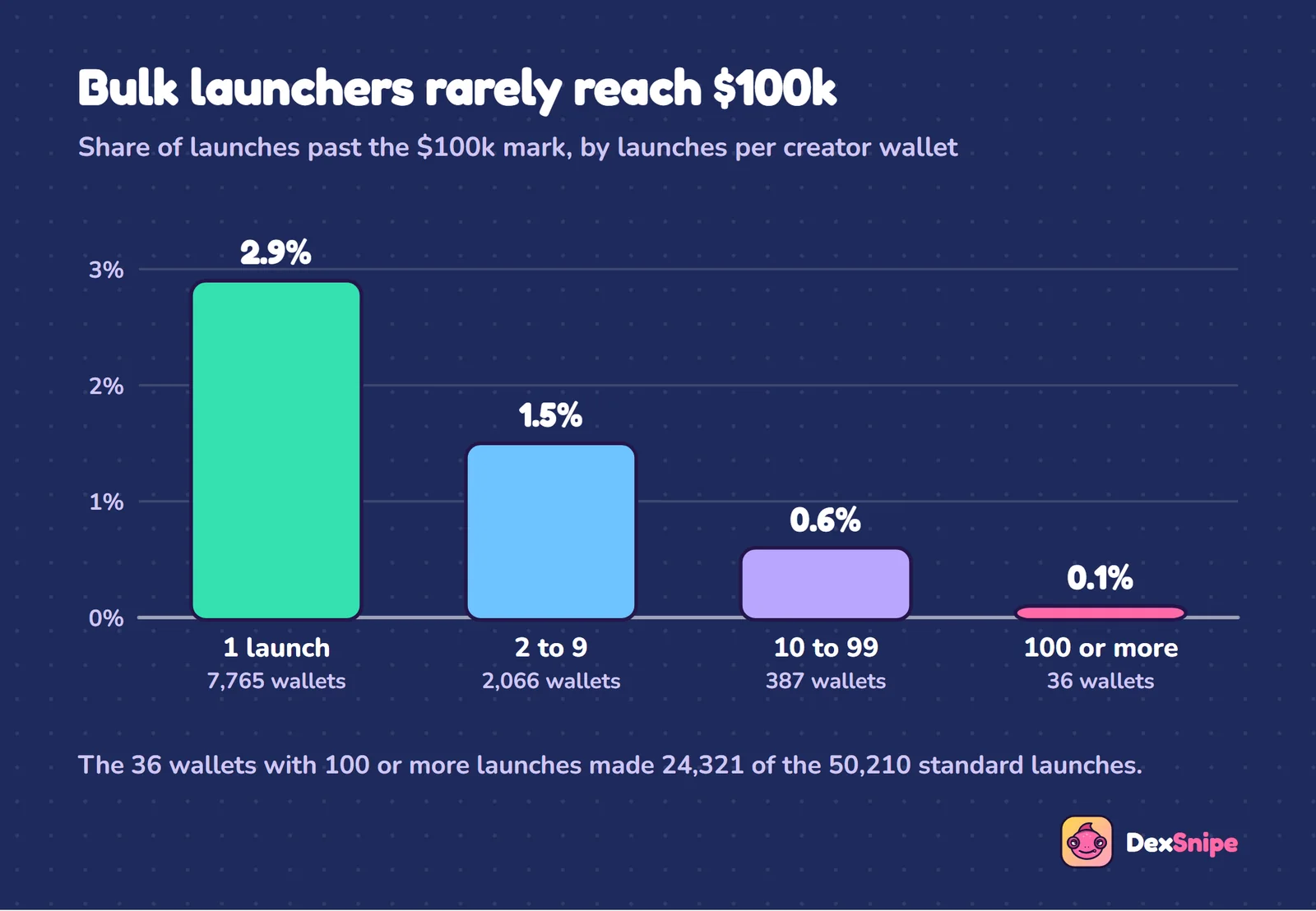
10,254 wallets created the 50,210 standard pools. That is fewer than one creator per four launches, a sign of very heavy bulk launching.
Data table
Heaven creators by number of launches
| Creator group | Wallets | Launches | Past $100k |
|---|---|---|---|
| One launch | 7,765 | 7,765 | 2.9% |
| 2 to 9 launches | 2,066 | 6,722 | 1.5% |
| 10 to 99 launches | 387 | 11,402 | 0.6% |
| 100 or more launches | 36 | 24,321 | 0.1% |
36 wallets made nearly half of all Heaven launches. The busiest single wallet made 14,629, more than a quarter of the whole launchpad on its own. Their coins almost never went anywhere: one in a thousand passed $100k, against about one in thirty-five for creators who launched once.
On a feed like this, Fresh launch sniping without a creator filter is mostly buying the output of a few machines. Creator watch is the opposite: a list of wallets that launched once or twice and saw their coins pass the mark is short, and every name on it beat the odds at least once.
What sits inside every Heaven coin
Heaven coins are Token-2022 mints, and every one we checked carries the transfer fee extension. On all 300 mints we sampled, the transfer fee is set to zero, and mint and freeze authority are both revoked. That is the reassuring part.
The detail worth knowing is who controls the fee setting. On every sampled mint, the transfer fee authority is not the creator but one of Heaven's own protocol configs, and Heaven's IDL includes an admin instruction for setting transfer fees. Heaven used a transfer fee on LIGHT itself in its first weeks, 1.5%, then set it to zero, and the docs describe that change.
We found no Heaven launch with a non-zero transfer fee. But the setting is there, and it is held by the protocol. For a sniper this is simple to handle: DexSnipe's maximum tax filter reads the transfer fee on the mint before buying, so a Heaven coin that ever had one set would be skipped automatically.
Heaven today
Heaven was an August 2025 launchpad, even more than most.
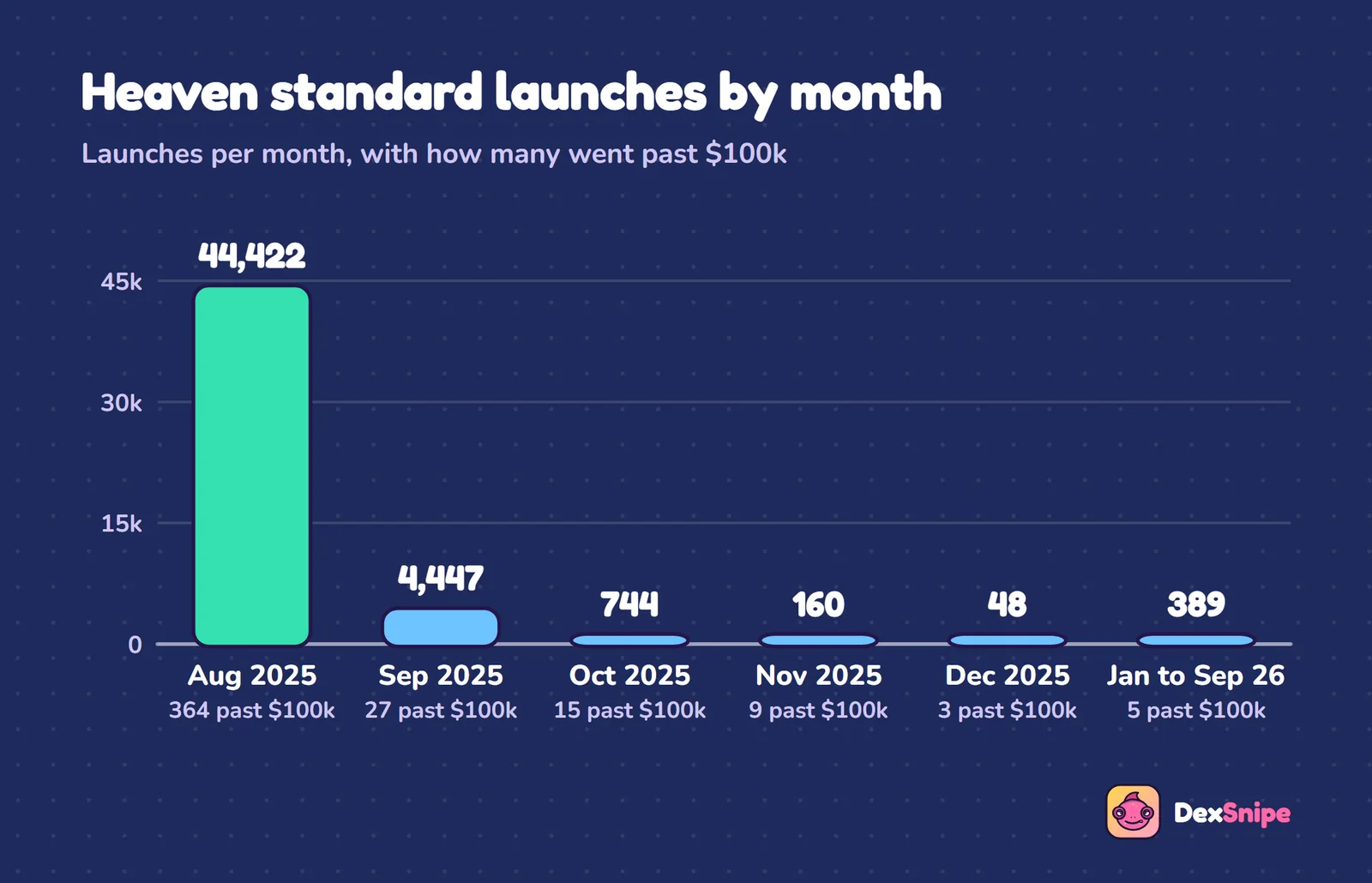
Data table
Standard launches by month
| Month | Launches | Past $100k |
|---|---|---|
| August 2025 | 44,422 | 364 |
| September 2025 | 4,447 | 27 |
| October 2025 | 744 | 15 |
| November 2025 | 160 | 9 |
| December 2025 | 48 | 3 |
| January to September 2026 | 389 | 5 |
Nearly nine in ten of all Heaven coins were launched in its first three weeks. Launches fell by a factor of ten in September 2025 and kept falling. In 2026 there were a few dozen a month, with a small rise in March, and the last standard pool was created on September 1, 2026.
When we read the configs on November 6, 2026, both standard launch configs had the flag that allows new pools set to off. Only the Pro Pool config still allowed creation. Existing pools still trade: the program is busy with buys and sells on coins that already exist, many of them routed through aggregators. But for now there is nothing new for a Fresh launch sniper to buy on Heaven.
DexSnipe still lists Heaven for Fresh launch, Migration, Creator watch and Copy trade. A Fresh launch sniper armed on it will fire if creation is switched back on, and a Migration sniper can still fire when an existing coin crosses the $100k mark. Until then, the useful thing to take from Heaven is its lesson about the launch slot, which applies anywhere a launchpad decides who may trade first.
Reading a Heaven launch
Everything that matters about a Heaven launch is in two places: the pool account and the launch transaction. In the order we would check them:
- Which config. Community or creator. A creator-config launch costs 2% a trade instead of 1.1%, but in Heaven's history it was nine times as likely to pass $100k.
- The creator's buy. How much did the creator take in the launch transaction? Under 2% is ordinary. Over 5% means one wallet can sell a large block into you, and it paid nothing to get it.
- The creator's record. How many Heaven pools has this wallet created? A wallet with hundreds is a bulk launcher.
- Who bought in the next few slots. A cluster of wallets buying in the same slot right after launch can be one buyer split across wallets.
- The transfer fee. Zero on every coin we checked. Confirm it anyway; it is one field on the mint.
What this data does not tell you
- The slot findings come from samples. 150 launches for first buys, 120 and 60 for fees, 60 for failed transactions. They are spread evenly through Heaven's history, but they are samples.
- We read the program's behaviour, not its code. We know no outsider buy landed in a launch slot and that the allowlist flag is off. We have not seen the source that enforces it.
- The first 40 transactions are not the whole launch. On busy launches, failed transactions can fill that window, so some first buys fall outside it. That is why only 98 of 150 launches show an outsider buy within it.
- The volume counter stops at the review threshold. We did not use it to rank coins for that reason.
- Wallets are not people. Creator counts are wallet counts, and the six repeat early buyers may be one operator or six.
- Dollar thresholds come from Heaven. The $100k mark is Heaven's own; we did not convert anything to dollars ourselves.
Filters that fit Heaven
- Dev holding cap. The most important filter on Heaven. The creator buys first, alone and free. Set the cap at 5% for Fresh launch, so the third of launches with heavier creator buys are skipped.
- Creator watch on proven wallets. Creators who launched once or twice and passed $100k are a short, useful list.
- Skip bundled launches. Groups of wallets buying in the same slot right after launch are often one buyer.
- Maximum tax at zero. Heaven coins carry a transfer fee setting controlled by the protocol. A zero cap costs nothing today and protects you if that ever changes.
- Blocklist words. 36 wallets made half the launches, and bulk launchers reuse names. A word blocklist trims them cheaply.
Heaven sniper settings
Starting points, for Heaven if creation is switched back on and for any launchpad with a closed first slot.
| Setting | Creator watch | Fresh launch |
|---|---|---|
| Trigger | Creator watch, one sniper per wallet | New Heaven pools |
| Buy size | 0.2 to 0.5 SOL | 0.05 to 0.1 SOL |
| Slippage cap | 15% | 15% |
| Priority fee | 0.001 SOL | 0.001 SOL |
| Jito tip | 0.002 SOL | 0.002 SOL |
| Dev holding cap | 10% | 5% |
| Skip bundled launches | On | On |
| Top 10 holder cap | 35% | 25% |
| Maximum tax | 0% | 0% |
| Take-profit | +50% sell 50%, +150% sell 50% | +30% sell 50%, +80% sell 50% |
| Stop-loss | 30% | 25% |
| Timer | 60 minutes | 15 minutes |
| Dev-sell exit | On | On |
Why the tip is moderate
On a launchpad with an open launch slot, a big tip can buy a place next to the creator. On Heaven it cannot: the earliest any outsider buys is the next slot. A moderate tip is enough to compete for that slot without paying for one you cannot have.
Why the slippage cap is wider
By the time an outsider buys, the creator's buy has already moved the price, and several other bots are buying in the same slot. A tight cap fails often in that crowd. Fifteen percent leaves room without letting a single fill go badly wrong.
Take profit, stop loss and selling
The pool does not hold orders, so every exit is the bot watching the price and sending a sell. DexSnipe gives each sniper up to four take-profit steps, a stop-loss, a trailing stop, a timer and a dev-sell exit, all running on the server after you close the tab.
- Count the fee in every target. A round trip on a fresh community coin costs about 2.2%, on a creator coin about 4%. Above $100k, a round trip on a community coin falls to under 1%.
- Keep the dev-sell exit on. The creator holds the cheapest tokens on every Heaven coin. When they sell, you want to be out.
- Expect the fastest bots to flip within seconds. A first take-profit set too far away will watch them sell into it.
- Use the timer. Most Heaven coins never traded much. A timer frees the SOL.
| What you see | Likely cause | What to change |
|---|---|---|
| Buys always land a slot after launch | Same-slot trading is off | Nothing; that is the earliest possible |
| Price already well above the floor at your fill | Creator buy and slot-1 bots | Lower the dev cap, raise the slippage cap slightly |
| Sniper never fires | Standard launches are switched off | Add an active venue |
| Dozens of buys from one creator | Bulk launcher | Switch to Creator watch |
Choosing a Heaven sniper bot
- Does it read Heaven's own AMM? Heaven is not a Raydium or Meteora launchpad. A bot built only for those will not see its launches.
- Does it check the creator's buy before firing? On Heaven that is the main risk.
- Does it read Token-2022 transfer fees? Every Heaven coin is a Token-2022 mint.
- Do exits run on a server when you are offline?
- Does it cover other venues? Heaven's standard launches are off for now. A bot that can only watch Heaven has nothing to do.
- Is the price flat? A bot that takes a cut of every trade costs more on exactly the small, frequent trades launch sniping produces.
Heaven in DexSnipe
DexSnipe supports Heaven with Fresh launch, Migration, Creator watch and Copy trade. A Creator watch or Copy trade sniper can cover Heaven together with any of the other venues, including Pump.fun, LetsBonk, LaunchLab, Bags, Believe, Boop and Jupiter Studio, plus pools on PumpSwap, Raydium, Meteora and Orca. Every sniper has a dev holding cap, a top 10 holder cap, a bundled launch check, a socials check, a maximum tax check and a word blocklist, and up to four take-profit steps with a stop-loss, trailing stop, timer and dev-sell exit. The price is a flat plan from 1 SOL for 7 days with no cut of your trades.
Set up a Heaven sniper in DexSnipe
- Open the panel and click New sniper. Choose Creator watch, Fresh launch or Migration.
- Tick Heaven, and at least one active launchpad, so the sniper has launches to act on while Heaven's standard launches are off.
- Set the buy: size, a 15% slippage cap, a moderate priority fee and tip.
- Set the filters: dev holding cap at 5%, bundle check on, maximum tax at zero, blocklist words.
- Set the exits: two take-profit steps, a stop-loss, a timer and dev-sell on.
- Connect your wallet and save. Snipers are stored on your wallet address.
- Pick a plan, add a sniper wallet and arm it. Send 1, 3 or 5 SOL to the reserved address, add the key of a separate funded wallet, arm the sniper and close the tab.
Trade only what you can lose. Most new coins on any launchpad lose value, and the creator always holds the cheapest tokens. This page is not financial advice.
Heaven sniper bot questions
What is a Heaven sniper bot?
+
A bot that buys new Heaven coins in the first moments after their pool opens and sells on rules you set. Heaven has no bonding curve: every coin trades on Heaven's own AMM from the first second, so the launch and the pool are the same thing. A sniper can also follow chosen creator wallets and buy only their launches.
Can a sniper buy in the same slot as a Heaven launch?
+
Not in what we measured. Across 150 standard launches from August and September 2025, no wallet other than the creator completed a buy in the slot the pool was created. The earliest outside buys landed one slot later, about 0.4 seconds, on 65 of the 150 launches. Almost every standard pool has same-slot trading switched off in its allowlist.
Does Heaven have an anti-sniper fee?
+
Heaven's docs list a 6 second linear decay for standard pools. We did not find one in the trades. Buys in the first slot after launch paid the same fee as buys a minute later: about 1.1% on community coins and 2% on creator coins, in launches from both 2025 and 2026. Pro Pools can set their own slot-based fees.
Does the creator pay a fee on the dev buy?
+
No, not on the buy made inside the launch transaction. In all 50 creator buys we decoded from launch transactions, the fee paid was zero. The median creator bought about 1.5% of supply this way, and 38% of launches had a creator buy of 5% or more.
What fees does Heaven charge?
+
Heaven's docs set a 1% protocol fee while a coin's market cap is under $100k, falling to 0.25% for community coins and 0.5% for creator coins above it. The creator fee is 0.1% for community coins and 1% for creator coins. Launching a coin is free. Heaven's docs say all protocol revenue goes to buying back and burning LIGHT.
Is Heaven still launching coins?
+
Not standard launches, as of November 6, 2026. Both standard launch configs have the flag that allows new pools switched off, and the last standard pool was created on September 1, 2026. Existing pools still trade. Pro Pools, a separate product for existing tokens, are still allowed but only seven exist.
How many coins were launched on Heaven?
+
50,210 standard pools, created by 10,254 wallets, from August 11, 2025 to September 1, 2026. 44,422 of them were created in August 2025. Nearly every Heaven mint ends in 777.
Is liquidity locked on Heaven?
+
Yes. On all 50,210 standard pools, the LP tokens are recorded as locked in the pool account. There is also no real bonding curve to sell into: the pool starts with 35 SOL of virtual liquidity that sets a price floor and cannot be withdrawn.
Does DexSnipe take a fee on Heaven trades?
+
No. DexSnipe is a flat plan: 1 SOL for 7 days, 3 SOL for 30 days or 5 SOL for 90 days. You pay the network fee, your priority fee and tip, and Heaven's own trading fee.
Sources and method
On November 6, 2026 we listed every account of the Heaven AMM program and decoded the 50,217 pool accounts and three protocol configs with the IDL published in Heaven's docs. From each pool we read the creator, launch time, config version, reserves, LP lock, fee brackets, allowlist, feature flags, creator fee totals, the review counter and the virtual migration flag.
For the launch slot, we read the first 40 transactions of 150 standard launches chosen at even intervals from August and September 2025, and the first 60 of 60 more for failed transactions. For fees, we decoded the trade event of every successful trade in the first 60 slots of 120 launches from 2025 and 60 from 2026; the event records the SOL in or out and the total fee paid. Creator buys were identified as buys by the pool's creator inside the launch transaction. Mint extensions and authorities come from 300 mints sampled at even intervals. The worked example was traced transaction by transaction. DexSnipe triggers, filters and exits are taken from the product itself.
- Heaven docs: No bonding curveVirtual SOL seeding at 35 SOL, no migration, the $100k virtual migration cap, and creators buying as much supply as they like.
- Heaven docs: FeesFree launches, the 1% protocol fee under $100k, and the 0.25% and 0.5% tiers above it.
- Heaven docs: Permissioned feesThe review at $100k and the Creator, Community and Blocked categories.
- Heaven docs: Pro PoolsSlot-offset fees, the same-slot trading and sandwich resistance toggles, and the 6 second linear decay listed for standard pools.
- Heaven docs: The god flywheelAll protocol revenue used to buy back and burn LIGHT.
- Heaven docs: StandardizedEvery standard launch deployed with the same parameters.
- Heaven docs: Contract addressesThe Heaven AMM program and its protocol configs.
- Heaven docs: IDLThe interface we used to decode every pool account, protocol config and trade event.
- Heaven AMM program on SolscanThe program whose 50,217 pool accounts we read.
- Heaven community launch config on SolscanThe protocol config behind 48,924 standard pools.
- Alpha Group launch transaction on SolscanSeptember 14, 2025. The worked example on this page.
- Alea Research: HeavenDEX, unified launchpad and AMM on SolanaAugust 20, 2025. An early overview of the model and its fee tiers.
- The Defiant: Heaven DEX surges post-ICO on token buybacksCoverage of the LIGHT launch and the buyback model.
One sniper, every active launchpad
Build your snipers for free, then a plan from 1 SOL switches them on. No cut of your trades.