Raydium LaunchLab Sniper Bot
About one Raydium LaunchLab launch in ten takes a cut of every transfer of its token: your buy, your sell, even a move between your own wallets. Most buyers never look. We read the mint of every Token-2022 token LaunchLab has launched, then followed the tax to the wallet that collects it and watched what it does with it. Here is what that tax costs a sniper, and how to set a bot so it never surprises you.
The short version
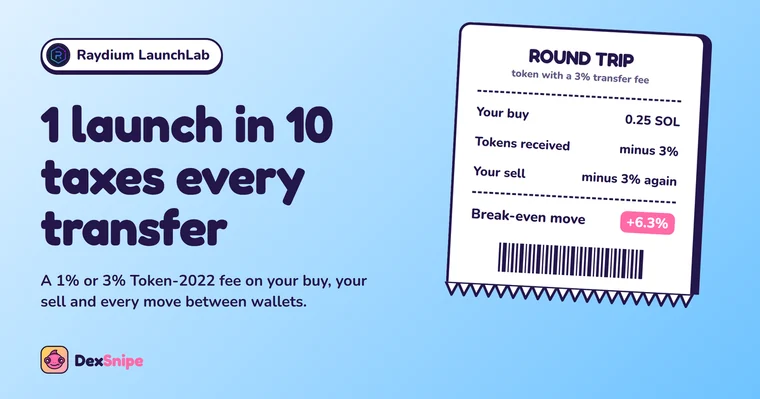
- The tax is 1% or 3% in almost every case, taken on the buy and again on the sell. On a 3% token the price has to rise 6.3% before you break even.
- It is not a scam feature hidden by random creators. Nearly all taxed tokens come from StonkFun, which sells it as a holder reward. That changes who it suits: holders, not flippers.
- The collected tax is sold back into the same curves. We watched the collecting wallet send about a thousand of these transactions an hour.
- LaunchLab blocks the nastier Token-2022 features. No transfer hooks, no permanent delegates, no frozen accounts, no mint or freeze authority on any of the 201,767 Token-2022 mints we read.
Two kinds of LaunchLab token
Raydium LaunchLab is the bonding curve program behind Raydium's own launch page and thousands of other launchpads, LetsBonk the largest among them. A creator picks a launchpad, the launchpad picks the settings, and the token starts trading on a curve. When the curve raises its target, the token moves into a Raydium pool.
Every LaunchLab curve records which token program its mint uses. Most launches use the classic SPL token program, where a token is just a balance and a transfer moves exactly what you send. A growing minority use Token-2022, the newer token program, which lets a mint carry extensions. One of those extensions is a transfer fee: a cut of every transfer, held back from the amount the receiver gets.
Data table
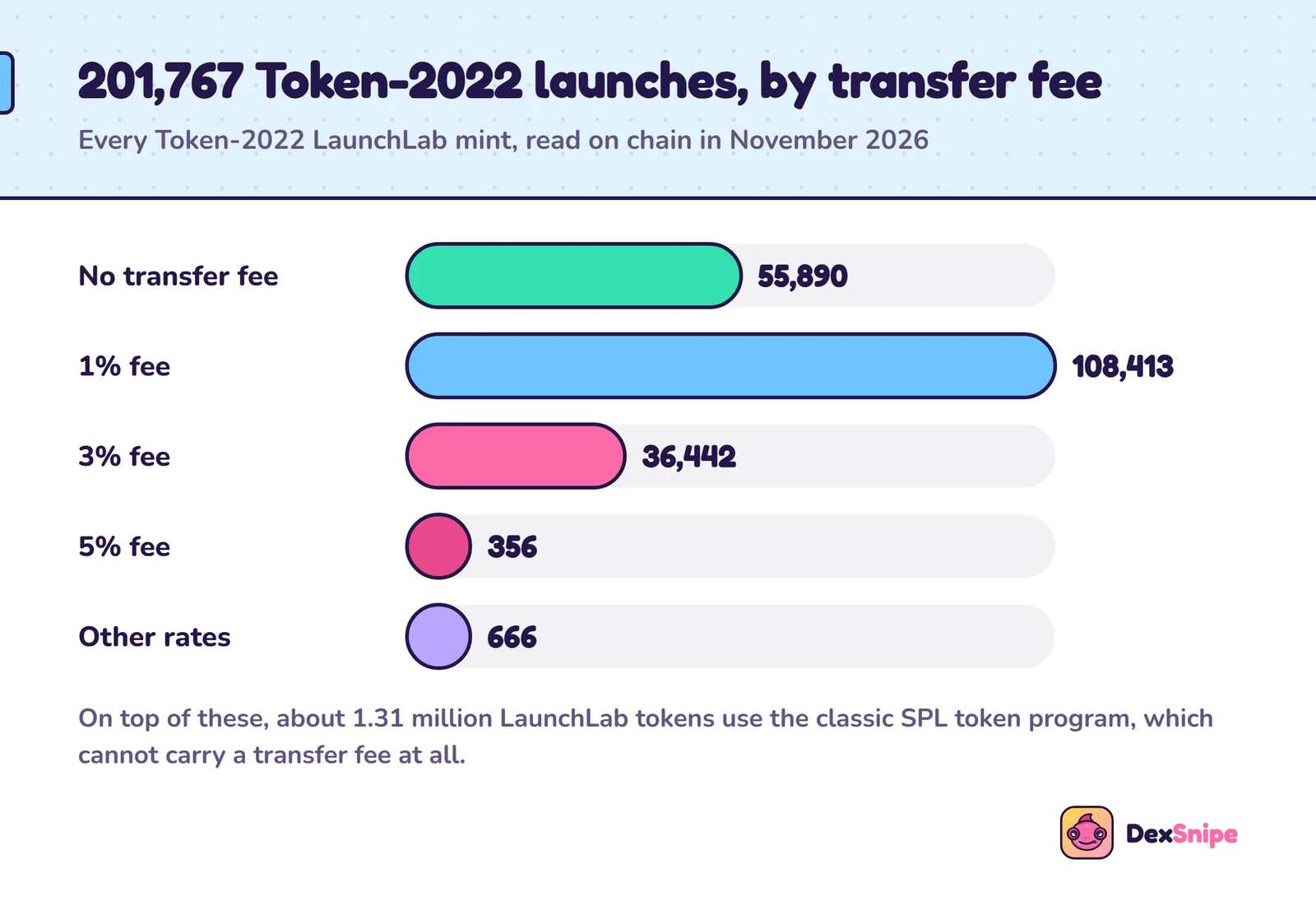
LaunchLab tokens by token program and transfer fee, read on chain in November 2026
| Token | Curves |
|---|---|
| Classic SPL token, no tax possible | about 1.31 million |
| Token-2022, no transfer fee | 55,890 |
| Token-2022, 1% transfer fee | 108,413 |
| Token-2022, 3% transfer fee | 36,442 |
| Token-2022, 5% transfer fee | 356 |
| Token-2022, other rates | 666 |
Put together, 145,877 of roughly 1.5 million LaunchLab curves launched a taxed token. That is close to one in ten, and because one launchpad produces almost all of them, the share is far higher on some days and some launchpads than others.
What LaunchLab lets a token do
Token-2022 is a toolbox, and some of the tools are dangerous in the hands of a token creator. A transfer hook runs a custom program on every transfer and can block sells. A permanent delegate can move tokens out of any holder's wallet. A default frozen state means new accounts start frozen. Any sniper that buys Token-2022 tokens on other venues has to check for all of them.
On LaunchLab, the program does that filtering at launch. Raydium's docs state that the launch program rejects extensions such as transfer hooks and permanent delegates, even for Token-2022 tokens. We checked what is actually on chain:
| Extension or authority | Mints with it |
|---|---|
| Metadata pointer | 201,767 |
| Token metadata | 201,767 |
| Transfer fee setting | 146,122 |
| Transfer hook | 0 |
| Permanent delegate | 0 |
| Accounts frozen by default | 0 |
| Mint authority still active | 0 |
| Freeze authority still active | 0 |
That is a cleaner picture than most venues give you. On a LaunchLab token, the Token-2022 question comes down to one setting: the transfer fee. If your bot reads that correctly, it has covered the extension risk on this venue.
Fee setting is not the same as tax. 146,122 mints carry the transfer fee extension, but 245 of them have the rate set to zero. Read the rate, not just whether the extension exists.
Where the taxed tokens come from
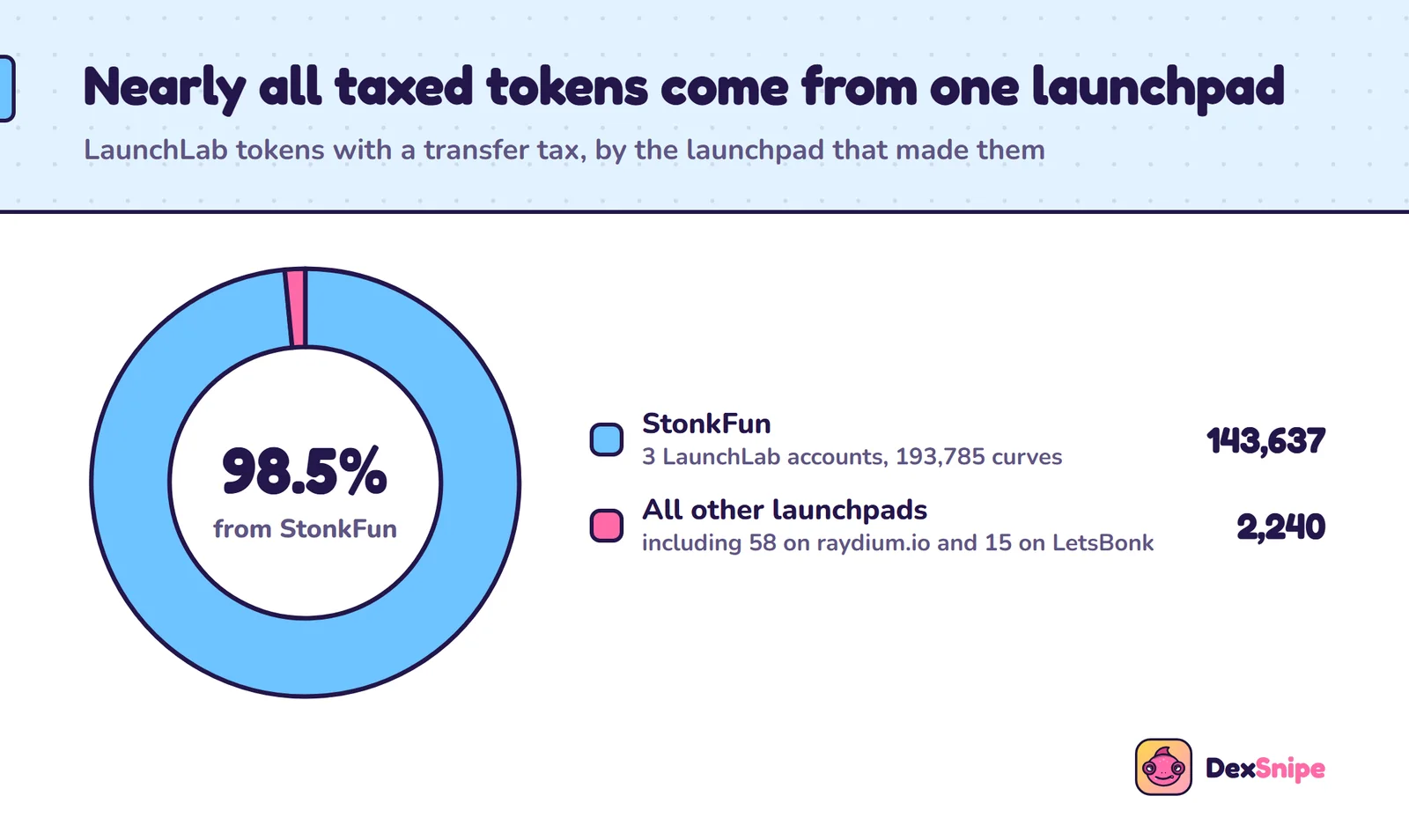
Every LaunchLab curve also records the launchpad, or platform account, that launched it. When we grouped the taxed tokens by platform, one name took almost the whole table.
Data table
LaunchLab launchpads by curves launched, with Token-2022 and taxed tokens
| Launchpad | Curves | Token-2022 | Taxed |
|---|---|---|---|
| LetsBonk | 1,150,183 | 1,608 | 15 |
| StonkFun (3 accounts) | 193,785 | nearly all | 143,637 |
| Raydium (raydium.io) | 98,431 | 79 | 58 |
| RevShare | 11,589 | 0 | 0 |
| cook.meme | 5,178 | 0 | 0 |
| uselaunch.fun | 1,674 | 1,674 | 0 |
| Bankr | 1,509 | 0 | 0 |
| SURGE | 1,305 | 2 | 0 |
| TRiX | 1,074 | 3 | 3 |
| All taxed tokens outside StonkFun | 2,240 |
StonkFun is a launchpad where anyone can create a token priced in another asset: tokenized stocks, pre-IPO tokens, Zcash, its own STONK token and hundreds of others. It moved its new launches onto Raydium LaunchLab in early September 2026. Practically all StonkFun launches use Token-2022, and about three in four carry a tax, 1% on most and 3% on the rest. StonkFun calls these reward tokens and says the tax is converted into the paired asset and paid out to holders.
Note uselaunch.fun in the table: every one of its 1,674 launches is a Token-2022 token, and none is taxed. Token-2022 on its own tells you nothing about a tax. Only the rate does.
Outside StonkFun, taxed tokens are rare and scattered: 2,240 across 291 launchpads, at a wider spread of rates, with 5% the highest common one. LetsBonk, which runs more than a million curves, had 15. So the practical rule is simple. If a LaunchLab sniper buys StonkFun launches, it will meet taxed tokens all day. If it only buys LetsBonk, it will almost never see one.
Follow the tax
A Token-2022 transfer fee does not go anywhere on its own. When you receive taxed tokens, the fee is held back inside your own token account as a withheld amount. Anyone can then sweep withheld amounts into the token's mint, and the wallet named as withdraw authority can take them out from there. So to find out where a tax goes, you look at that authority.
On 143,643 of the 145,877 taxed LaunchLab tokens, the withdraw authority is the same wallet. We read its most recent thousand transactions, which covered about an hour. They fall into a repeating pair: a withdrawal of withheld tax from a token's mint, followed by a sell of those tokens on the token's own LaunchLab curve.
- You buy. The curve sends you tokens, and the transfer fee is held back from what arrives in your wallet.
- The withheld tax is collected. It is swept to the mint and withdrawn by the authority wallet.
- The tax tokens are sold into the same curve, turning them into the quote asset.
- According to StonkFun, that quote asset is paid out to holders.
How much selling that creates
To size it, we took the 40 taxed curves that wallet traded most often and read up to 400 recent transactions on each, separating its sells from everyone else's. On the median 1% token, the tax wallet's sells added up to 2.7% of the buy volume over the same period. On the median 3% token, 6.1%, though only six of the 40 curves were 3% tokens. That fits the mechanism: the tax is taken on buys and sells alike, so the tokens sold back are roughly twice the rate times the trading volume.
For a sniper this is a steady drip of selling, not a crash. But it is selling that does not exist on an untaxed curve, it scales with exactly the volume a hot launch attracts, and it lands in the minutes when a sniper is trying to sell into rising buys.
Who can change the rate
A Token-2022 transfer fee has a second key: the fee config authority, which can set a new rate. On LaunchLab's taxed tokens, 141,887 share one fee authority, and only 26 have none at all. The maximum fee per transfer, a cap the extension allows, is set on 144,606 of them to a number as large as the whole token supply, which in practice means no cap.
That sounds alarming, so it is worth being precise about what the key can and cannot do:
- It can raise the rate, up to the Token-2022 ceiling of 10,000 basis points, which is 100%.
- It cannot do it quickly. In Token-2022's code, a new rate always starts two epochs after it is set, with a comment saying this is to avoid rug pulls at the end of an epoch. Until then the old rate stays in force, and both are visible in the mint.
- It has never been used here. On all 146,122 LaunchLab mints with a fee setting, the current and next rate were identical, and none had a change scheduled.
So the rate a sniper reads at the buy is the rate it pays at the sell, for any trade shorter than a couple of epochs. For holders the key is a trust question, not a timing trick: you are relying on whoever controls it not to schedule a higher tax, and you would see it coming if they did.
If you ever see a change scheduled
The newer fee in a mint carries the epoch it starts in. If that rate is higher than the current one and the epoch is in the future, the authority has already decided to raise the tax. For a sniper that means the position has an expiry date: sell before that epoch, or accept the new rate on the way out. For a bot, the rule is simple to write: read both fees, and treat the higher one as the rate you will pay if you might still hold when the newer one starts.
The sniper's tax math
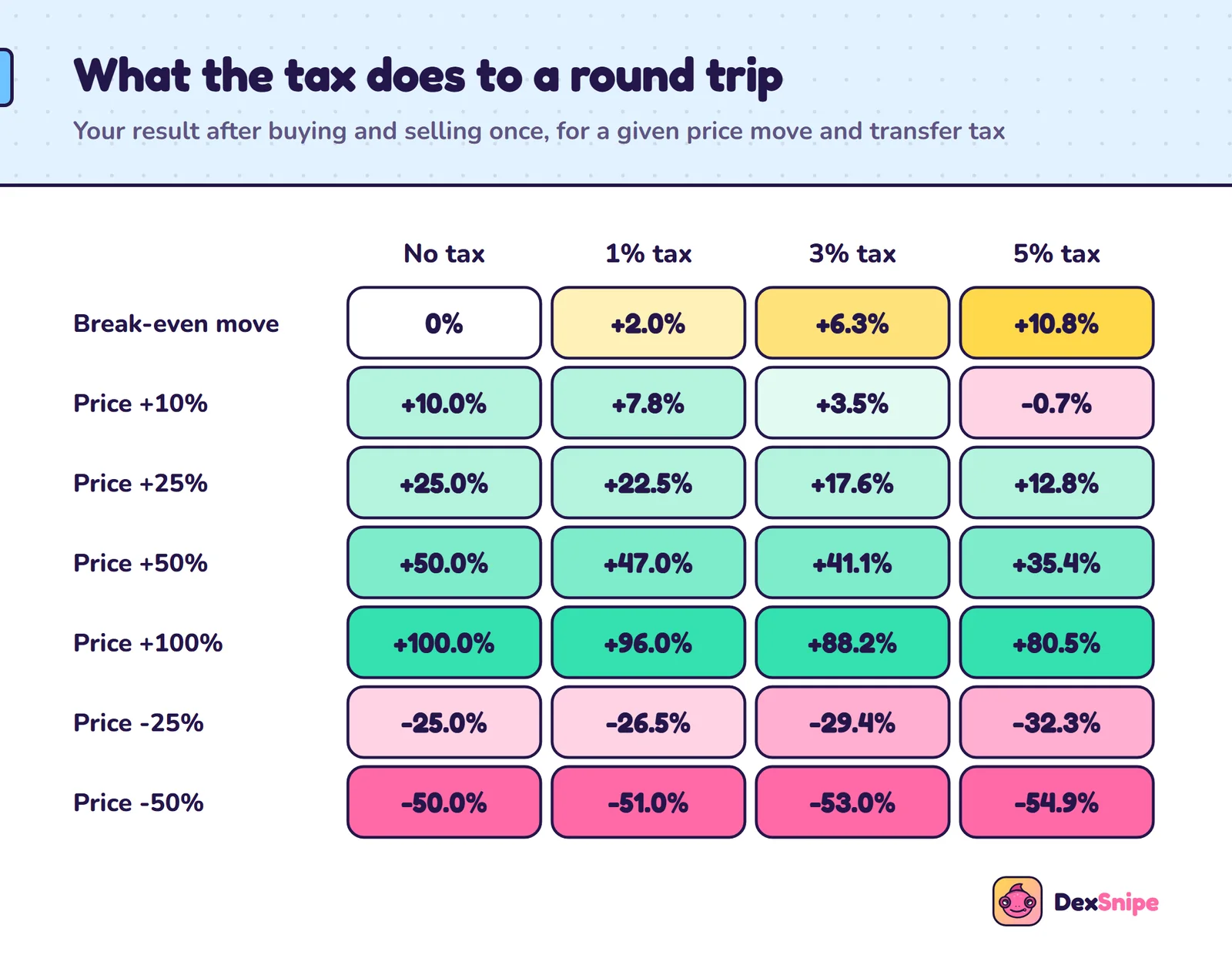
The tax comes off your tokens twice: once when the buy delivers them and once when you send them to sell. So your result is the price move times one minus the tax, squared. The table leaves out the curve's own trading fee and your network costs, which come on top.
Data table
What a transfer tax does to common targets, round trip
| Price move | No tax | 1% tax | 3% tax | 5% tax |
|---|---|---|---|---|
| Break-even move needed | 0% | +2.0% | +6.3% | +10.8% |
| +10% | +10.0% | +7.8% | +3.5% | -0.7% |
| +25% | +25.0% | +22.5% | +17.6% | +12.8% |
| +50% | +50.0% | +47.0% | +41.1% | +35.4% |
| +100% | +100.0% | +96.0% | +88.2% | +80.5% |
| -25% | -25.0% | -26.5% | -29.4% | -32.3% |
| -50% | -50.0% | -51.0% | -53.0% | -54.9% |
Read the +10% row first, because it is where most snipes live. On a 1% token a quick 10% scalp still works. On a 3% token about two thirds of it is gone. On a 5% token the trade loses money even though the price went up. A strategy built around small fast gains needs a low tax cap or none.
Three things people miss
- Moving tokens costs tax too. If your sniper wallet sends tokens to your main wallet, that transfer is taxed like any other.
- Slippage settings do not cover it. A bot quoting the curve price will see fewer tokens arrive than the curve sent. Whether that trips a slippage check depends on how the bot builds its quote; the reliable fix is a tax rule of its own.
- Stop-losses fire later than you think. A 25% stop on a 3% token realises a 29.4% loss. Set it a few points tighter than you would on an untaxed token to land in the same place.
One taxed buy, step by step
Numbers in a table are easy to nod at. Here is what a single snipe on a typical taxed launch looks like from the sniper's side. The token is a 3% StonkFun launch priced in Zcash, the most common quote asset among taxed tokens, and the sniper spends 0.5 SOL. The amounts are rounded and the prices are illustrative; the steps are the real ones.
- SOL becomes Zcash. The curve only accepts its quote asset, so the bot first swaps 0.5 SOL into wrapped ZEC on a DEX, paying that pool's fee and some slippage.
- Zcash buys tokens on the curve. The curve takes its trading fee and sends, say, 1,000,000 tokens.
- 970,000 arrive. The Token-2022 program holds back 3%, 30,000 tokens, inside the sniper's own token account as withheld tax. The position is already 3% smaller than the curve's quote said.
- The tax wallet collects. The withheld tokens are swept to the mint, withdrawn and sold back into the same curve.
- The price rises 25% and the bot sells. It sends 970,000 tokens; the curve receives 940,900 after another 3% is held back. The Zcash that comes out is worth about 17.6% more than the Zcash that went in, before fees.
- Zcash becomes SOL. The bot swaps back, paying a second DEX fee. If Zcash fell against SOL in the meantime, part of the gain is gone too.
Four fees, two taxes and two exposures to a third asset, for one trade. None of it is hidden, and none of it is a trick. It is simply a different trade from sniping a SOL-paired, untaxed LetsBonk launch, and a sniper should be set up for one or the other on purpose.
How this differs from tax tokens on other chains
If you have traded on Ethereum or BNB Chain, "tax token" may set off alarms, and for good reason. There, a tax is usually code inside the token contract itself. The owner can often change it in the next block, set different rates for buys and sells, or exempt their own wallets, and the worst versions are honeypots that let you buy and never sell. Every tax token on those chains is a contract you have to read.
A Token-2022 transfer fee is a different animal, and in several ways a safer one:
- It is a standard setting, not custom code. Every taxed token uses the same extension of the same token program, so there is nothing new to read per token.
- It cannot change quickly. A new rate waits two epochs, and the pending rate is visible in the mint.
- It treats every transfer the same. There is no separate sell tax and no exemption list for the creator's wallets. Buys, sells and transfers all pay the one rate.
- It cannot block a sell by itself. On LaunchLab, the extensions that could, such as transfer hooks, are rejected at launch.
The one thing it shares with its cousins on other chains is the cost. A tax is a tax, and on a fast trade it takes a bigger share of the gain than most people expect.
Reward tokens: who the tax pays
StonkFun's pitch for its taxed tokens is that holders get paid. Coverage of the platform describes the tax as converted into the token's paired asset and distributed pro rata to holders, and cites a reported distribution of more than 5 million dollars in Zcash to holders of one Zcash-paired token. We did not trace the payout side, so we cannot say how much of the tax reaches holders or on what schedule.
What we can say is who the design favours. A reward based on holding pays the people who stay. A sniper that enters in the first block and leaves within minutes pays the tax twice and holds through little or none of the payout. In effect, fast traders fund the rewards of slow ones. That is a fair trade if you mean to hold a reward token. It is a bad one if your plan is to flip it.
A useful way to decide. Before you allow taxed tokens in a sniper, ask whether this sniper is a holder or a flipper. For a holder, a 1% reward token can make sense. For a flipper, every taxed token is a handicap before the first trade.
Priced in stocks, Zcash and STONK
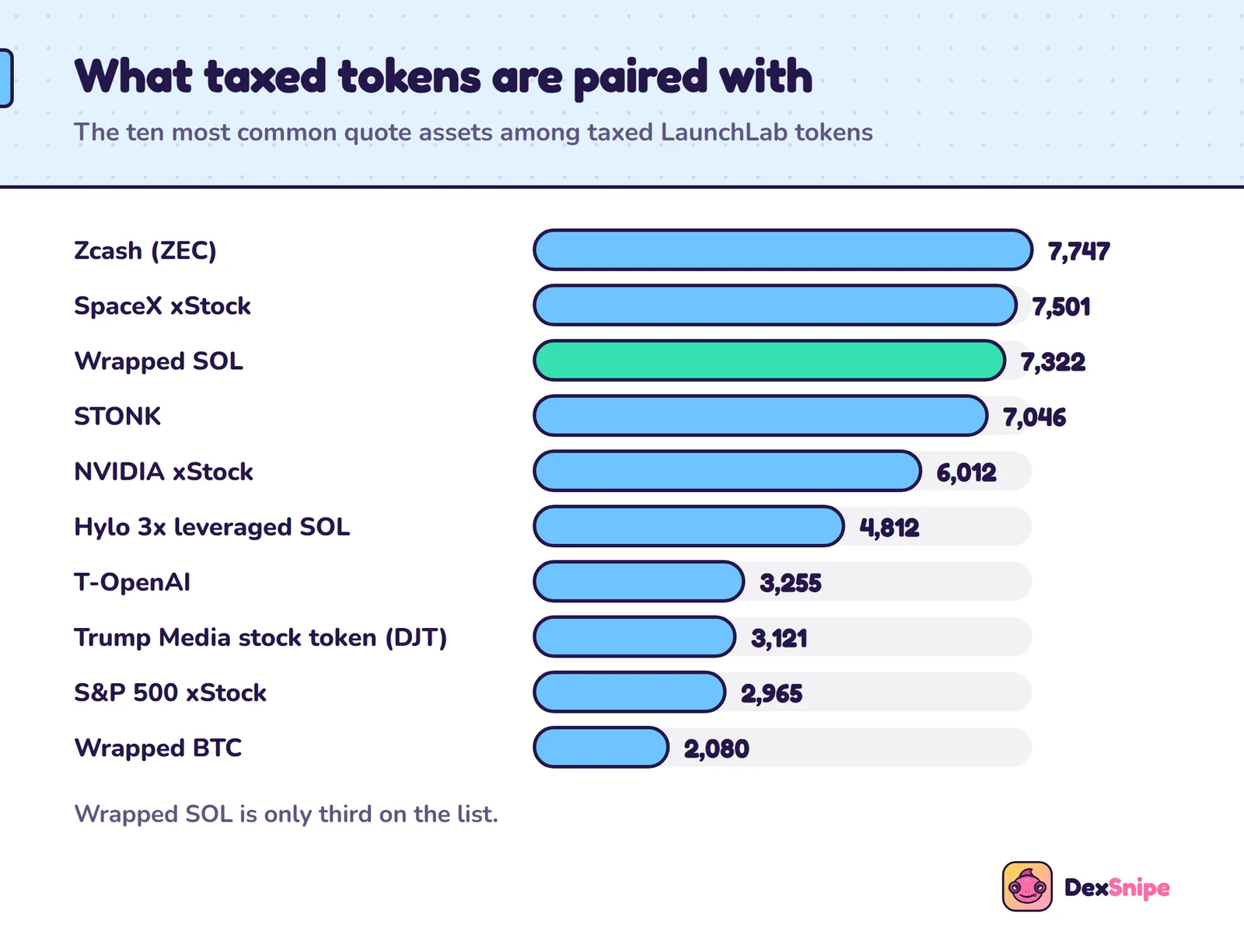
There is a second reason taxed LaunchLab tokens behave differently: what they are priced in. Each LaunchLab curve has one quote asset, the thing you pay with. Among StonkFun's taxed tokens we counted 577 different quote assets. SOL was the quote on only 5,876 of them, about 4%.
Data table
Most common quote assets among taxed LaunchLab tokens
| Quote asset | Taxed tokens |
|---|---|
| Zcash (ZEC) | 7,747 |
| SpaceX xStock | 7,501 |
| Wrapped SOL | 7,322 |
| STONK | 7,046 |
| NVIDIA xStock | 6,012 |
| Hylo 3x leveraged SOL | 4,812 |
| T-OpenAI | 3,255 |
| Trump Media stock token (DJT) | 3,121 |
| S&P 500 xStock | 2,965 |
| Wrapped BTC | 2,080 |
Tokenized stocks alone, 24 different xStock assets, were the quote for 33,817 taxed tokens. For a sniper that holds SOL, this matters in two ways:
- Every buy is two trades. SOL has to be swapped into the quote asset first, with its own slippage and fees, and the sell has to come back the same way.
- Your result depends on the quote asset too. A token priced in NVIDIA stock can rise against NVIDIA while NVIDIA falls against SOL. A take-profit that watches the curve price in its quote asset is not watching your SOL.
Neither is a reason to avoid these launches outright. Both are reasons to check what a launch is paired with and what tax it carries before you buy, rather than buying anything the program launches.
After graduation: the tax does not go away
A transfer fee belongs to the token's mint, not to the curve, so graduation changes nothing. When a taxed curve fills its target and moves into a Raydium CPMM pool, every swap in that pool still pays the tax on the token side. Of the 18,583 LaunchLab tokens that had graduated when we read the program, 3,990 were taxed.
For migration snipers the logic is the same as on the curve, with one difference. On the curve, the launchpad's tax wallet sells back into the curve. After graduation, any tax withdrawn and sold goes into the Raydium pool instead, and the pool also carries the swap fee of its fee tier. On StonkFun, the graduated pool's LP is locked to the platform rather than burned, so the liquidity cannot be pulled, but the platform keeps earning from it.
What we could not measure
A page like this is only as useful as its limits are clear, so here they are. We did not trace the reward payouts, so we cannot tell you what share of the tax comes back to holders, how often, or whether short-term holders receive any of it. Our selling estimate covers 40 active curves, only six of them at 3%, and measures a period of normal trading rather than a launch minute. Launchpad names come from the platform accounts the launchpads registered themselves; a launchpad can run several accounts, and we grouped those we could identify. Finally, these numbers describe LaunchLab in November 2026. StonkFun only moved its launches onto LaunchLab in September 2026, and taxed tokens could become far more or far less common after a single product decision. A sniper should read the mint on every buy rather than rely on any share in this article.
Check a LaunchLab token's tax yourself
- Open the token on Solscan. If the program shown is Token-2022, check its extensions. A classic SPL token cannot carry a tax at all.
- Find the Transfer Fee extension. It shows the rate in basis points (100 is 1%), the maximum fee per transfer and two authorities.
- Compare the older and newer fee. Each has an epoch. If the newer fee has a higher rate with a future epoch, a change is scheduled. We found none on LaunchLab, but this is where it would show.
- Note the quote asset of the curve. If it is not SOL, your bot has to route through it.
- Decide whether you are a holder or a flipper for this token, and size your take-profit and stop-loss with the round trip in mind.
Raydium LaunchLab sniper settings
The right settings depend on which kind of LaunchLab trader you are. These are starting points, not promises.
| Setting | Flipper, no taxed tokens | Holder, 1% reward tokens | Migration hunter |
|---|---|---|---|
| Trigger | Fresh launch | Fresh launch | Migration |
| Max transfer tax | 0% | 1% | 0% |
| Buy size | 0.1 to 0.25 SOL | 0.1 to 0.25 SOL | 0.25 to 0.5 SOL |
| Slippage cap | 15 to 25% | 15 to 25% | 10 to 15% |
| Priority fee | 0.001 SOL | 0.0005 SOL | 0.001 SOL |
| Jito tip | 0.002 SOL | 0.001 SOL | 0.002 SOL |
| Dev holding cap | 10% | 10% | 10% |
| Take-profit | +30% sell 60%, +80% sell 40% | +100% sell 30%, +300% sell 30% | +50% sell 50%, +150% sell 50% |
| Stop-loss | 25% | 35% | 25% |
| Timer | 10 min | off | 60 min |
Why the cap defaults to 0%
In DexSnipe the Max transfer tax filter starts at 0%, which skips every taxed token. That is the right default for a sniper whose edge is speed and small gains, because the tax eats exactly those gains. Raise it only on a sniper that is meant to hold, and only to the rate you have priced in.
Untaxed LaunchLab launches
With the tax filtered out, LaunchLab sniping is mostly LetsBonk sniping, since LetsBonk runs about three quarters of all LaunchLab curves and almost none of them are taxed. Its curve, its graduation and its own risks are in the LetsBonk sniper bot guide. For hand-opened Raydium pools, where the main risk is the opener pulling the liquidity, see the Raydium sniper bot guide.
Choosing a Raydium LaunchLab sniper bot
- Does it read the token program and the transfer fee from the mint before every buy, including the newer fee and its epoch?
- Does it let you cap the tax as a number, not just a yes or no?
- Does it know the launchpad each curve came from, so you can include or skip launchpads?
- Does it show the quote asset and handle non-SOL curves, or skip them cleanly?
- Does it trade from a separate wallet you control, so a bad trade costs only what is in that wallet?
LaunchLab in DexSnipe
Raydium LaunchLab and LetsBonk are separate venues in DexSnipe, each with Fresh launch, Migration, Creator watch and Copy trade triggers. Every sniper has the Max transfer tax filter alongside mint and freeze authority checks, dev and top-10 holder caps, a bundled launch check and a word blocklist, and up to four take-profit steps, a stop-loss, a trailing stop, a timer and a dev-sell exit. The price is a flat plan from 1 SOL for 7 days with no cut of your trades.
Set up a LaunchLab sniper in DexSnipe
- Open the panel and click New sniper. Pick Fresh launch or Migration and tick Raydium LaunchLab, LetsBonk or both.
- Set Max transfer tax. Leave it at 0% for a flipping sniper. Raise it to 1% only for a sniper meant to hold reward tokens.
- Tighten the other filters: mint and freeze authority revoked, dev cap 10%, top 10 cap around 30%.
- Build exits with the tax in mind: take-profit levels a few points higher and stops a few points tighter on any sniper that allows taxed tokens.
- Connect your wallet and save. Snipers are stored on your wallet address.
- Pick a plan, add a sniper wallet and arm it. Send 1, 3 or 5 SOL to the reserved address, add the key of a separate funded wallet, arm the sniper and close the tab.
Trade only what you can lose. A sniper improves your entry and your discipline. It does not change how most new tokens end, and a transfer tax makes small wins smaller. This page is not financial advice.
LaunchLab sniper bot questions
What is a Raydium LaunchLab sniper bot?
+
A bot that buys new tokens on Raydium LaunchLab, Raydium's bonding curve launch program, in the first blocks after their curve is created, or when a curve graduates into a Raydium pool, then sells on rules you set. On LaunchLab it also has to read the token's mint, because about one launch in ten charges a tax on every transfer.
Do Raydium LaunchLab tokens have a tax?
+
Some do. Of about 1.5 million LaunchLab curves, 145,877 launched a Token-2022 token with a transfer fee: 108,413 at 1%, 36,442 at 3% and about a thousand at other rates, most at or below 5%. The fee is taken on every transfer, including the one that delivers your buy and the one that carries your sell.
Who collects the LaunchLab token tax?
+
Whoever holds the token's withdraw authority. On 143,643 of the 145,877 taxed tokens, that is the same single wallet. We watched it withdraw collected tax from token mints and sell it back into the LaunchLab curves, about a thousand transactions an hour. The launchpad behind almost all of these tokens, StonkFun, describes the tax as a reward paid out to holders in the quote asset.
Which launchpad makes taxed LaunchLab tokens?
+
Almost all of them come from StonkFun: 143,637 of the 145,877 taxed tokens, or 98.5%. About three in four StonkFun launches carry a tax. LetsBonk, the largest LaunchLab launchpad, had 15 taxed tokens among more than a million launches.
Can the tax on a LaunchLab token be raised?
+
Technically yes, if the mint has a fee authority, and almost all taxed LaunchLab tokens do. But Token-2022 makes a new rate wait two epochs before it applies, so it cannot change between a buy and a sell a minute later. On the 146,122 LaunchLab mints with a transfer fee setting, we found no rate that had ever been changed and none waiting to change.
How much does a 3% transfer tax cost on a trade?
+
About 6% on a round trip, because the tax is taken on the buy and again on the sell. The price has to rise 6.3% just to break even, before the curve's trading fee and your network fees. A take-profit at +25% nets about +17.6%, and a 25% stop-loss realises a loss of about 29.4%.
Can a LaunchLab token have a transfer hook or freeze my tokens?
+
Not under LaunchLab's current rules. Raydium's docs say the launch program rejects Token-2022 extensions such as transfer hooks and permanent delegates. Across 201,767 Token-2022 LaunchLab mints we found only three extensions in use: transfer fee, metadata pointer and token metadata, and no mint or freeze authority.
Is a Token-2022 token on LaunchLab always taxed?
+
No. Of 201,767 Token-2022 LaunchLab tokens, 55,890 carry no tax. uselaunch.fun, for example, launches only Token-2022 tokens and none of its 1,674 launches is taxed. The token program tells you a tax is possible; only the transfer fee rate tells you whether there is one.
Is a LaunchLab transfer tax the same as an EVM tax token?
+
No. On Ethereum or BNB Chain a tax is usually custom contract code the owner can change at once, often with separate buy and sell rates. A Token-2022 transfer fee is a standard extension with one rate for every transfer, and any change waits two epochs and is visible in advance.
Does DexSnipe take a fee on LaunchLab trades?
+
No. DexSnipe is a flat plan: 1 SOL for 7 days, 3 SOL for 30 days or 5 SOL for 90 days. You pay the network fee, your own priority fee and tip, the trading fees LaunchLab and Raydium charge, and any transfer tax the token itself carries.
Sources and method
In November 2026 we listed every curve account of the Raydium LaunchLab program through a Solana RPC node. Each curve stores a token program flag; we fetched every curve whose flag marks a Token-2022 mint, 201,767 in all, read each mint and decoded its extensions, authorities and transfer fee settings, including the older and newer fee and their epochs. Launchpad names come from the platform accounts each curve points to. Quote asset names come from on-chain token metadata. Graduation counts are curves whose status shows migration to a Raydium pool.
For the tax flow we read the most recent thousand transactions of the wallet that is withdraw authority on 143,643 taxed mints, and the instructions in a sample of them. For the selling estimate we took the 40 taxed curves that appeared most often in a sample of 300 of those transactions, read up to 400 recent transactions of each, and compared that wallet's sells with all buys on the same curve, in the curve's own quote asset. Tax math assumes the transfer fee is taken once on the buy and once on the sell and leaves out trading fees. StonkFun's description of its reward tokens comes from published coverage; we did not trace payouts. DexSnipe triggers, filters and defaults are taken from the product itself.
- LaunchLab overview (Raydium docs)Curve, graduation and the Token-2022 extensions the launch program rejects, including transfer hooks and permanent delegates.
- LaunchLab bonding curve (Raydium docs)The curve types the program supports and how the graduation target is derived.
- LaunchLab platforms (Raydium docs)How any team can register a launchpad on LaunchLab and set its fee share and LP scales.
- Transfer fees for Token-2022 (Solana docs)How the transfer fee extension works: withheld amounts, harvesting and the withdraw authority.
- Token-2022 transfer fee processor (source code)Where a new fee rate is set two epochs ahead, with the comment that this is to avoid rug pulls at the end of an epoch.
- Token-2022 transfer fee interface (source code)The 10,000 basis point (100%) ceiling on a transfer fee.
- Raydium LaunchLab program on SolscanProgram LanMV9sAd7wArD4vJFi2qDdfnVhFxYSUg6eADduJ3uj. Every curve count on this page was read from its accounts.
- The tax withdraw authority wallet, on SolscanWithdraw authority on 143,643 taxed LaunchLab mints. Its history shows the withdraw and sell cycle described on this page.
- A graduated LaunchLab token with a 1% transfer fee, on SolscanA Token-2022 mint whose transfer fee settings you can inspect in the explorer.
- Datawallet: Stonk Fun explainedHow StonkFun works, its move to LaunchLab in September 2026 and its description of reward tokens funded by a transfer tax.
- Decrypt: Raydium debuts Solana token launchpad following split from Pump.funApril 2025 launch report and why Raydium built LaunchLab.
Snipe LaunchLab without paying a tax you did not plan for
Build your sniper for free, then a plan from 1 SOL switches it on. No cut of your trades.